I'm fascinated by Eskimo-Aleut languages in Alaska, Canada and Greenland. There are many of these languages; they ring much of the Arctic Ocean. I just learned that they use a base 20 system for numbers, with a 'sub-base' of 5. That is, quantities are counted in 'scores' (twenties) with intermediate numerals for 5, 10, and 15. This makes a lot of sense if you look at your fingers and toes.
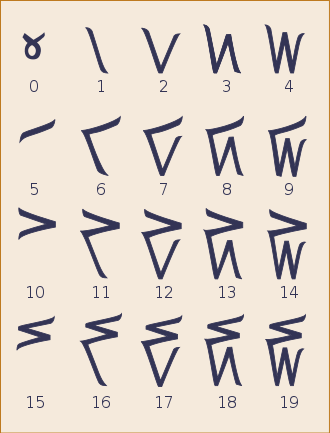
But the Inuit didn't have a written form of their number system until the early 1990s, when nine high school students in a small northern Alaskan school invented one!
They used 5 principles:
• Visual simplicity: The symbols should be easy to remember.
• Iconicity: There should be a clear relationship between the symbols and their meanings.
• Efficiency: It should be easy to write the symbols without lifting the pencil from the paper.
• Distinctiveness: There should be no confusion between this system and Arabic numerals.
• Aesthetics: They should be pleasing to look at.
They decided that the Kaktovik digit 0 should look like crossed arms, meaning that nothing was being counted.
This was the start of quite a tale!
(1/n)



@amkhosla - That's a great shot. And it's impressive that you've actually visited this place! Wikipedia says the population is 283:
https://en.wikipedia.org/wiki/Kaktovik,_Alaska