

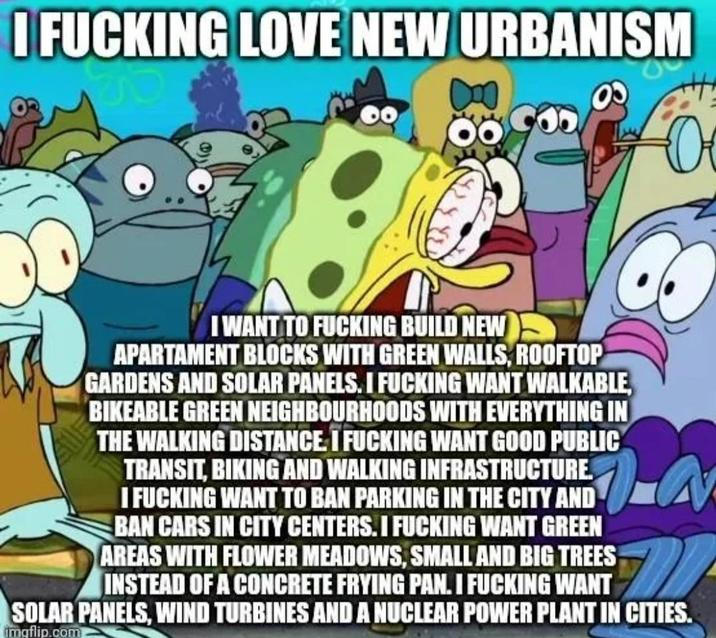
"new urbanism"
implying cities weren't walkable 100 years ago

Turns out bulldozing a city doesn't take very long.
Actually sustainable and healthy urbanism isn't as simple as many of the proponents of such actions claim.
The latter bit about technocrats and technology makes me think very much of the case presented by ecomodernists (the eco part is window-dressing, they're very much just modernists).
Kurzgesagt has been pushing that nonsense a lot.

 bonifartius 𒂼𒄄
@lispi314 @iska @KaiserKitty
i think many here in germany really believe that if you glue plastic insulation onto old buildings (of course creating problems with humidity 🤡 ) and put a wind turbine on every spot consequences be damned, that it will fix things and the future will be good.
if they'd really care for the climate and the environment the push would have to be to transform back into a mostly agricultural society with much less technology. with 80-90% employed in the agricultural and supporting sector. doing manual labor like it was 100-150 years ago. won't happen of course.
kurzgesagt is receiving much money from the german state. it's official policy channel at best, bordering on psyop.
@lispi314
germany 1900 had a population of ~60 million and was feeding its population. there were 30.6 workers/hectare.
giant agriculture companies wouldn't even exist if the state didn't meddle in the market with subsidies in the first place. which were required to prop up smaller farmers because of industrialized agriculture - with giant farms incentivized by the government. they still are.
the current practice is to insulate the outside of buildings which literally begs to become a problem just because the temperature gradient is completely bonkers that way. sure, one can throw active management like de-humidification on the problem, but that isn't the sound way to do it in my opinion. things should be solved as low tech as possible.
seems like i was a bit outdated with my information about kurzgesagt, it's the global elite funding it. which also finance and thus control many of the "ngos" and thus the governments. so i guess it's about the same :)

@bonifartius @iska @KaiserKitty The problem with the low-tech solution for insulation is that it mostly requires rebuilding those buildings as they were badly designed. Slapping plastic insulation on a badly designed old building isn't really addressing any of the root causes.
It's even possible to have mostly passive low-tech cooling, but it would be completely cost-prohibitive with current land management practices. Ultimately those would still be the sound and preferable way, since they're also not grid-dependent which means that a power outage doesn't result in heatstroke deaths.