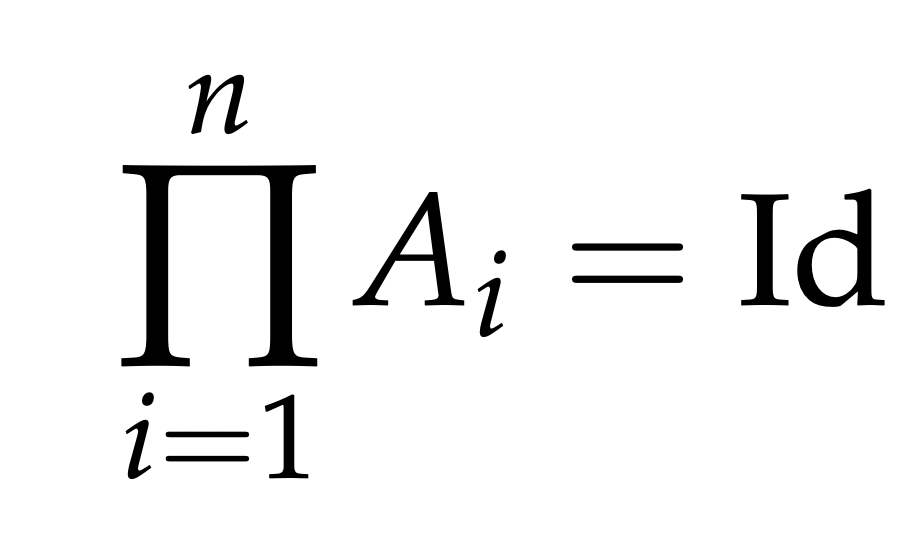
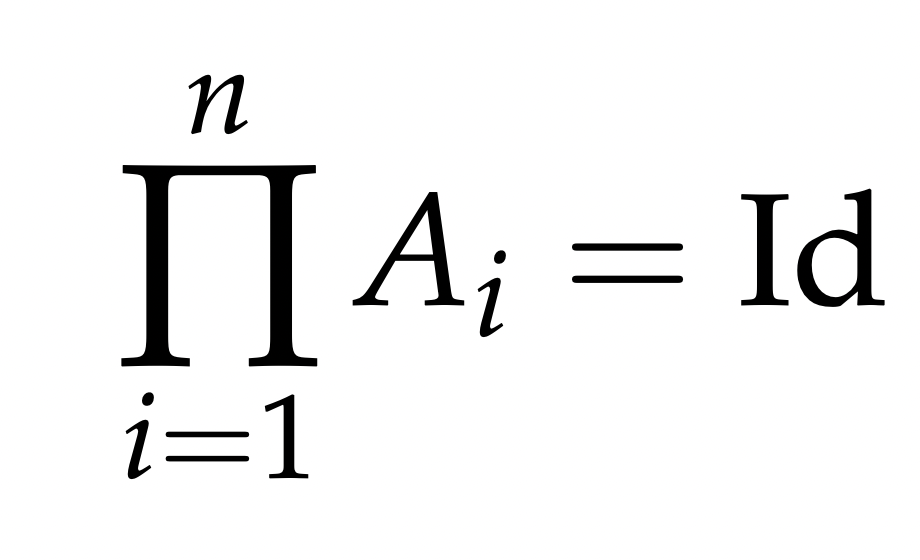
A math thread about some of the questions I've been thinking about lately. The goal is to answer some concrete questions about 2x2 matrices. Our starting point is the equation below--but it will take us on a journey through algebraic geometry, classical analysis, and more.
1/n
Everything here is joint work with Aaron Landesman and Josh Lam -- if you're an expert, you can read the paper here: https://arxiv.org/abs/2308.01376 2/n
As a starting point, we’re trying to understand n-tuples of 2x2 matrices A₁, …, Aₙ whose product is the identity matrix. This question goes back to the middle of the 19th century, as I'll explain later in the thread, but let's just play around for now. 3/n
Given one solution (A₁, …, Aₙ), there’s an easy way to make more solutions—simply change coordinates. That is, replace A₁, …, Aₙ with BA₁B⁻¹,⋯, BAₙB⁻¹ for some matrix B. This is boring, so we’ll regard A₁, …, Aₙ as *equivalent* to BA₁B⁻¹,⋯, BAₙB⁻¹. 4/n
Let’s define
Xₙ={A₁, ⋯, Aₙ ∣ ∏ Aᵢ=id}/∼
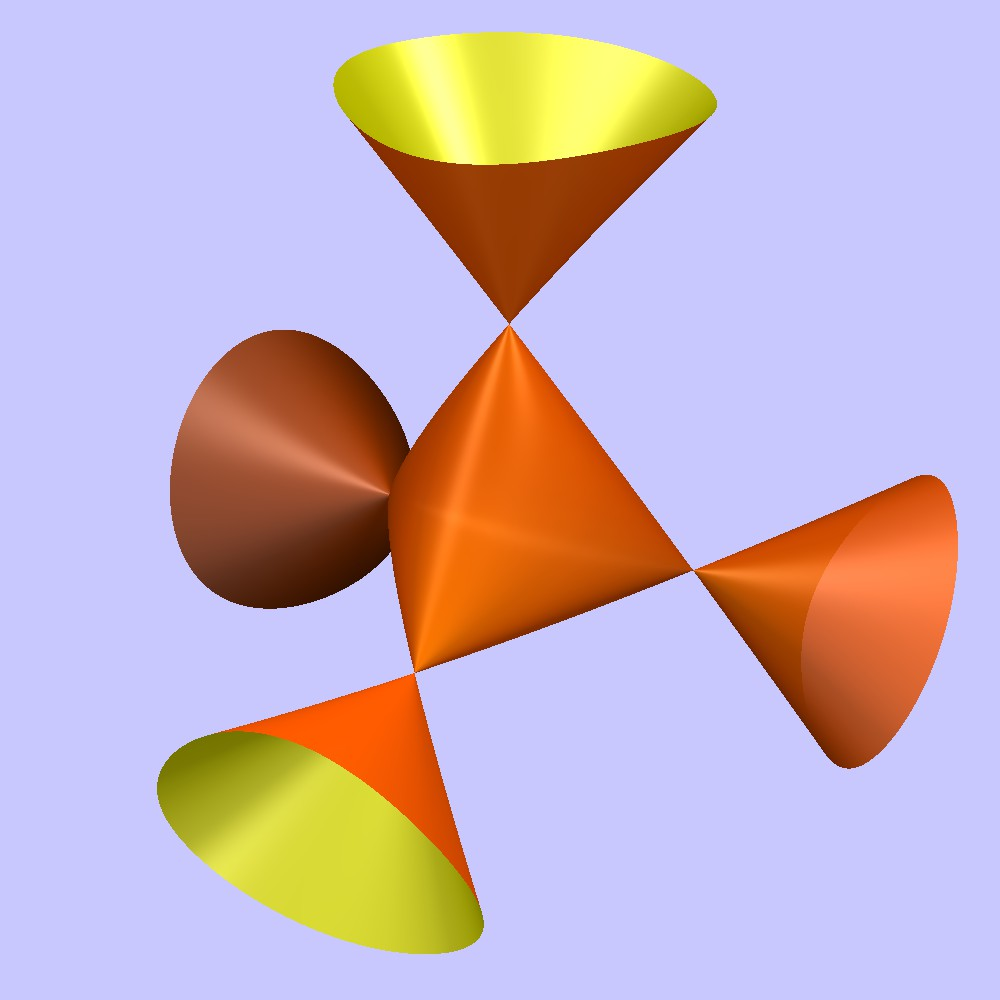
to be the set of solutions, up to equivalence. Xₙ is an interesting geometric space—for example, if n=4 and one restricts the Aᵢ appropriately, one gets the Cayley cubic. 5/n
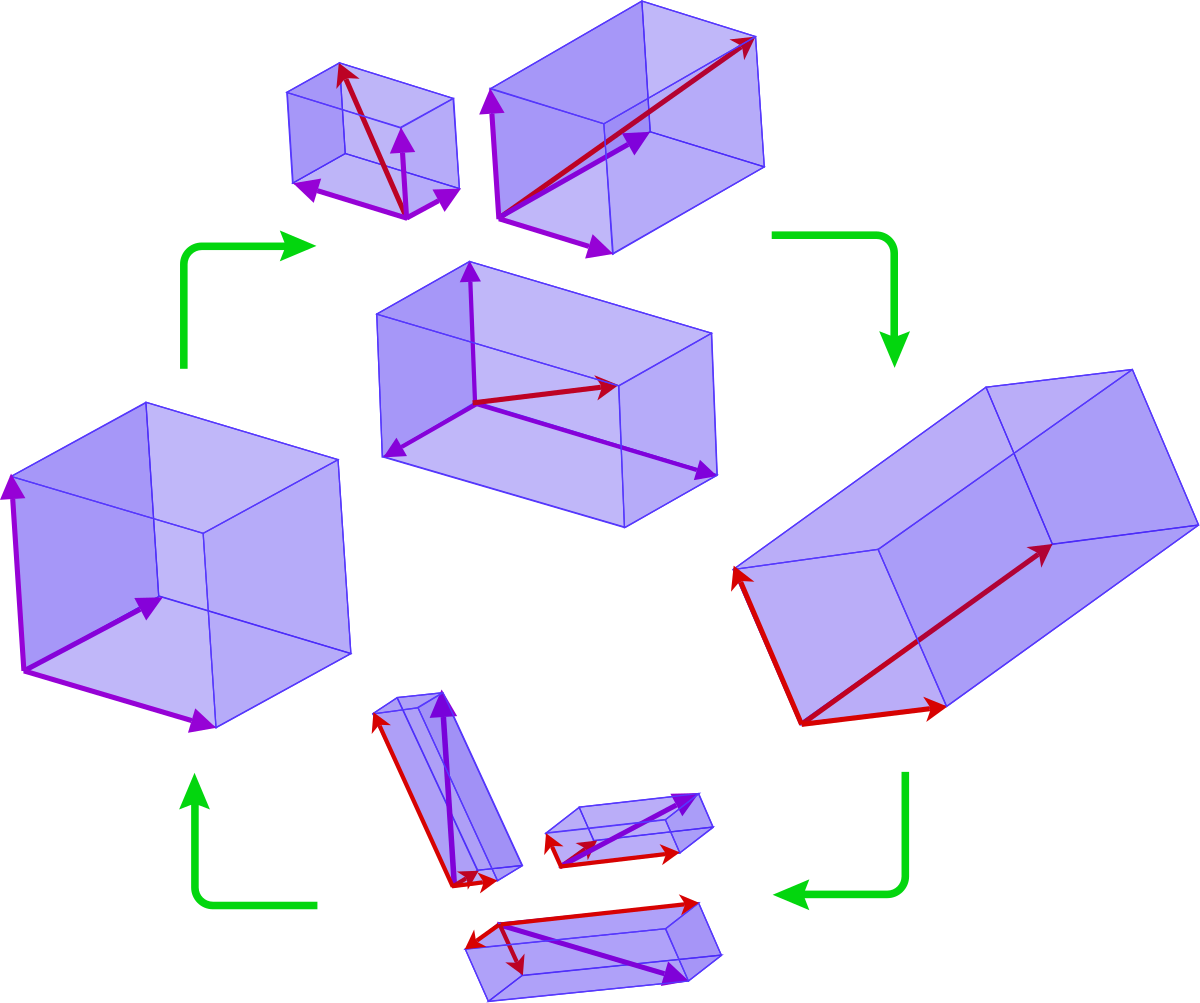
The spaces Xₙ have a huge amount of symmetry—in other words, we haven’t exhausted all ways to produce new solutions to our equation
∏ Aᵢ=id.
Here’s one: given (A₁, …, Aₙ), consider
(A₁, …, AᵢAᵢ₊₁Aᵢ⁻¹, Aᵢ, …, Aₙ). 6/n
In other words, we’ve swapped the i-th and (i+1)st matrices—but to make sure our equation
∏ Aᵢ=id
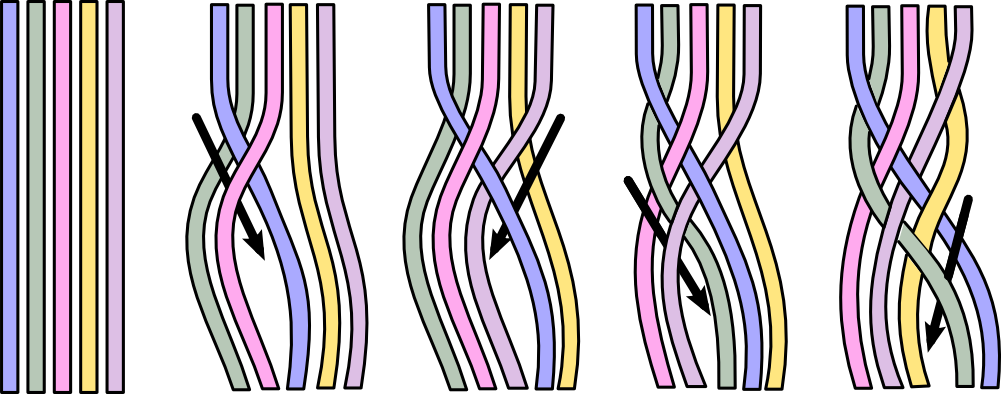
Is still satisfied, we have to conjugate the (i+1)st by the i-th. This is called a “half-twist.” 7/n
For the experts, the group generated by the half-twists is the braid group, and it acts on Xₙ. 8/n
We’re trying to understand the finite orbits—that is, the solutions to
∏ Aᵢ=id
with the most symmetry. In other words, we want to classify solutions where, no matter how we twist, we always come back to where we started (up to equivalence). 9/n
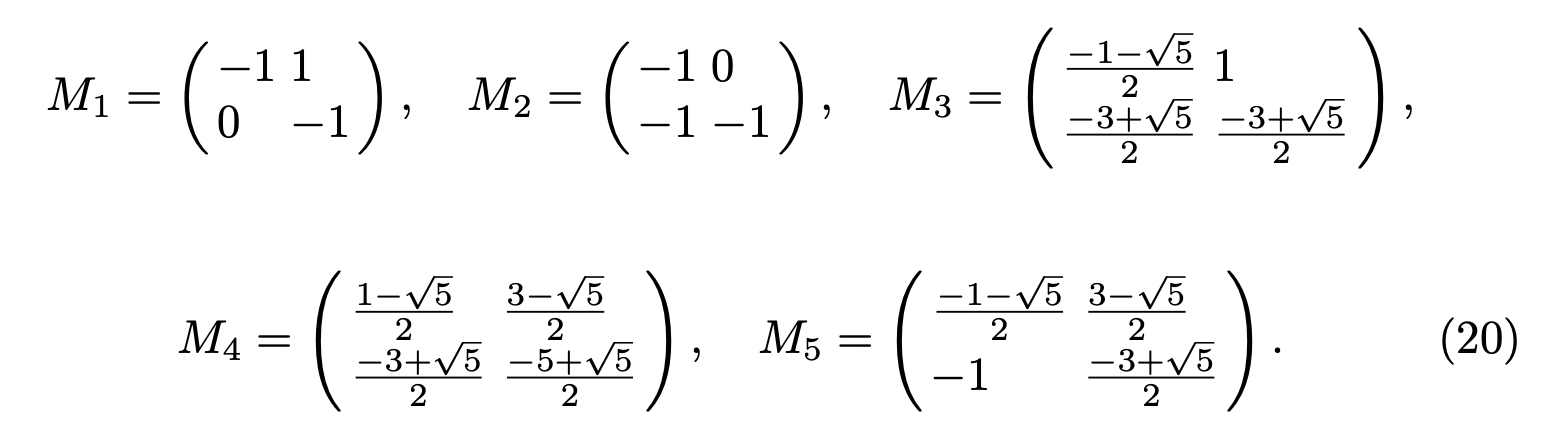
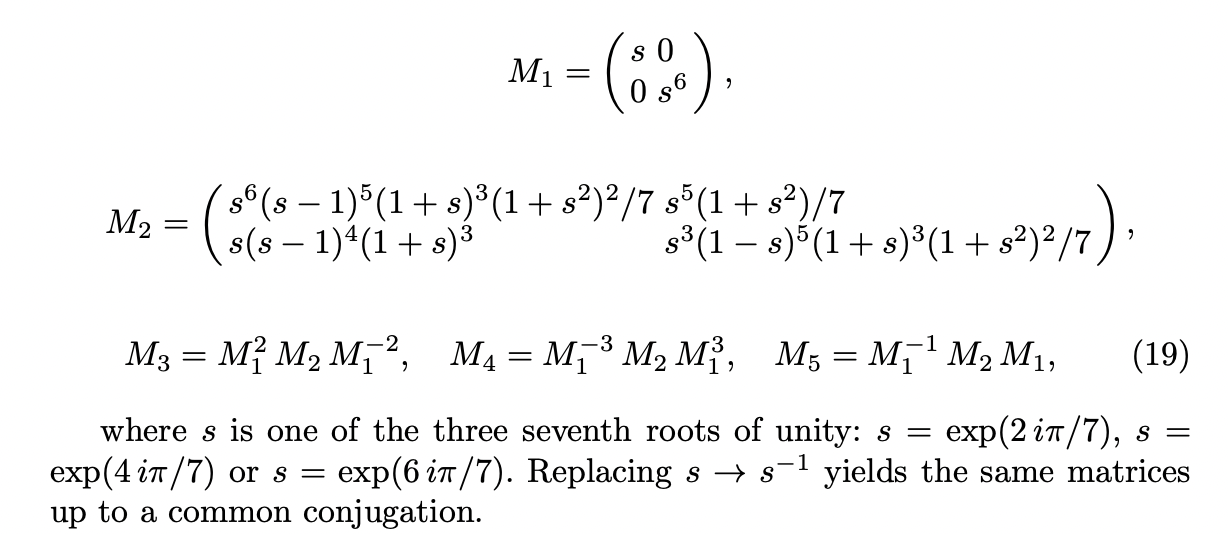
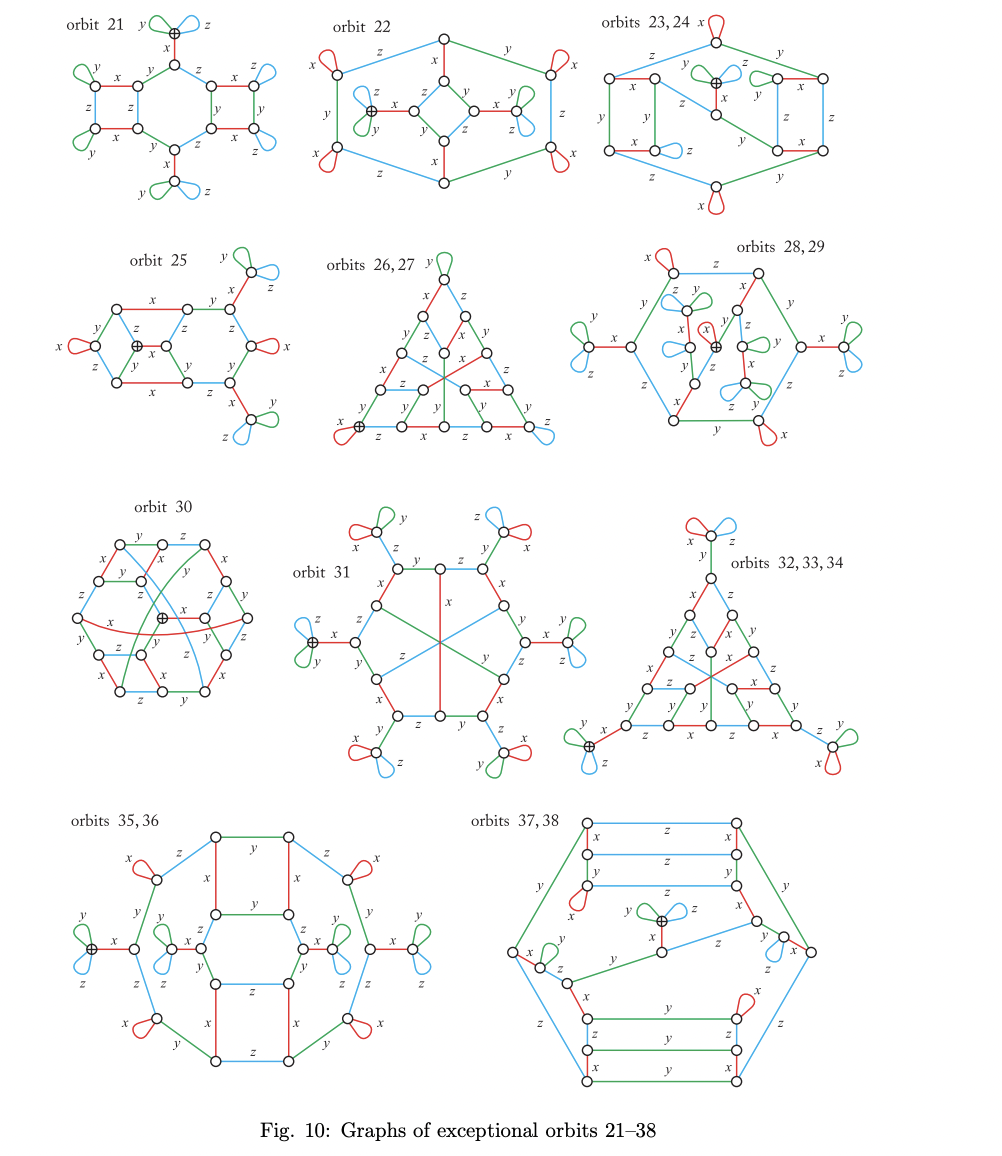
Here’s an example (and the picture in the previous tweet is another). Both are taken from this paper of Yuriy Tykhyy: https://arxiv.org/pdf/2010.08477.pdf
10/n
Where does this question come from? In some sense it goes back to the beginning of the 20th century. When n=4 (that is, we have 4 2x2 matrices), these finite orbits are the same as algebraic solutions to the Painlevé VI equation. 11/n