
"""
Since the closure of the two reactors at Ignalina in 2004 and 2009, Lithuania switched from being an electricity exporter to importer, and significantly increased its consumption of natural gas and biomass. In 2020 some 70% of the country’s electricity requirements were met through imports.
"""
https://www.world-nuclear.org/information-library/country-profiles/countries-g-n/lithuania.aspx
Still in 2022 Lithuania had a net import of 8.7 TWh of electricity, mostly from Sweden and Latvia.

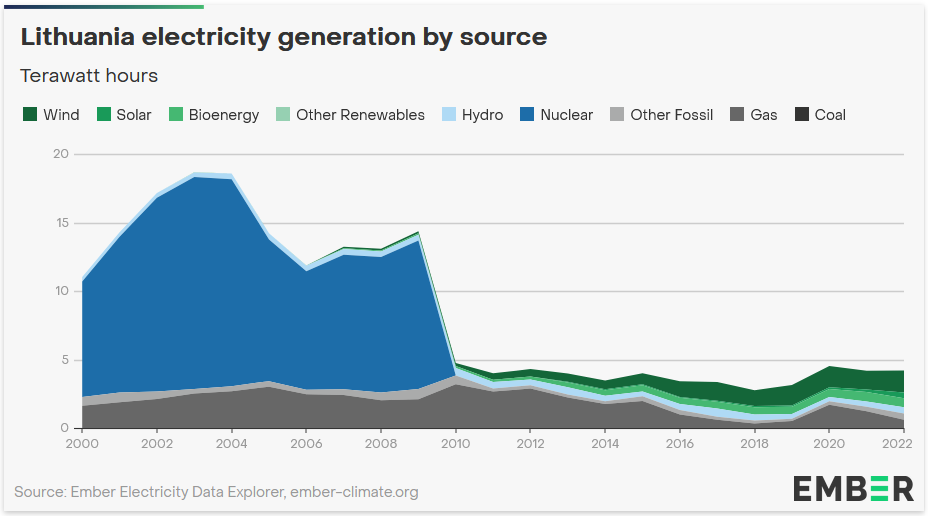
@jackofalltrades Uhm, where in this graph do fossils increase after shutdown of nuclear? I guess this comes from where the imported electricity is sourced, but tbh that's the mostest wrongestest graph to support that claim.
That's fair, this part is not clearly visible on this graph.
Here's a more clear picture, with the electricity split by source.
Between 2009 and 2010, when the last nuclear reactor was closed, natural gas use jumped 50% from 2.1 TWh to 3.19 TWh.
Also notice the steady growth of bioenergy, which in this case means burning wood.
"""
About 75% of heat (district and residential) is produced from burning woody biomass, after a major shift away from the use of natural gas.
"""

As a side note, the growth of wind and solar looks impressive until you align the Y axes (laughing through tears).

Overall, the carbon intensity of electricity produced in Lithuania hasn't yet recovered from the time when they had the nuclear reactors running.

@jackofalltrades That was to be expected (despite the quite controversial CO2eq values some publications attribute to nuclear electricity - it is certainly non-zero, contrary to what some claim).
From the last graph, at least, there is quite some progress visible. However, it does not show the import contribution. So, it may well show the progress of the providing neighbours. ;-)
@Lats
I don't think there's a single source of electricity with zero lifetime emissions, but nuclear is certainly down there with wind, solar, and other renewables.
Here's what Ember says in their Methodology document:

@jackofalltrades Not quite, no. The difference is that Lithuania went from 75% nuclear to 0% in a very short period.
Germany, on the other hand, peaked at 30% in the 1990s and early 2000s, and phased it out over roughly 15-20 years.
They basically decommissioned the old plants and refused to build new ones.
There is a little peak in CO2-intensity at the moment, but this is mainly due to
a) a change of natural gas sourcing (going from Putins Best to LNG from across the pond), and
b) the continuing phase-out of lignite where for some reason, no-one thought of replacing it with renewables, i.e. sticking to the road map. Renewables installation has been lagging behind plan for half a decade now. Technical issues with off-shore wind projects and a blockade of HV lines from north to south as well as a blockade of on-shore wind; both particularly by Bavaria.
So, it's far from clear, really messy and there's a lot of room for the blame game (ongoing right now).
@Lats
