
@bohaceklab @eLife @richardsever
interesting question. Preprints were a similar massive movement in #neuroscience, wouldn't you say?
Thing is, publishing preprints was pretty riskless (so is leaving twitter), whereas abandoning the publishing system is, at this time, rather risky if you still have a career in front of you.

@HeedLab @bohaceklab @eLife @richardsever Interesting question, but IMHO it is the wrong question.
Similar to how the climate crisis has been wrongly pinned on individuals and their choices rather than big corporations and governments, our infrastructure crisis is tackled more effectively if our institutions are "incenitvized" to modernize, rather than incentivizing ECRs to risk their careeers.

@brembs *whispers*: what if instead of funders giving money to scientists earmarked for publishing costs they directly funded publishers depending on their policies and incentivised openness and eliminated APCs?

@minimammoth @brembs To have publishers compete for public/philanthropic funds on the basis of quality & cost was an interesting idea that we discussed with Adriano Aguzzi on the #EMBOPodcast https://www.embo.org/podcasts/from-prions-to-preprints/
@cyrilpedia oooh, thanks for sharing! I'll have a listen. It's obviously a problematic question cos you end up with the same issues you get in science funding generally, but considering how much profit publishers currently make? It feels like a way to save money in the long term (though of course it would have to be done very carefully and transparently). This is of course ignoring diamond open access journals, but those rely on volunteer labour, which poses its own issues.
@minimammoth I know that it comes up in the second half of the episode (we discussed prions in the first half, publishing and preprints in the second - also with Thomas Lemberger of EMBO). I think if you remove the lobbying component from publisher's, it's not that hard to see the general framework: ban the use of funds for APCs, mandate preprints, and fund only publications in journals that accepted the public competition model, which would include a cap on either profit margins or total cost per paper (or some version of both)
@brembs @minimammoth I think one way to view it is through the public contracts bidding system. We offer X amount for the publication of Y. This is not dissimilar from build a rocket for the Apollo program, and now lets see the price bids from private companies and the quality on offer. Authors would be free to publish anywhere, but publishing outside this system would not be permitted with public funds, for example.
@brembs @minimammoth I hope we could recover/reboost the diverse ecosystem of academic run journals.
@cyrilpedia @minimammoth In principle, yes, but what purpose do journals serve that we could not replciate more efficiently in a system wthout journals?
I mean, if journals were so crucial for communication, why don't Twitter, facebook, TikTok or Mastodon have any journals?
Why would one re-create journals?
@brembs how would you replicate the curation-side of journals? Their selection of papers for one (especially in the case of smaller, specialised journals), but for another their science journalism, which is valuable in itself. And the experience and infrastructure that journals have built around organising peer review is also valuable. It could of course be replicated, but I would the resulting 'thing' be that different from a journal?
@minimammoth The Glam signal is easy to copy and improve upon, as we currently don't even have a false negative rate for each service, i.e., we don't know which rejections or misses went on to be great hits:
http://bjoern.brembs.net/2022/02/replacing-the-prestige-signal/
WRT non-journal peer-review, I'mm sure you know funding agencies perform peer-review, too?
Other than funders, journal-independent peer-review services have been around for more than a decade now. Oldest one:
https://en.wikipedia.org/wiki/Peerage_of_Science
@minimammoth So for peer-review, we all know journals are not required. WRT Glam, given the evidence that the highest ranking journals publish the least reliable science:
https://www.frontiersin.org/articles/10.3389/fnhum.2018.00037/full
We of course COULD replicate that - the question is SHOULD we do that, given the pernicious consequences?
@brembs of course, I'm not saying that peer review is only the purview of journals. All I'm saying that if journals exist and we keep using them, there may be some value? And the value I can see personally (from my own experience doing a PhD) is curation through subject (e.g. an issue of Development is usually a great read for me as a developmental biologist, without having to look for/find individual papers), the facilities for peer review (which exist elsewhere, but that doesn't take away ->
@brembs the experience of journals) and again, science journalism for a science literate audience, and covering topics of exclusive interest to scientists.
As someone who has enjoyed reading journals for more than just the research articles for years, I struggle to believe that they are entirely value-less, even if they could what they could do more cheaply.
@minimammoth
Science journalism is a great topic!
But what does it have to do with publishing research articles? Scientific American, The Scientist, New Scientist, etc. they don't publish original research.
Why should we pay extra for our research papers, so that journalism, which ought to be paid for, can be had for free? Doesn't that devalue the work of these journalists who have to give away their work for free?
@brembs @minimammoth I can't speak for all publications, but Nature does pay journalists for the front matter content - these are commissioned pieces with a rate attached. So that actually is a legitimate cost (if you consider the content valuable). But it absolutely does not have to be packaged with the original research papers. I think this is a holdover from when they (the two weeklies) had a broader individual subscription base of people who read them as magazines.
@minimammoth
By the way, we are paying these publishers so much for journalism and other non-publication activities, that this is no by far the biggest item on what we pay:
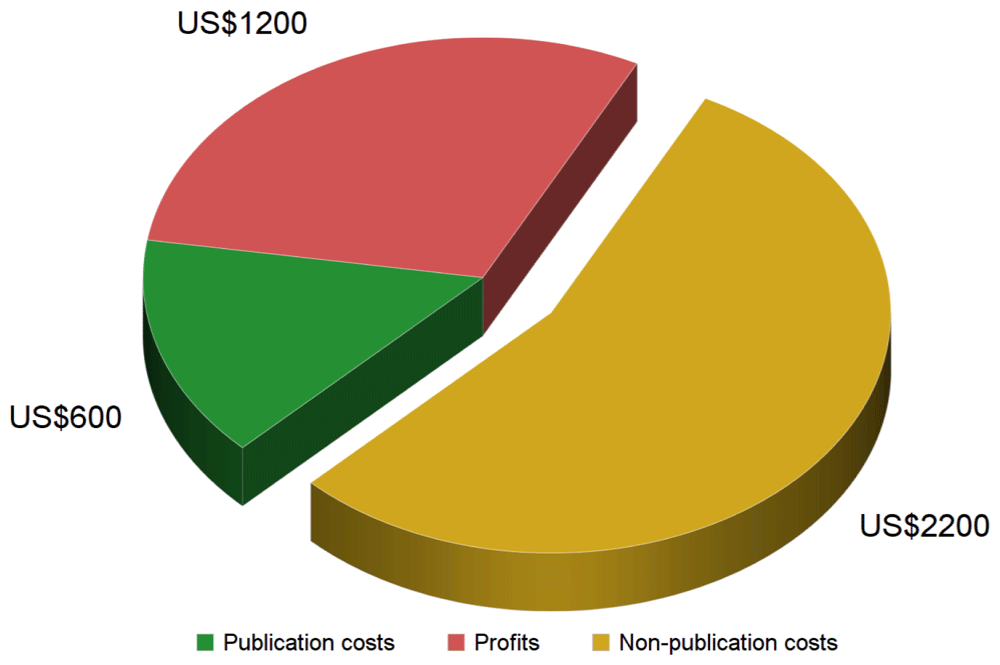
@minimammoth
However, mostz of that non-publication money doesn't even go to journalism, it goes towards surveillance technology:
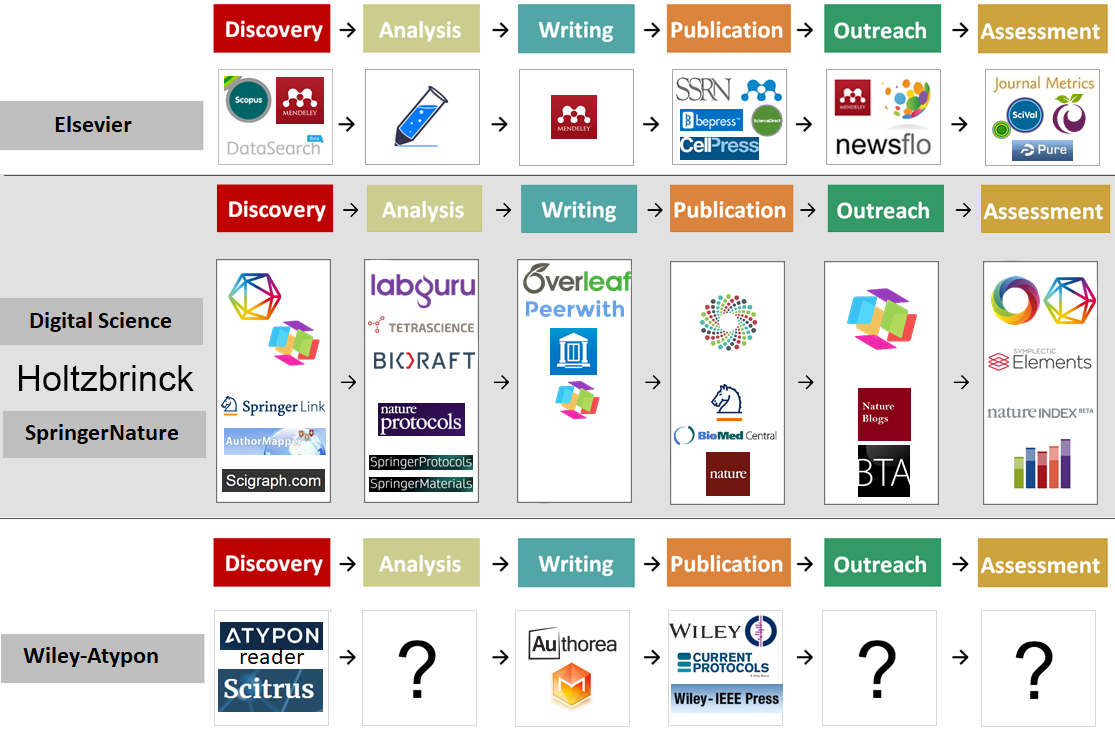
@minimammoth See these articles to löearn more about how publishers are not publishers any more, but are now data analytics corporations that have reversed the flow of information, such that, effectively, it's now our information that they collect that makes them the big money:
https://journals.publishing.umich.edu/jep/article/id/1874/
or
https://zenodo.org/record/6399726
or, from our funder (!):
https://www.dfg.de/download/pdf/foerderung/programme/lis/datentracking_papier_en.pdf
@brembs Yes, this is a HUGE problem.
Good point!
But how is journal based sorting into topics superior to more modern solutions such as, e.g., tags and keywords?
My field is spread over so many journals, there is no usefuilness for that sorting at all:
Journal of Neuroscience, European Journal of Neuroscience, Neuroscience, Nature Neroscience, Neuroscience letters, Neuroscience buletin, neuroscience research
.
.
.
.
They all publish the same stuff!
@brembs this is a fair point. I do think that given the internet (especially) there should be better and easier ways to disseminate science, definitely.
@brembs yup, totally agreed. It's an issue. You'd have to basically reset the entire publishing landscape in a way.
@minimammoth @cyrilpedia Hence the title of our paper 🤣
@cyrilpedia @brembs this is certainly how I think of it. Instead of money being earmarked in grants (for scientists) to spend on publishing, the money goes to publishers fulfilling certain criteria to publish X number of articles, in exchange for them not charging APCs or subscription charges. Of course, this is can only work if it's enforced (e.g. scientists in institutions agreeing to this mode of funding cannot publish in other journals, which would not be popular).

@cyrilpedia @minimammoth Yes, this is what we propose as wel - but it requires that the current journals are replaced with something else, as they are owned by single companies: you can't have different companies compete to publish, say, Nature. 😂
That's what we try to explain in our publication.