
"The main and interesting conclusion in the abstract is that of the 45% of alumni not continuing in academic research, one third does industry research and one third is in a science-related profession."


@cyclotopie @cyrilpedia @academicchatter
I would add....I don't see a lot of differences in the probability between PhD and PostDocs.
Does have any sense to conduct a PostDoc if it does not increases your changes of becoming a PI? (I mean, in the career construction aspect)

@copdeb @cyclotopie @cyrilpedia @academicchatter
I'm pretty sure that the PhD alumni that go to be PIs do Postdocs. They just don't do them at EMBL.
I've never, ever, met a molecular biology PI who hasn't done at least one postdoc (including fellowships).

@IanSudbery @copdeb @cyrilpedia @academicchatter
It's not what I'm writing, but indeed maybe it needs to be more clear:
Back in 2013, PhD holders (EMBL alumni here, considered a sample of "good PhDs" in the reasonning) who had obtained their PhD in 1997-2004 used to be 45% in academia plus 6% in post-doc.
Now in 2021, the cohort of PhDs of the same origin who have obtained their PhD in 2005-2012 (so also have 9 years of experience) are now 36% in academia plus 12% post-docs.
(rough readings)
Oh sorry
@IanSudbery I thought you were replyng my message, hadn't seen @copdeb 's one!
@IanSudbery @cyclotopie @cyrilpedia @academicchatter That's a good point. Thanks

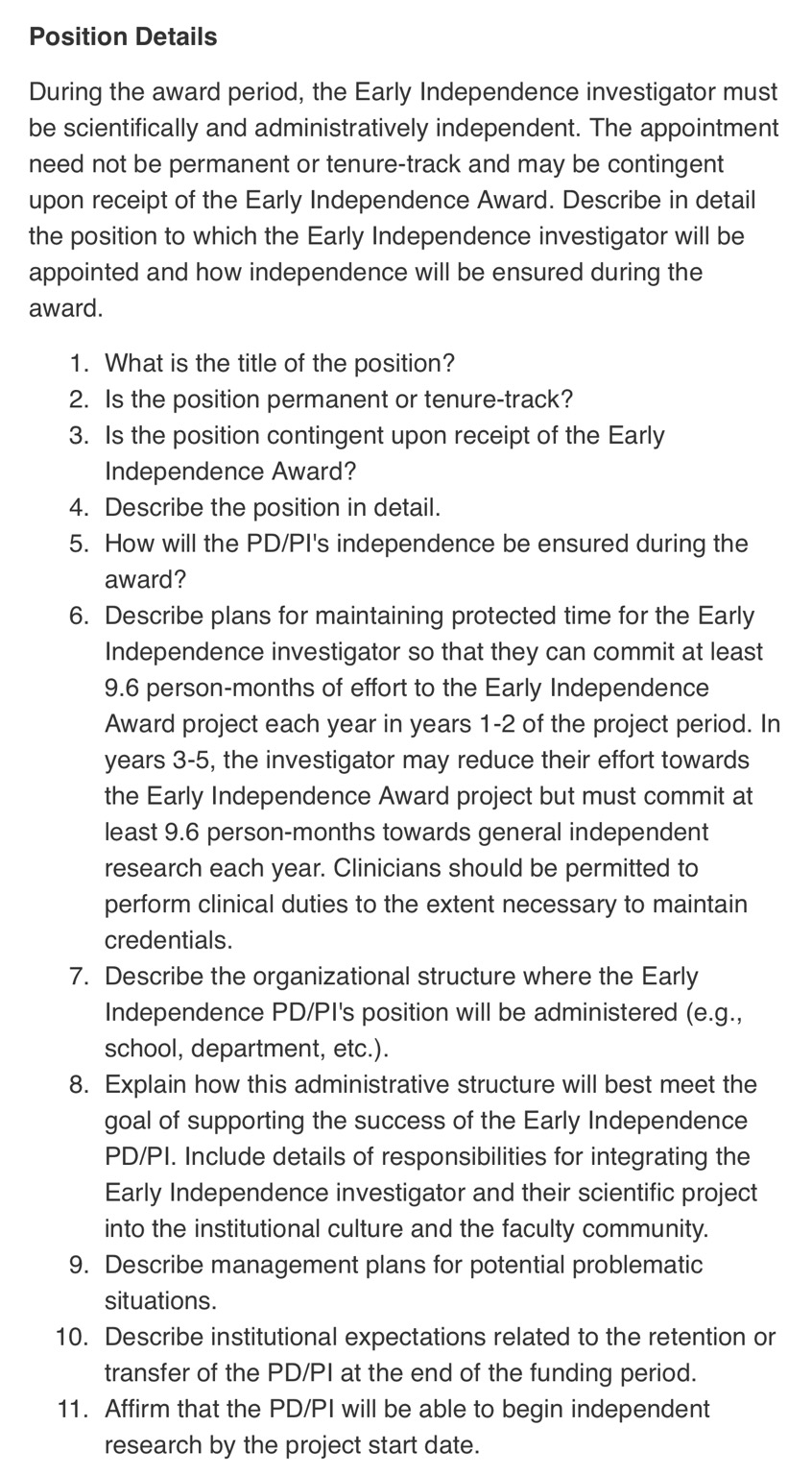
@IanSudbery @copdeb @cyclotopie @cyrilpedia @academicchatter as I understand it, the NIH DP5 program is intended to transition early career scientists to independence without a postdoctoral period https://commonfund.nih.gov/earlyindependence
@kristine_willis @copdeb @cyclotopie @cyrilpedia @academicchatter
That sounds like a great program. Although it will only ever support a tiny number of people. And those people can have done quite
a substantial amount of work, post graduation it looks like.
I also wonder how different it really is from an independent postdoctoral fellowship.
Yes, these indeviduals are independent, but these aren't stable, long-term, tenure/tenure-track-like positions.
@kristine_willis @copdeb @cyclotopie @cyrilpedia @academicchatter
Seem similar to the Wellcome Trust's Early Career Fellowship:
https://wellcome.org/grant-funding/schemes/early-career-awards
In many departments I think ECFs are treated a bit like "super-postdocs" or "Postdocs without a PI".
@kristine_willis @copdeb @cyclotopie @cyrilpedia @academicchatter
Still think they are both fanatsic programmes.
@IanSudbery @copdeb @cyclotopie @cyrilpedia @academicchatter yes, the program supports a very small number of people. The vast majority of PIs will do at least one post-doc.
Re: stability, applicants are required to provide quite a long list of information about the position they will hold if awarded, including whether or not it is permanent/TT; and institutional commitment is an explicit review criteria.
@IanSudbery @copdeb @cyclotopie @cyrilpedia @academicchatter of course, that doesn’t guarantee awardees will land in a secure position, and it would be good to have an analysis, but - I would be surprised if most DP5 awardees aren’t in stable, even TT jobs.
@kristine_willis @copdeb @cyclotopie @cyrilpedia @academicchatter
It would be interesting to hear how many of these institutions do offer a TT position.
I think for the equivalent Wellcome ECF program, a proleptic appointment is fairly rare, although not unheard of - we have an ECF with a proleptic, although they had already done a (short) postdoc before getting the ECF.

@cyclotopie @cyrilpedia @academicchatter
These graphs show the increased scarcity of #PI and other (possibly) stable #academic jobs. #PostDoc jobs cover a good part of the difference.


@jocelyn_etienne @cyclotopie @cyrilpedia @academicchatter
These are really beautiful graphs. They show a lot of information and allow to define conclussions
Actaully, I think 45% is really high. Nearly 30% of allumni ending up in PI positions is astonishing, when previous research in the UK put the number at more like 5%.
What this points out to me is the non-uniform distribution of who gets a job.
If on average every PI trains one PhD student who will go on to be a PI (which would be the neccessery at steadystate). And every PI trains, say, 20 PhDs over their career, then the only way 30% of EMBL alumni can be PIs is if the vast majority of PIs never train someone who goes on to be a PI.
That is, the value of a PhD at EMBL (or other elite places) is very different to at normal places.

@cyrilpedia
Many interesting things in there about the increasing scarcity of stable #academic jobs …and also #gender inequalities.
@academicchatter