

Thiago Carvalho @cyrilpedia@social.cleverlibre.org
I've worked on all of science, from B cells to T cells.
https://fellowsherpa.com
Joined Nov 2022
Thiago Carvalho
boosted

Thiago Carvalho
boosted

I tracked down the source on the Nobel posthumous rule. Jason Sheltzer pointed it out on twitter.
https://twitter.com/JSheltzer/status/1287403278062497793?s=20&t=qeqzrSHdXj5HpoColDFJYA
Thiago Carvalho
boosted

Evidence for ancient flaviviruses: https://academic.oup.com/ve/advance-article/doi/10.1093/ve/veac124/6960983?utm_source=advanceaccess&utm_campaign=ve&utm_medium=email
Building on nice work from Rob Gifford and Connor Bamford
Thiago Carvalho
boosted

After sufficient lurking, here is my #introduction
I’m a #computational #cognitive #neuroscientist and asst. prof. at JHU Cog Sci studying social vision. Our lab uses a combination of human behavior, neuroimaging and computational modeling to understanding how humans can so effortlessly extract rich social information from the visual world around them.
Our recent work relies heavily on naturalistic neuroimaging and state of the art modeling (such as graph neural networks and disentangled representation learning). You can learn more/find papers on our website: isiklab.org
Thiago Carvalho
boosted

Science question: how quick can be the development of a hACE2 mouse model?
@cyrilpedia @iannaconelab @flodebarre
A couple of months these days. We had a point mutant ready in June 2020 (published muuuch later though)
Thiago Carvalho
boosted


https://stuartritchie.substack.com/p/science-isnt-storytelling?utm_medium=web the idea that a scientific paper needs to read like “a nice story” is the worst thing we, and the top “vanity journals” have taught - a disservice to science #philosophyofscience #metascience
Thiago Carvalho
boosted

Science question: how quick can be the development of a hACE2 mouse model?
Hello #ScienceMastodon,
How fast could have been the development of the hACE2 mouse model described in https://www.cell.com/cell-host-microbe/fulltext/S1931-3128(20)30302-4 ?
Context: the speed argument was used by the US National Security Council to argue for a lab leak. I'd like to fact-check this.
[It is a question I would have asked on Twltter back in the days; please boost to help me reach the relevant people! - thanks]
Thiago Carvalho
boosted

Comparative effectiveness of four COVID-19 vaccines, BNT162b2 mRNA, mRNA-1273, ChAdOx1 nCov-19 and NVX-CoV2373 against SARS-CoV-2 B.1.1.529
#covid19
mRNA kicked the ass of adenoviral/nova vax, but 6 months old news & limited by the few nonRNA participants. https://www.medrxiv.org/content/10.1101/2022.12.22.22283869v1
Thiago Carvalho
boosted
@cyrilpedia Great article. Thanks for sharing. I can’t remember where I read it, but someone pointed out that there is always the same mistake in all articles about Franklin. The statement that Franklin could not win the Nobel prize because they are not given posthumously is incorrect. The Nobel committee didn’t institute that statute/rule until 1974. They had given the prize to others after death. They just snubbed her.
Thiago Carvalho
boosted

Welp
This broke my brain
Cyclosporine A as a vaccine adjuvant to induce TRegs is something that would never have occurred to me, let alone it leading to *enhanced* antibody responses
'In 1927, W. Somerset Maugham wrote “Ashenden: or, The British Agent,” about a writer who is recruited into British intelligence by a handler called R. During the war, Maugham had been a spook; he was recruited after “Of Human Bondage” came out. Writers make good joes (as Herron might say): they’re keen observers, and they tend to know languages. (Maugham had French and German.)'
https://www.newyorker.com/magazine/2022/12/05/is-mick-herron-the-best-spy-novelist-of-his-generation
Thiago Carvalho
boosted
The US National Academies will hold a workshop on Earth System tipping points, cascading impacts and interacting risks in January: https://www.nationalacademies.org/event/01-17-2023/workshop-on-tipping-points-cascading-impacts-and-interacting-risks-in-the-earth-system?mc_cid=3d0ad5185d&mc_eid=48f916cbb4
'In Franklin’s day, sexism ran rampant in science. Her own father, judging science no career for a woman, actively discouraged her aspirations. Her doctoral supervisor at Cambridge, eventual Nobel Laureate Ronald G.W. Norrish, called her “stubborn and difficult to supervise” and offered little support. James Watson, whose Nobel Prize hinged in large part on her work, referred to her in his memoir as “Rosy” (against her preference), and stated that, because of her “belligerent moods,” colleagues knew she “either had to go or be put in her place.”
Thiago Carvalho
boosted

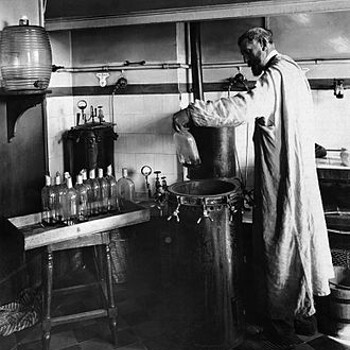
On this day in 1822: Louis Pasteur born, invented pasterisation and developed 1st rabies vaccine #ThisDayInBiotech
Thiago Carvalho
boosted

#Sexism pushed Rosalind Franklin toward the scientific sidelines during her short life, but her work still shines on her 100th birthday https://theconversation.com/sexism-pushed-rosalind-franklin-toward-the-scientific-sidelines-during-her-short-life-but-her-work-still-shines-on-her-100th-birthday-139249 #science #Women #WomenInSTEM
Thiago Carvalho
boosted

What a cool paper!
Objective definition of the surgical gestures associated with better / worse outcomes!
Surgery has always had the problem that interventions retain strong user-specific variability, whereas this leverages more standardised robotic movements, to correlate with outcomes.
Can see potential to impact on practice / training.
Thiago Carvalho
boosted
Biologist J. B. S. Haldane once quipped that if there's a God, the Creator seems to have “an inordinate fondness for beetles.”
Why? Well, 1/2 of species described in #science are insects (among eukaryotes). Of those, >1/3 are beetles, at ~400,000 known species.
I’m especially fond of these critters bc I began my career working with Plagiodera versicolora, a particularly cute beetle.
Now some entomologists suspect there may be just as many parasitic wasps, but that’s a tale for another day.
Thiago Carvalho
boosted

Delighted to say our #Monkeypox/#MPOX paper is now out as a preprint:
https://www.medrxiv.org/content/10.1101/2022.12.22.22283648v1
It's a bit of a beast, but a thread of the results we've found...🧵
Thiago Carvalho
boosted

Hi all, instead of a re- #introduction after moving instances, I'd like to introduce you to my graduate student Peter Salvino, who passed away under tragic circumstances last week.
Because of his way too early passing, most of you didn't get to know him. So I wanted to make sure my #neuroscience community knows how brilliant and kind a scientist he was. Peter wore many hats in the lab. Being my very first student, he built with me, and knew the ins and outs of every bit of hardware and software. He was also a masterful engineer and inventor, and had a keen scientific mind. He knew what the big questions in the field were and was completely fearless in going after them. We will slowly publish all his great contributions, so you will read his name again.
Most importantly, he was so generous to his lab mates. He helped every single person in the lab, with such selflessness and genuine humbleness. He was really loved by all of us. This is such a huge loss to our field. He was destined to greatness.
Peter's family has set up a GoFundMe campaign to help support research similar to his at Northwestern. They welcome any contributions to honor the memory of this amazing human being.
Thiago Carvalho
boosted


Fascinating article by Will Chavez in High Country News about Jennie Ross Cobb, the first known Native American female photographer. Most of her photographs, including the one below, were made between 1902 and 1905.
#Photography #Cherokee #JennieRossCobb #Indigenous
https://www.hcn.org/issues/54.4/indigenous-affairs-photos-images-from-the-first-known-native-american-female-photographer

I've worked on all of science, from B cells to T cells.
https://fellowsherpa.com
Joined Nov 2022
