


 🇳🇱
@realcaseyrollins How would you measure a "booming economy" in the context of a communism anyway? Usually we rate the health of an economy by how much disposable income someone has. The whole point of a communism is that there is no distinction between disposable income since there is no code income needed for necessities, those are (supposedly) provided.
Cumulative wealth divided by the population and compared to median wealth? GDP? Growth of businesses?
I don't think disposable income should be the best indicator of a good economy, but rather the economy's ability to perform, grow and expand.
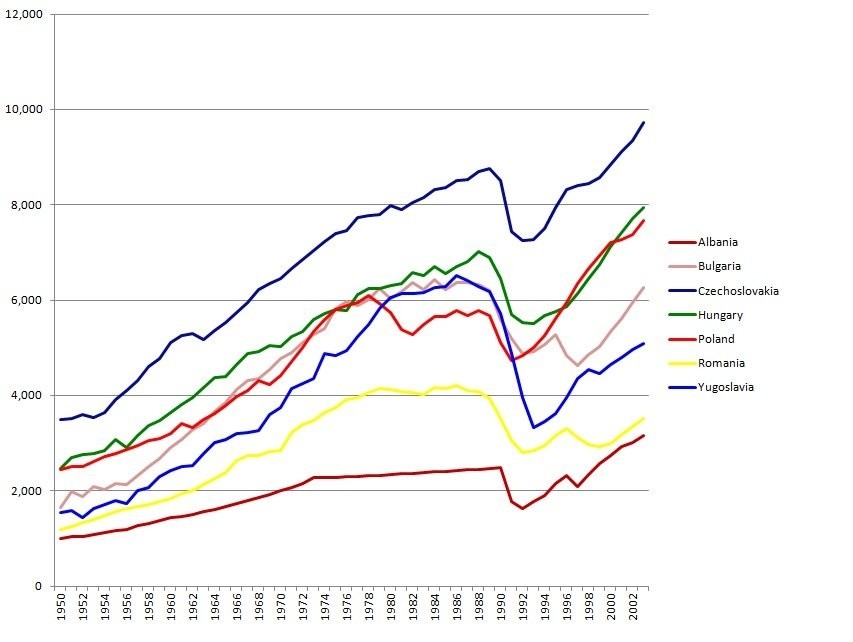
In that case here you go, a graph of previously communist countries showing GDP per capita. You can clearly see how the growth of GDP changed pre and post communism here as well as the cost of the transition itself.

@freemo @realcaseyrollins GDP isn’t the only measure of a country’s success. In fact, I remember reading an interesting blog post about it. Here: https://lukesmith.xyz/articles/why-its-bad-to-have-high-gdp He’s a wacky right-wing memelord, but he makes a good point IMO.
@Hyolobrika Putting aside the link you shared, as I agree his conclusions arent consistent with what we observe, at least not in a cause-effect sort of way lets discuss your main point.
I both agree and disagree with where you are going. On the one hand I do agree that simply measuring GDP and using it as the metric of success of an economy is not correct. Though I disagree on saying that it is an incorrect measure overall, I simply feel it is one among several metrics that all need to be considered and in isolation wont really tell you much.
I think the prime example of how GDP alone isnt a good measure is because where and how those goods get used means everything. If a country puts all of its man power into building tanks that they promptly just dump into the middle of the ocean as they come off the supply line then the GDP would be the total value of all the tanks produced. But those tanks in no way represent a healthy economy or an improvement to the quality of living of people in that country.
Now you could say that while doing the above may not be beneficial it still demonstrates the manufacturing capability of the country, this is true, but even then it doesnt imply much of anything useful. For example what if the country just took a massive loan far beyond its ability to pay back and used all that money to build the tank factories and tanks in the first place. Well since the country isnt using that loan in a productive way then when the loan's term is over then they will just be in more dept than the value of their entire production capabilities and would ultimately need to sell all those factories to pay it back. So in the end even their temporary ability to manufacture billions worth of tanks a year is not an indication of a healthy economy and a economy with a GDP of 1/10th that would in the long term be in a better place.
The above applies to rate of change of GDP as much as GDP itself.
That said it is still a valid and valuable point int he equation. It just must be evaluated against a countries debt, as well as its store of wealth (GDP is the amount of wealth produced in a year but tells you nothing about the total wealth of a country). Lastly we need to ask if "healthy" economy is what we care about at all in a given context and if instead we might not in fact mean "average quality of life" which we often relate to healthy economies, and there is a valid link between them despite being very different measures of different things.
