
Don't idolize scientists. Some of the dumbest people I've ever known I met in undergrad.
Graduates were only mildly better.
Everything is a bell-curve even if scientists on average have an IQ of 110 (generous). +40% of them are sub 100.

 🇳🇱
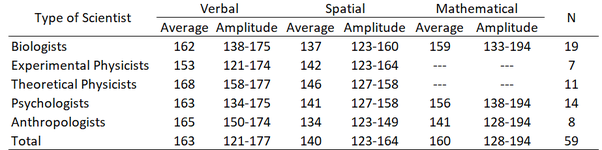
@NickolasGir Actually your numbers are way off from reality. On average the IQ of scientists is something much higher than 154. In fact 154 is the IQ you get if you exclude the math portion of an IQ test in an attempt to make it "fair". On an ordinary IQ test their IQ would be even higher. In fact a vanishingly small portion of scientists have an IQ below 122.
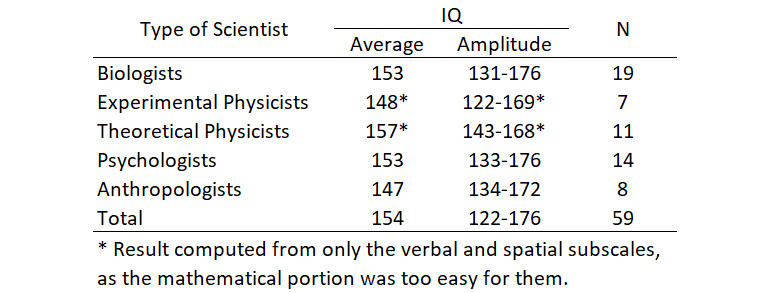
@NickolasGir Here is the breakdown by verbal, spatial, and mathematical if you are curious.
@freemo
Nah, literally not possible. Post a link the study that is from and I bet I can find 3 basic methodological problems without trying.
@NickolasGir Well before you even attempted to counter-prove the point you've already had a major methodological problem of your own. You've admited to extreme confirmation bias and that you will find something wrong with a study you havent even read yet.
I'll find the link when im back behind a computer again.
@freemo
Conformation bias would be if I dismissed you and did not ask for the study. I think I'm being very magnanimous in offering to find the problems, not just assuming they will be there.
@NickolasGir No that wouldnt be confirmation bias, that would simply be not expressing your confirmation bias.
If you already drew conclusions about data you didnt see and have promised to disagree with it before seeing what it is, that is confirmation bias. Doing it silently doesnt make it any more or less a bias, it just means you keep your bias to yourself.
@freemo
Incorrect, I disagree with your conclusion, I promised to find methodological problems.
@NickolasGir exactly, you promised/garunteed methodological problems in a study you havent seen yet. Now if your response had been humble and suggests that you thought the numbers were high and **suspected** methological problems but would earnestly consider the data without drawing a conclusion then you wouldnt have confirmation bias.
But your two levels deep on confirmation bias now. Not only did you already conclude you'd find methological problems in a study you havent seen, but you are also certain that assuming a study cant possibly be correct because it disagreed with you is somehow not confirmation bias when it is pretty much the definition quality of it.
@freemo
I suspect there are methodological problems because getting good data on that would be expensive and not worth much.
Again the study could be correct I can't know i haven't read it. And if its a good study it would probably list reasons why it could be incorrect. I'm disagreeing with your interpretation.
@NickolasGir Ahh now see **this** statement is very respectable. You have went from "there **is** methodological problems in data that disagrees with me that I havent seen but must be wrong" to "I **suspect** there are...".
Now thats the correct way to approach this.
@NickolasGir It isnt, originally you claimed it was wrong, not that you were simply suspicious of it. Huge difference. In one case you already had a conclusion and intended to work backwards by finding reasons to invalidate anything that disagreed and dig up some sort of study that would support the numbers you made up out of thin air.
Now you are simply "suspicious", which admits you could be wrong and the data could be right.
These two are significantly different approaches.

@freemo
No I originally claimed you were wrong.
This is a very basic problem you've yet to grasp.