
This nonsense should have been REALLY settled with the Crown Act being signed into law, but here we are....
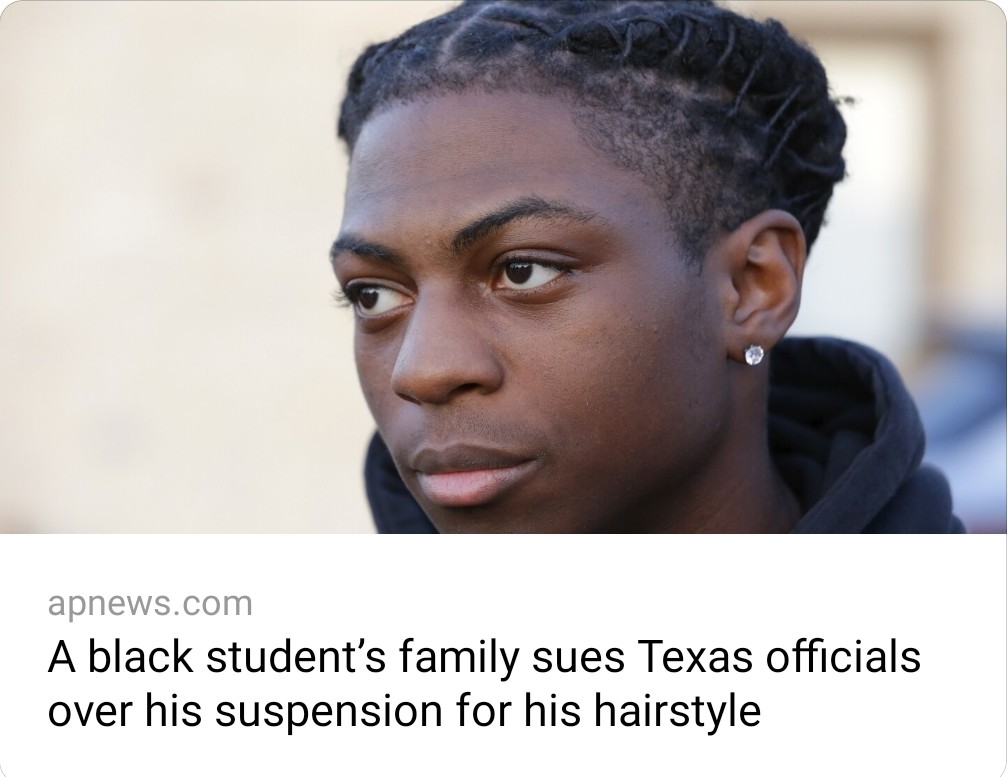
NEWS: The family of a Black high school student suspended for his hairstyle has filed a federal civil rights lawsuit against Texas' governor and attorney general.
https://apnews.com/article/hairstyles-dreadlocks-racial-discrimination-crown-act-e79ede512923b672a275abf054e2407b

 🇳🇱
🇳🇱
@LilHulkQ While I am certainly against dress codes in public schools of any kind, im confused why they claim a policy that is neutrally written (simply doesnt hair past a certain length) somehow is a racial issue itself.
Now i think its fair to be concerned it was **applied** raciall and only use to attack this poor kid and letting whites who violate get a pass.. and that should be illegal and persued in court if that happened.
But reading the court case thats not what they are arguing. They are arguing the policy itself, even if uniformly applied, disproportionately attacks blacks... how does a length restriction on hair disproportionately target blacks on its own? I mean if anything the opposite, since the law is defined by length past ones elbows that would target straight haired people disproportionately while tightly-curled hair would form an afro and would take quite the effort to get an afro "below the elbows"...
So yea... while i dont know if he was discriminated against specifically im really having a hard time seeing where this rule, when applied evenly, would be racist. I would love to hear thoughts that might explain this.

So is the argument here that the law, in and of itself, isnt racist. But it has been applied in a racist way?
> If you want a theoretical discussion about law philosophy, then maybe you are right.
No im not asking these questions in a theoretical context but rather a practical one and specific to this situation.
> But this has little connection to reality. And in this case, the intention of proving in a theoretical-philosophical discussion derails from the racist intentions behind these laws. Therefore, why would you want to prove that?
Agreed, which is why I have no interested about the general or philosophical case. I am asking about the real world practical case where a law like this is itself discriminatory. I am curious about this law, and trying to understand the reasoning behind, practically, why it is discriminatory, not philosophically... Real cause and effect.
> Think this analogy: Now we talk about a law in the US that allows police to shoot immediately when they feel threatened.
>
> Following the theoretical-philosphical logic, this law wouldn't be racist. Because in an "ideal" world heavily armed cops would shoot only the bad guys, right and have no racist bias. But we all know that POCs have a much higher chance to get shot.
By that logic wouldnt **all** laws and rules be discriminatory in practice, since cops can (and will) apply racial bias in applying it... so that still leads me to wonder, what makes this rule any more or less racially discriminatory than literally any other rule.. sure the application is **always** discriminatory of any rule because of racist bias... but why is this rule any more discriminatory than literally anything else.
I think we were close to an answer when we were talking about the perception of long hair in various cultures. Black culture and White culture are differently compatible with this rule and thus not culturally neutral and thus a discriminatory, that explanation lines up with me just fine.. less so the explanation we are attempting now.

@freemo @LilHulkQ
If you want a theoretical discussion about law philosophy, then maybe you are right.
But this has little connection to reality. And in this case, the intention of proving in a theoretical-philosophical discussion derails from the racist intentions behind these laws. Therefore, why would you want to prove that?
Think this analogy: Now we talk about a law in the US that allows police to shoot immediately when they feel threatened.
Following the theoretical-philosphical logic, this law wouldn't be racist. Because in an "ideal" world heavily armed cops would shoot only the bad guys, right and have no racist bias. But we all know that POCs have a much higher chance to get shot.
again: the lawmakers usually know what they are doing (ok, not always, as there are accidents).
Furthermore, I could imagine that the issue might also have to do with the fact that hairstyle is for some groups more important than others. For white folks, hairstyles can be used to show rebellion (long haired hippies in the 60-70s, punks in th 80-90s).
But then there is this thing of cultural expression and identity that seems a little bit more important for some black folks, wouldn't you agree?
So, when laws about hairstyles are made, you repress both rebellious youth (that chose to have long hair or punk hairstyles to show their disagreement with societal standars, but otherwise could pass as sons and daughters in law) and people from historically oppressed groups that can't hide that see every day they are not part of the dominant (white) society and have their own issues finding their identity. And for some of them, hairstyle is more than just a fashion choice.