

🎓 Dr. Freemo  🇳🇱
@freemo@social.cleverlibre.org
- UFoI Member
- http://UFoI.org/u/freemo/
- Website
- http://JeffreyFreeman.me
- Gitlab
- https://git.qoto.org/freemo
Admin
Jeffrey Phillips Freeman
Innovator & Entrepreneur in Machine Learning, Evolutionary Computing & Big Data. Avid SCUBA diver, Open-source developer, HAM radio operator, astrophotographer, and anything nerdy.
Born and raised in Philadelphia, PA, USA, currently living in Utrecht, Netherlands, USA, and Thailand. Was also living in Israel, but left.
Pronouns: Sir / Mister
(Above pronouns are not intended to mock, i will respect any persons pronouns and only wish pronouns to show respect be used with me as well. These are called neopronouns, see an example of the word "frog" used as a neopronoun here: http://tinyurl.com/44hhej89 )
A proud member of the Penobscot Native American tribe, as well as a Mayflower passenger descendant. I sometimes post about my genealogical history.
My stance on various issues:
Education: Free to PhD, tax paid
Abortion: Protected, tax paid, limited time-frame
Welfare: Yes, no one should starve
UBI: No, use welfare
Racism: is real
Guns: Shall not be infringed
LGBT+/minorities: Support
Pronouns: Will respect
Trump: Moron, evil
Biden: Senile, racist
Police: ACAB
Drugs: Fully legal, no prescriptions needed
GPG/PGP Fingerprint: 8B23 64CD 2403 6DCB 7531 01D0 052D DA8E 0506 CBCE
Joined Jul 2018
right, so first minimum wage kicks in, they fire employees and find ways to make the rest more productive to stay in budget, over time they grow as a company and then maybe can hire some back that were fred.
Meanwhile without minimum wage hikes the company is still motivated to increase productivity and thus increase income but without the budget need to fire anyone. So now when they grow they arent hiring back the people they fired they hiring new people.
Exactly, because fewer people decided to be laborers and more people than before are becoming educated or otherwise acquiring more marketable skills and it all balances out :)
Yup, but that still means the least skilled loose their job.. if your employer can double workers productivity when minimum wage doubles then they fire half, same costs same productivity
So this falls into the categories of arguments why minimum wage results in those who need their jobs the most loosing them.
🎓 Dr. Freemo 🇳🇱
boosted
🇳🇱
boosted

yup, and while that causes them to love some customers its still cheaper than paying a higher wage after those losses
True plus the third point, a smarter more skilled person replaces them who is able to do the equivalent work of multiple people. For example a programmer writing ocr software to replace 100 data entry professionals
@hansw@mastodon.social right, but the cause of that is a too many people are underskilled and thus so many people compete for those jobs that the pay goes to shit due to supply-demand.
The solution still remains that people need more skills so there are fewer unskilled workers and as the unskilled worker pool shrinks the supply demand curve demands they be paid more, a living wage.
So the solution is the same if you have too many low-skill workers the solution is to have less
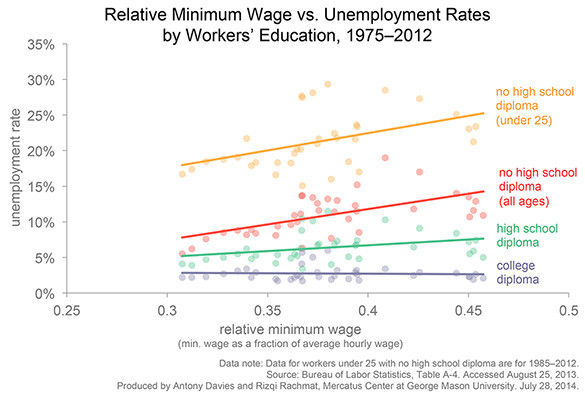
> But then the diagram actually refers to minimum wage as a ratio of an average wage, so if wages overall go up when the minimum wage does (which they do by definition to some extent, but they may also increase further as a side-effect), that wouldn't necessarily be visible.
its not that so much as the fact that your missing a bit of causative action in in the correlation diagram that correlation cant show... let me explain better...
Generally speaking the populations that demand increases in minimum wage the most are populations with larger poor populations. They arent educated enough to know its harmful to them and are in large enough numbers to sway political decisions. So these populations tend to be the ones that have the most upward pressure on minimum wage.
Likewise because an increase in minimum wage is most harmful to the least skilled and most poor part of the population the higher it is the less able poor people are to get out of their situation, so likewise minimum wage tends to cause an increasing poor population over time.
Because of these two factors the causitive direction can be reversed from what youd expect, that is populations with large portions of the poor are just as likely to cause a high minimum wage as a high minimum wage is likely to cause a larger population of poor
therefore the net unemployment of points on that chart ARE higher than points with lower minimum wage (as you pointed out), but that is not a contradiction to the study and ones like it that suggest net unemployment stays constant. It simply means that the places that enacted higher minimum wages likely had higher unemployment rates (net) prior to the rate increase as well as after, they just happen to be the ones more likely to raise unemployment.
@clacke In other words that chart I showed tells you nothing about how long its been since the minimum wage was enacted or how the overall employment rate compared bofore or after a change.
All it is showing you is that when minimum wage is higher then a much larger portion of the unumployment burden is on the least skilled members of the population
@clacke Possibly, but thats not what im saying. The study doesnt breakdown by education/skill if it did it would show low skill people started loosing their jobs and high skilled got more jobs, but they didnt do that breakdown.
The reason you dont see the "net number of jobs stay the same" in the chart i provided is because the X axis is not time, it is not showing you a chart of.a town or city and how its employment rates changed as minimum wage changed... it is instead comparing many different locations and at different points of time (Each dot) and looking at how minimum wage correlated to unemployment for each class of people.
In effect the net number of jobs and how they changed by minimum wage changes is not shown and can not be deduced from the chart I gave since it is not showing a before-after (or any time based) comparison
@clacke because its not a time-series chart, it doesnt show causality it shows correlation at steady state (after the effects have settled)
@clacke The problem with these studies is they know going in they intend to show a particular bias and avoid actually study the one part of minimum wage we already know to be true.. that while it doesnt cause **net** job loss it DOES cause the least skilled workers to loose their jobs and have them replaced with higher-skilled workers.
This is why they always look at net jobs to determine job loss and not job loss by education or skill level which would actually show that the minimum wage is harming the poorest (least skilled) of the population.
@academicalnerd I am not anti-vaccine either, and I too am deeply concerned. Everyone has blown covid so out of proportion (it is serious, just not as much as people make you think) that they have pushed through a vaccine without the proper safety and are putting everyone's lives at risk.
@sergiopantalone Yea, he was beating a subdued person senseless.. the dude casually threw a fire extinguisher at a distance at cops with full helmets on.. by looking at it I wouldnt have expected the fire extinguisher to do any actual harm, and even reports dont seem to agree on if it killed or injured him (he didnt collapse until he was at home many many hours later, so seems kinda unlikely it had anything to do with it at all, yea).
Considering the fire extinguisher almost certainly, or at least very unlikely was the cause of his death, then yes, he is 100% to blame for everything that went down.
So seems shortly before the protestors at the Capitol Hill riots actually overrun the barriers and went from protests to riots the cops there were actively pulling people out of the crowd and beating them senseless even after they were subdued and detained.
Nice way to start a riot huh?
- UFoI Member
- http://UFoI.org/u/freemo/
- Website
- http://JeffreyFreeman.me
- Gitlab
- https://git.qoto.org/freemo
Admin
Jeffrey Phillips Freeman
Innovator & Entrepreneur in Machine Learning, Evolutionary Computing & Big Data. Avid SCUBA diver, Open-source developer, HAM radio operator, astrophotographer, and anything nerdy.
Born and raised in Philadelphia, PA, USA, currently living in Utrecht, Netherlands, USA, and Thailand. Was also living in Israel, but left.
Pronouns: Sir / Mister
(Above pronouns are not intended to mock, i will respect any persons pronouns and only wish pronouns to show respect be used with me as well. These are called neopronouns, see an example of the word "frog" used as a neopronoun here: http://tinyurl.com/44hhej89 )
A proud member of the Penobscot Native American tribe, as well as a Mayflower passenger descendant. I sometimes post about my genealogical history.
My stance on various issues:
Education: Free to PhD, tax paid
Abortion: Protected, tax paid, limited time-frame
Welfare: Yes, no one should starve
UBI: No, use welfare
Racism: is real
Guns: Shall not be infringed
LGBT+/minorities: Support
Pronouns: Will respect
Trump: Moron, evil
Biden: Senile, racist
Police: ACAB
Drugs: Fully legal, no prescriptions needed
GPG/PGP Fingerprint: 8B23 64CD 2403 6DCB 7531 01D0 052D DA8E 0506 CBCE
Joined Jul 2018
