

hkl @hkl@social.cleverlibre.org
Professor of Neuroscience (Johns Hopkins Univ.)
Research interests: cortical plasticity, cross-modal plasticity, synaptic plasticity, metaplasticity, vision loss, visual cortex, auditory cortex
ORCID: 0000-0002-5554-983X
Joined Nov 2022
@wandell @dickretired I agree that early-onset and late-onset blind are going to be different. There's a lot more anatomical and functional reorganization that happens with early-onset blind that it will make functional recovery harder.
It's known that artificial cochlear implants need to be done really early to gain speech perception. I know the outcome is quite good for late-onset deaf. But for early-onset deaf with late implant the outcome is much poorer, because the adult auditory cortex cannot properly use the information coming from the implant. I expect similar will be true for the visual implants.
Generating phosphenes are good, but there's more to visual processing if you want to navigate in a 3D world.
@MatteoCarandini I agree that it's an impressive technical development. Many of the techniques could benefit scientific research for sure. I'm curious if they're considering that they might need to undo much of the functional reorganization that happens in blind V1 to gain functionality. Would this work? If artificial cochlear implants have told us anything, these types of prosthesis will need to be done quite early. Or is the shear number of electrodes they're proposing to use going to be the solution?
hkl
boosted

I may not be an expert in many things, but brain stimulation I think I qualify as having an expert opinion on.
@kevinrj @seeingwithsound That certainly is the case for recovering speech perception with artificial cochlear implants in deaf. The implants need to be done quite early to gain speech perception.
I presume similar will work for visual implants as well.
While this is all good, we do want to recover functionality in adults as well. Hopefully with more research 
@seeingwithsound I'd personally prefer non-invasive methods as long-term electrode implants can problems on their own. I am interested in your vOICe device. Certainly it has potential. It seems to have quite a bit of learning curve, so hopefully whatever we find that can help boost adult cortical plasticity could be useful for your device as well
hkl
boosted


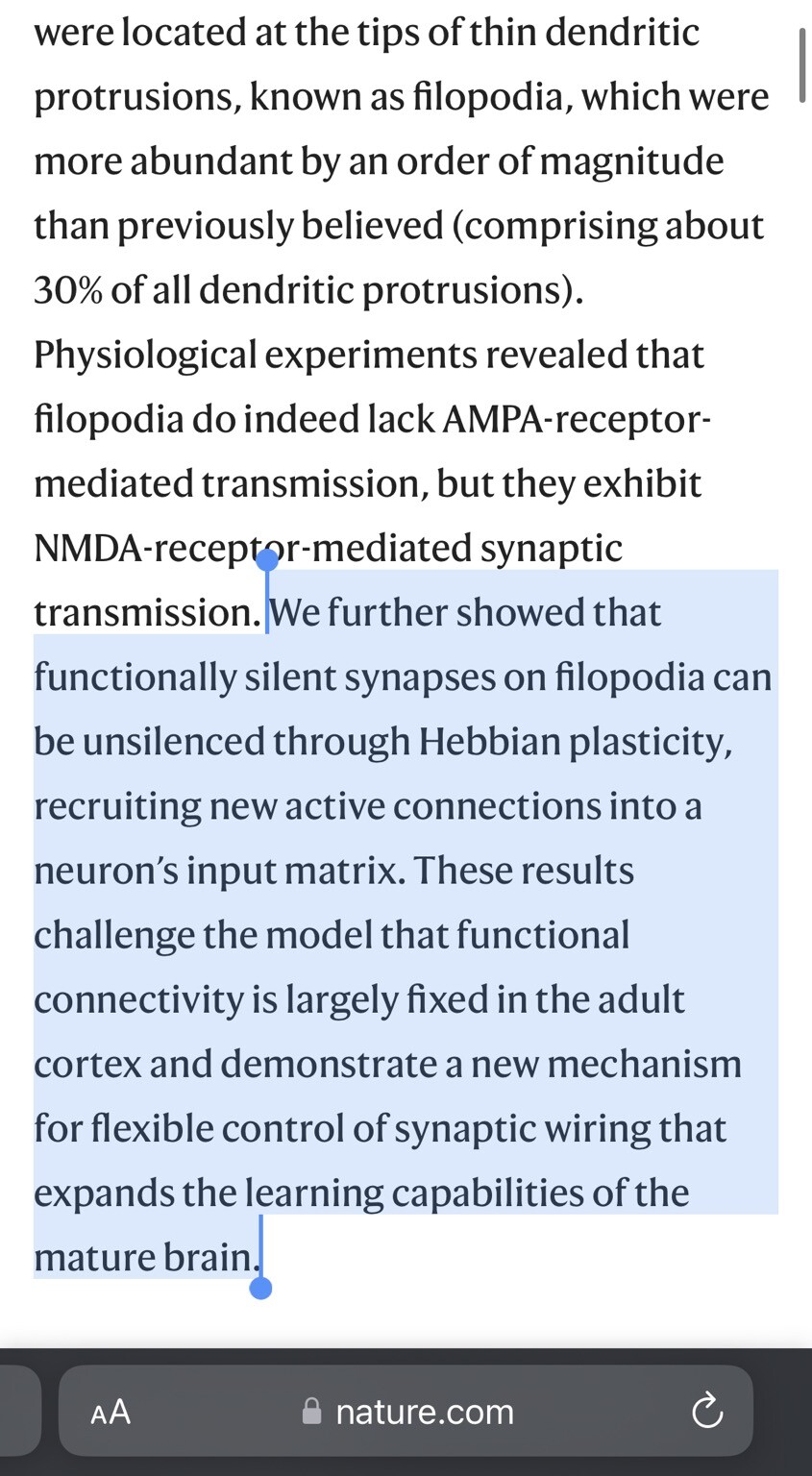
Fascinating new 🐭 study on the 🧠 from @MIT in @Nature. #Neuroscience #Plasticity
@tilo @seeingwithsound I totally agree with @seeingwithsound. Especially with all the crossmodal plasticity that occurs with losing vision early in life, we really need to work on restoring visual cortex plasticity to be able to recovery vision.
It's compounded by the fact that the adult brain has less plasticity and we'll need better understanding of the types of changes produced by congenital blindness to even understand what is needed to recover visual processing in the visual cortex.
In any event, even with the best visual prosthesis (whether peripheral or central), the signals will be very crude, so the adult brain must learn how to interpret these signals before it can use the information. Adult cortical plasticity is one of the things we're actively studying in my lab. Hope we'll figure this out
hkl
boosted

Long-range cortical synchronization supports abrupt visual learning
https://doi.org/10.1016/j.cub.2022.04.029
#neuroscience
hkl
boosted

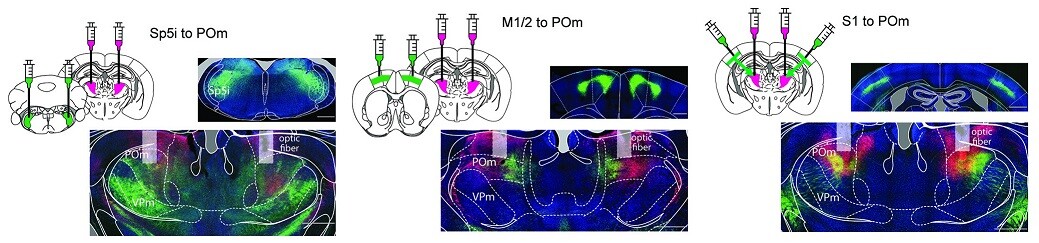
Higher-order sensory #ThalamicNuclei are densely connected with multiple #cortical & #subcortical areas, but what do they do? During active sensing, the POm integrates information from the #cortex & plays a key role in #SensoryPerception #PLOSBiology https://plos.io/3XFqbhx
hkl
boosted

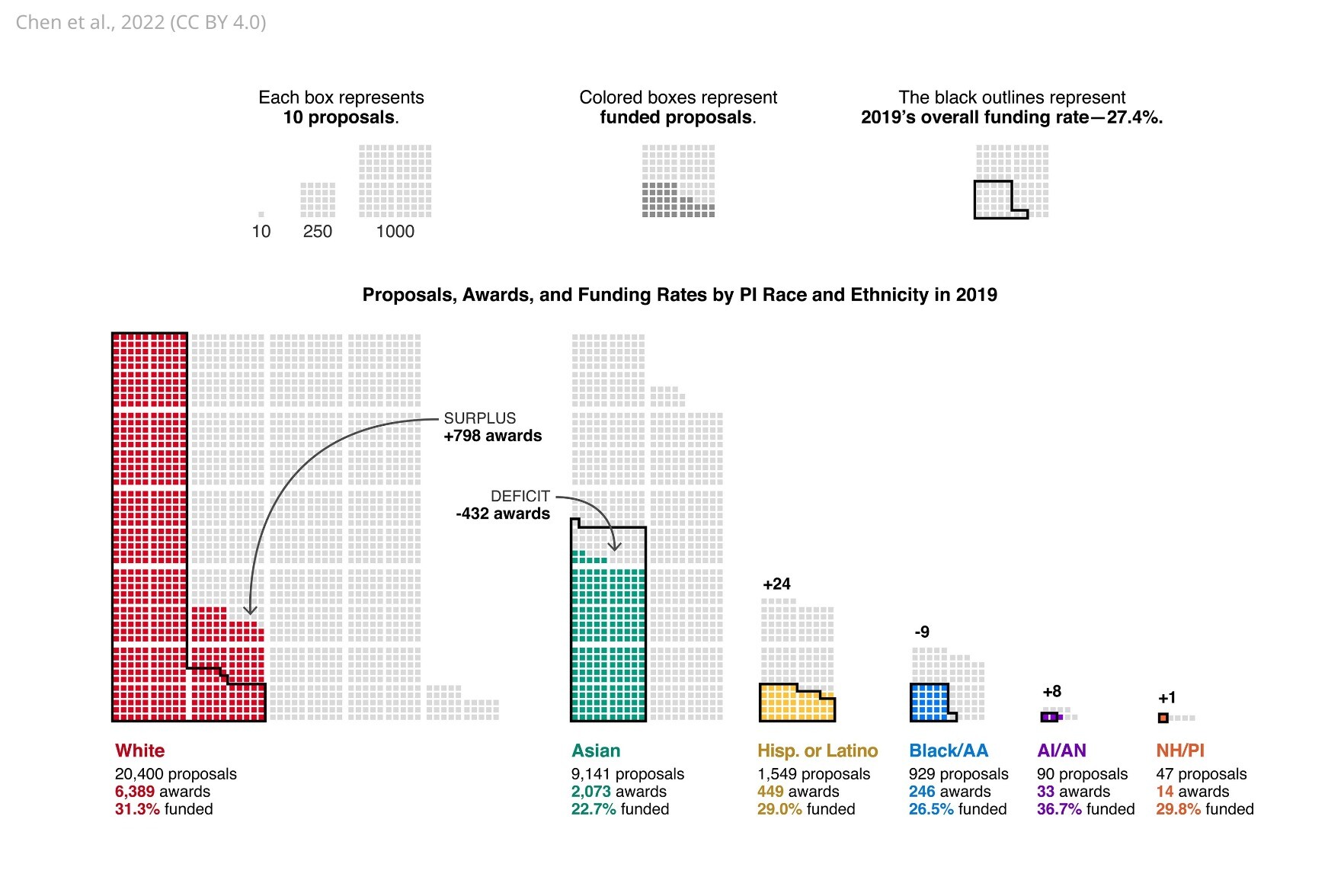
An examination of over 1 million funding proposals to the National Science Foundation from 1996 to 2019 reveals that white principal investigators are consistently funded at higher rates than most non-white PIs and relative funding rates for white PIs have been increasing. https://elifesciences.org/articles/83071?utm_source=mastodon&utm_medium=social&utm_campaign=organic_features
@tilo That's an interesting analogy. Without molecules there cannot be a mind or a football team. But just having a pile of molecules doesn't give rise to a mind or a football team. So I agree, just claiming it's all molecules is not exactly right. Understanding how mind arises from molecules is what some of us neuroscientists are interested in finding out
hkl
boosted

Starry Ocean
(Perpetual Ocean visualization by NASA/Goddard Space Flight Center Scientific Visualization Studio)
hkl
boosted
This is an interesting finding: After animals learn a visual task, there are substantial changes in the premotor/prefrontal cortex.
So motor/frontal cortex changes as a result of sensory learning, and those changes are long-lasting. The motor/frontal areas now treat those visual images differently in multiple ways.
One potentially surprising thing is that it's motor/frontal cortex that shows these changes.
from @flickerfusion@twitter.com @MatteoCarandini
#neuroscience
https://www.cell.com/cell-reports/pdfExtended/S2211-1247(22)01337-7
@NicoleCRust Great idea! Thanks for sharing!
@Renshaw01 I'm trying to set up a writing intensive neuroscience course, and this certainly is a helpful link. Thank you 
hkl
boosted

Academic writing tips
(linking to information posted MushtaqBilalPhD on bird app)
I don't know if this is going to work, but here is the unrolled thread:
https://threadreaderapp.com/thread/1597513824470695936.html
Including tips from:
hkl
boosted




Parametric information about eye movements is sent to the ears https://www.biorxiv.org/content/10.1101/2022.11.27.518089v1
@mibwright @ceoln Brazil is an all time favorite of mine. Terry Gilliam brings a lot of that flavor to 12 Monkeys.
@FetidTrash only 7 pick is hard
Professor of Neuroscience (Johns Hopkins Univ.)
Research interests: cortical plasticity, cross-modal plasticity, synaptic plasticity, metaplasticity, vision loss, visual cortex, auditory cortex
ORCID: 0000-0002-5554-983X
Joined Nov 2022
