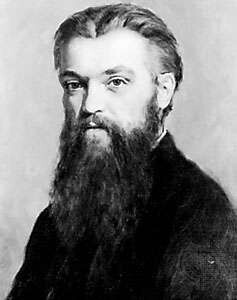
Mathematician William Clifford was born #OTD in 1845. He introduced the notion of geometric algebra, and in 1870 - 45 years before general relativity - he proposed that space might deviate from Euclid's geometry according to some dynamics.
Image: National Portrait Gallery, London
Clifford's geometric algebras show up all over physics and mathematics!
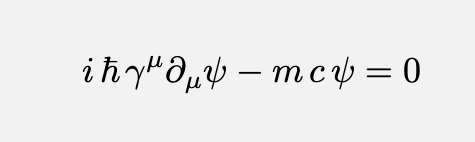
Dirac's relativistic wave equation for spin 1/2 particles (like electrons) depends on a set of four 4x4 matrices 𝛾^{μ}:
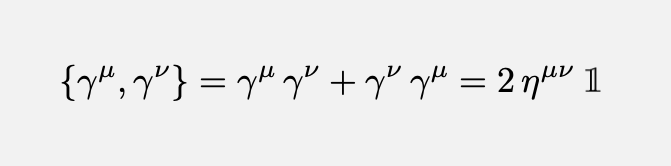
These gamma matrices give a representation of a "Clifford Algebra," defined by the following relationship, where η^{μν} = diag(-1,1,1,1) is the Minkowski metric:
Of course, Clifford didn't have this particular application in mind. Relativity and quantum mechanics were still a half-century away!
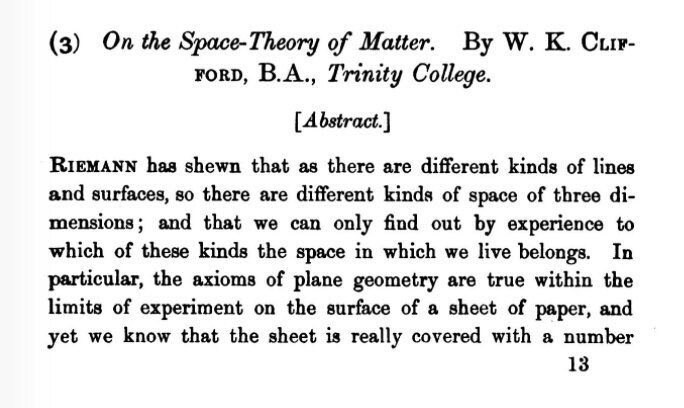
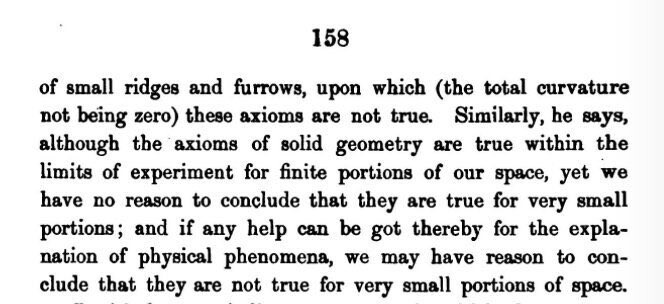
A lesser-known but sort of astounding contribution is found in a paper he read to the Cambridge Philosophical Society in 1870.
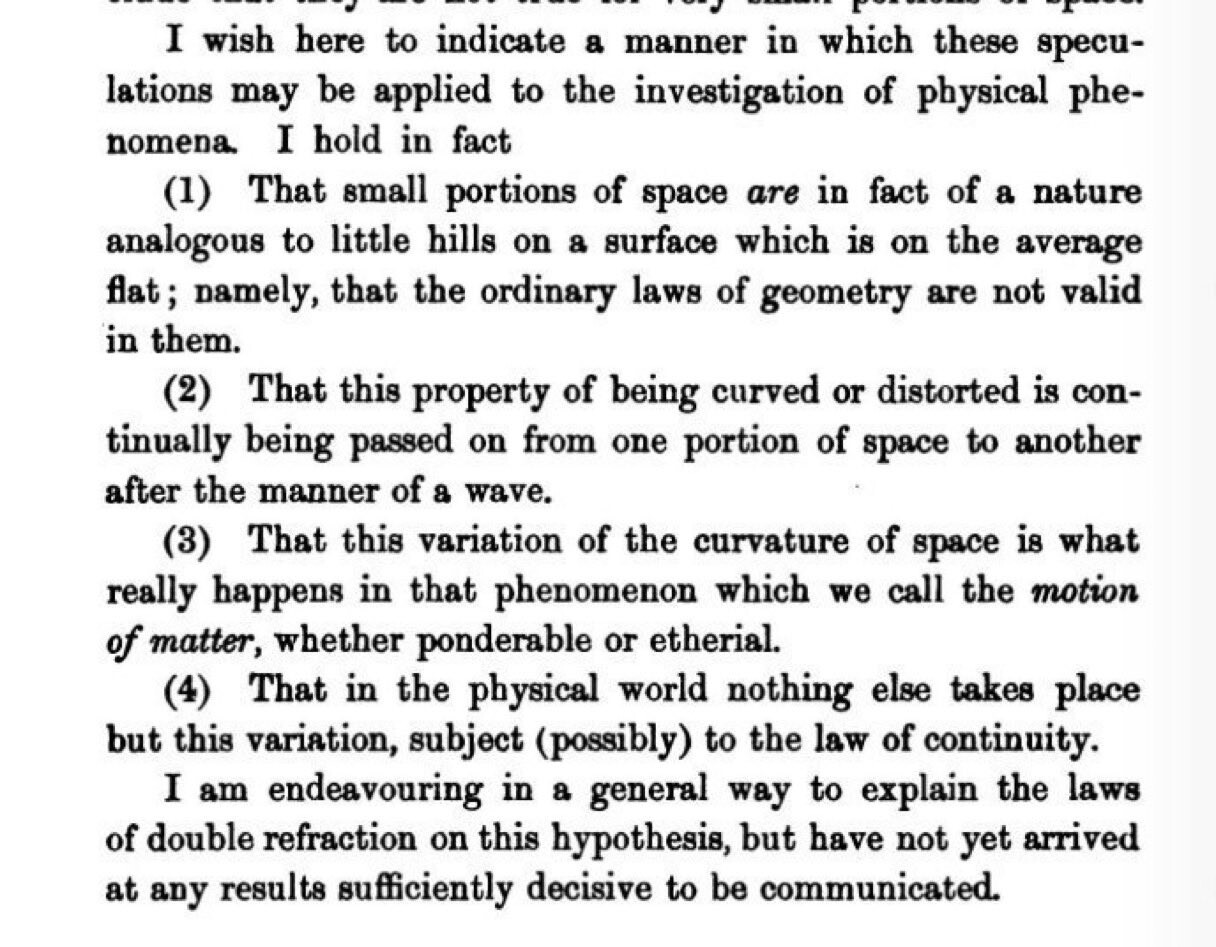
In his paper "On the Space-Theory of Matter,” Clifford speculates that space might on average be described by Euclidean geometry, but behave on small scales more like the geometry of Riemann!
Clifford even suggested that matter ("whether ponderable or etherial") might be a consequence of local curvature of space, and that small ripples of curvature could propagate from place to place like waves. This was 40 years before Einstein introduced general relativity!
His ideas about space and matter were entirely qualitative, based on the idea that the global axioms of traditional geometry were too rigid for understanding fundamental physical phenomena. He was a wildly original thinker.