
Mathematicians and math educators only, please. Which is correct?
(Background - Math was my best subject, but it was decades ago, and now that I’m tutoring my niece I run into things like this… This is a genuine request for assistance, not a trap!)
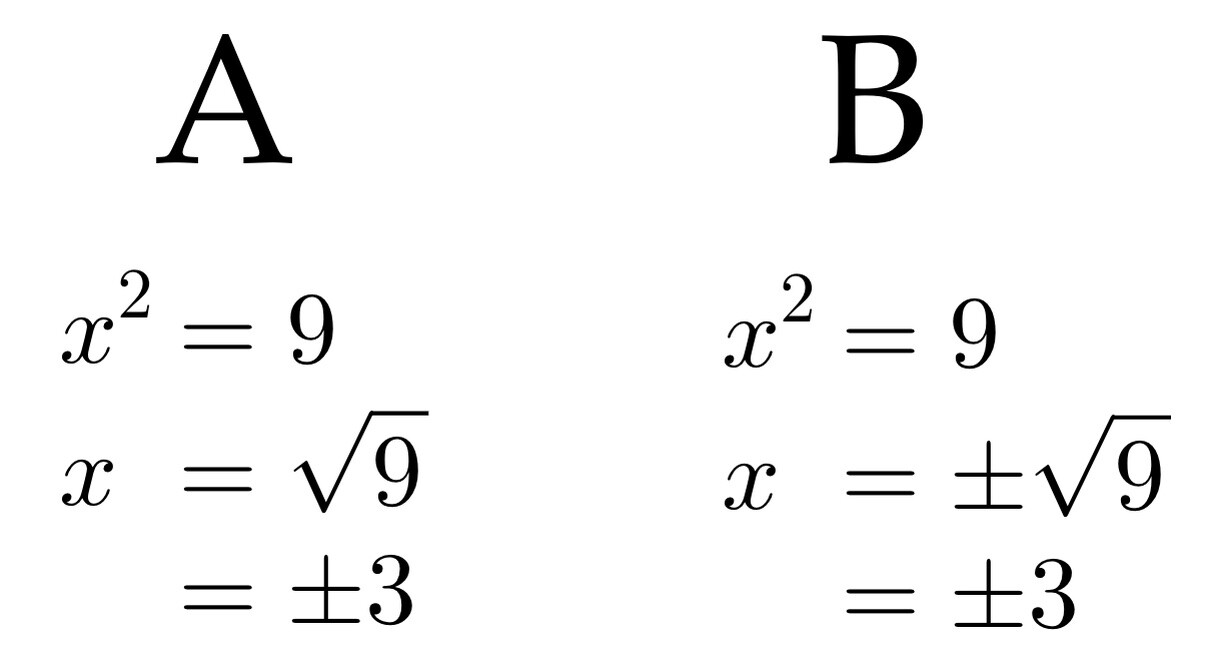
At some point, probably long after I left a math class, I started assuming the square root sign meant both roots. I am now becoming aware that it only means the principal (positive) root, and if you want both roots you have to be explicit.
Comments very welcome.

@MichaelPorter I'm not a math teacher per se, but I have certainly taught plenty of people plenty of math, so hopefully that's close enough.
I think the short answer is that there is not complete agreement. It's often surprising to people how non-uniform people (even mathematicians) are about their use of mathematical notation. I think I dimly recall that I was originally taught like A, but as my education progressed certainly B became predominant.
One way of viewing it is whether you are treating the square root as a function or a relation. If it's a relation on real numbers then it can have multiple values satisfying the relation as in A. In the relation viewpoint, line 2A would be basically a tautology. If it's a function then in the standard understanding of the term it would necessarily only have a single value (though in some contexts sometimes people do use terms like "multi-valued function"), so you need to specify plus or minus to encompass all solutions, as in 2B. As others have mentioned, in complex analysis you can take another way out of this conundrum using Riemann surfaces, but that doesn't seem useful for your current situation.
In my experience the viewpoint of treating the square root as a function is more predominant, perhaps in part because it then leads more neatly into discussions of functions in calculus. If I were grading papers, I probably wouldn't mark either as wrong, but I would probably teach it according to B.
As to which to teach your niece, I guess it probably depends on whether you're trying to 1) use the most pedagogically effective, 2) use what she's most likely to see again later, or 3) use what the teacher considers "correct". I don't know the empirical answer to (1). I suspect B is the answer to (2). And none of us can know the answer to (3) for sure; based on my own experience B seems more likely, but it's not a sure thing.
@internic Thank you, I appreciate your thoughts.
My niece was getting taught “B,” but my brain hiccuped for a moment, hence the question to the masses. It’s all good, as long as she doesn’t tell on me to her teacher 😄
@MichaelPorter One additional thought did occur to me later: Usually when you're first introduced to square roots, you deal with values whose square root is a whole number, or at least a rational number. But eventually you have to think about irrational roots, like the square roots of 2. And you would like to speak about both the negative and positive roots. If you use convention B, then you can refer to those as sqrt(2) and -sqrt(2), but if you use convention A I'm not quite sure how you'd refer to them. Perhaps that's another reason convention B ends up being favored.

@internic How about “roots of 2” and “sqrts(2)”? That won’t make the coding/spreadsheet people happy, I know.
Maybe the problem is that people are being unconsciously influenced by the term “square root,” which is singular. It’s making them feel that there should only be one answer.
There are many examples where we are taught an incomplete picture, something simple that the kids can understand, and then if we get deeper into the subject we learn more interesting details. Those details enrich the subject, and you can use ‘em if you want. If you’re a grade 7 (or whatever) teacher, mark √9 = 3 as correct and tell the curious kids that there’s more to be discovered. In later years, insist on √9 = ±3 because now they know better. That’s my perfect world, we’ve already established that convention disagrees with me 😊