
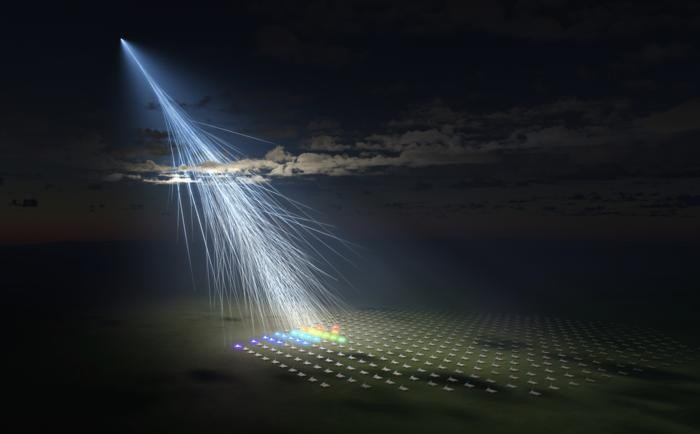
In 1991, researchers detected a powerful cosmic ray called the "Oh-My-God-Particle." Nothing in the Milky Way could kick a particle with so much energy. It's been a long time, but astronomers have found a second particle that's almost as energetic. They clocked in at 2.4 x 10^20eV, the equivalent of dropping a brick from waist height. Astronomers still don't know what could be the source of these particles. Even supernovae aren't powerful enough.

@fraser I have a feeling I’m really wrong, if so I’d love to hear why. Is it possible for something like this to just be spontaneously created, à la virtual particles? Even though the odds would be extremely low, the universe is vast. Rather than look for a process that involves such energies, rely on the uncertainty principle instead?
#Cosmology #Physics

@MichaelPorter While many popular science pieces make it sound like particles can just pop out of the vacuum due to the uncertainty principle, quantum field theory doesn't quite work that way. Quantum field theory still obeys conservation of energy and momentum, so particles can't pop out of the vacuum, because it would violate conservation of energy. What makes virtual particles "virtual" is that they only feature within the interaction of other particles but are not actually observable in and of themselves. While they're often talked about as real physical things, they can be regarded as nothing more than a creative way of interpreting the terms summed up in the approximation method (perturbation theory) that we use to compute the observable results in quantum field theory.
@fraser
@internic @fraser I just read an article which seems to suggest that the primary mystery is not that such a particle couldn't be accelerated to that energy, but that, tracing back along the supposed trajectory, there is no apparent source candidate. So maybe a different kind of mystery.
So, putting aside the cosmic ray…
You say QFT obeys conservation laws - I’m wondering if the uncertainty principle allows for some wiggle room there. e.g. You can violate conservation of energy, but only for a short time? (Not sure how to phrase this for momentum - you can violate conservation of momentum, but only over short distances?)
Another thought, this one along the lines of my obsession with our perceptions of reality (apologies in advance!). If virtual particles are a creative way of interpreting QFT calculations, to what extent are “real" particles also an interpretation of our models? I'm thinking of that description of a proton, in which went from a particle, to a combination of three quarks, to a roiling chaotic mess of many particles, real and virtual.
Thanks for indulging me 😊
@MichaelPorter Now this bit I've honestly never thought much about how to explain to a non-physicist, so...bear with me. In a field theory we generally start with a theory of, say, matter by itself and light by itself and then we introduce a "coupling" term that describes how they interact*. But once you've coupled them, that changes the set of energy states that the new coupled field theory can have.
Ideally when we want to calculate interactions in the coupled theory, we'd like to work in terms of the new energy states, however we generally don't know those states exactly. But in many cases we can use the trick of perturbation theory, which basically says we can compute things in terms of our original energy states with an infinite series of smaller and smaller corrections as long as the coupling term is small enough (small compared to 1 in dimensionless units). The individual terms in this expansion can appear to violate conservation of energy/momentum, but we know from Noether's theorem that the full summation must balance out to exactly conserve energy and momentum.
Many of the terms in such a perturbative summation can be thought of as corresponding to these short-lived virtual particles popping into existence (often in violation of energy/momentum conversation) to interact and then disappearing again. Physicists often talk about these as physically extant things, but I guess I would say that they are useful conceptual tools but nothing more than an artifact of this approximation technique; I don't view them as a real physical thing. I'm certainly not alone in this position, but I'm not sure it's the consensus among physicists.
In any case, the bottom line is that we know the full theory always exactly obeys conservation and these supposedly conservation-violating things involving virtual particles always have to be arranged just so in order that they cannot actually be observed. (2/2)
*Actually there's a totally different way to go about things using a notion called gauge theory, but that's too much of a detour.
@MichaelPorter Oh, and one bonus aside: This Noether's theorem business comes in handy for ruling out other speculative ideas.
You may recall years ago there were these people claiming to have created a "reactionless drive" they were calling the "EM drive". The idea was that it used a closed microwave cavity as a means of propulsion, supposedly generating a differential EM pressure against the front and back walls of the cavity. If it worked, it would be an example of a "reactionless drive", i.e. a propulsion system that produces thrust in empty space without shooting out any propellant. The thing is, this violates conservation of momentum; normally you propel something by exchanging momentum with another body, either something you're pushing against or propellant you're expelling. So, generally speaking, a reactionless drive could only work by overturning one of the most fundamental physical principles.
Anyway, these people had a whole "explanation" of how this supposedly worked involving a "virtual particle plasma" or some such phrase, i.e. trying to invoke QFT. But, as you now know, Noether's theorem tells us that quantum electrodynamics has to obey conservation of momentum every bit as much as classical physics, so no amount of quantum weirdness with virtual particles can possible make such a device work, and we know this without ever having to unravel their supposed explanation and where it goes wrong (as long as they agree it's based on the known laws of physics).
@internic Thanks - I’m going to read this over a few times and let it percolate a bit… 😊

@MichaelPorter To answer the last part of your question about the reality of particles or lack there-of: particles are real in the sense that we can detect them, i.e your detector goes click or flashes or makes a track in discrete localized units that we call a particle detection. But you're correct that the sort of abstract, metaphysical notion of a particle existing in and of itself is more questionable.
In some cases what we think is a fundamental particle turns out to exhibit signs of internal structure and turns out to be a composite particle made up of bound fundamental particles (and like you said this can involve many Bosons and potentially lots of virtual particles). Quantum Chromodynamics (QCD) (which is relevant to the proton situation) is actually an example of a non-perturbative QFT; the coupling constant is *not* small, so you can't use perturbation theory at all. I'm honestly not very knowledgeable about that, so I don't think I can easily lend much insight.
Alternatively, sometimes something that looks like a fundamental particle is actually a quasi-particle, i.e. a disturbance in some underlying medium that must be present, rather than something fundamental thing that can exist anywhere. Holes in semiconductors are the classic example of this, and Dirac even floated the idea of positrons being a sort of hole in the "Dirac sea" of filled energy states, though we don't need such a notion with modern QFT.
Finally, it turns out that while all inertial observers will agree on the number of particles in a given situation (so far as it's well-defined in the state in question), non-inertial observers will not agree. So the same underlying state of the quantum field may be described by different observes as comprising a different number of particles. The most basic example is the Unruh effect, in which an accelerated observer sees thermal radiation where an inertial observer sees just the vacuum. But then the equivalence principle in Einstein's General Theory of Relativity says that gravitation is (locally) equivalent to being in an accelerated frame of reference, which means that this Unruh effect should also arise due to gravity, and this is exactly what Hawking found was the case, where black holes emit thermal radiation ("Hawking radiation") due to these effects.
Again, though, we're wandering to areas I don't know so well. I'm not sure how comprehensible that discussion was, but maybe it helps a little. (3/2 😉 )
@fraser