
RT @astrofalls@twitter.com
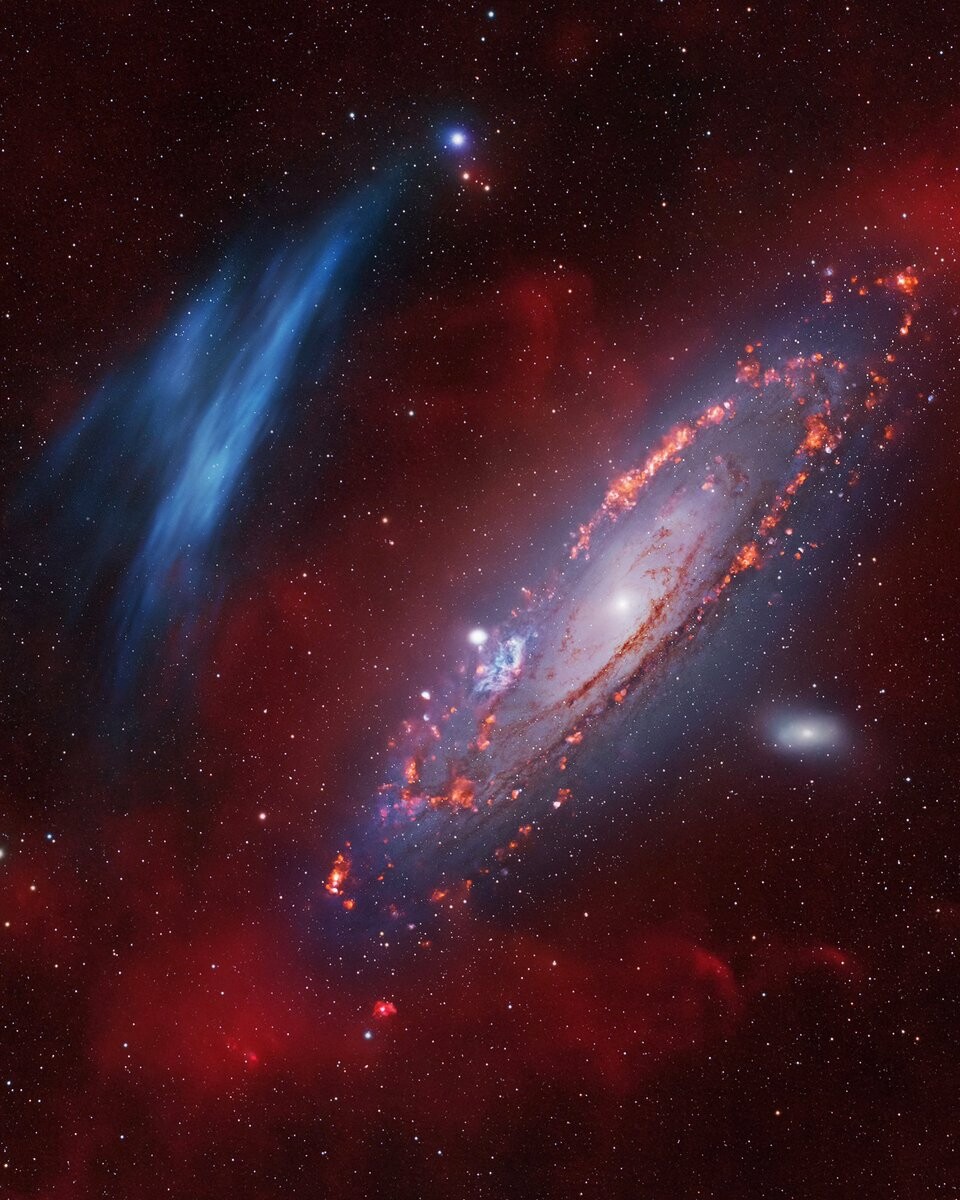
For the last 134 years people have photographed the andromeda galaxy, but everyone up until now has missed this giant undiscovered nebula!
🐦🔗: https://twitter.com/astrofalls/status/1612419792178380800

@sandorkruk to be fair that's a BIG patch of sky in that image. Like several full moons across.. and you need really deep and precise imaging to pull something so LSB out... so I don't find this too surprising.
@sandorkruk (cool though to this that it was hiding there all this time!).

@karenlmasters @sandorkruk i poked very briefly at the rnaas and could not satisfy myself that this was not Galactic. Do we know this is not Galactic? It looks a lot like the magnetized structures we have been studying in the MW for about a decade.

@rdrimmel @karenlmasters @sandorkruk has someone looked in the HI?

@jegpeek @rdrimmel @karenlmasters @sandorkruk Actually I did, but it's hard to say. I don't have a proper fits file with Bray's image and there is lots of filamentary stuff in this area.
@HIprocessor @rdrimmel @karenlmasters @sandorkruk seems like astrometry.net might give you a reasonable fits header?
@jegpeek @rdrimmel @karenlmasters @sandorkruk
If you upload to astrometry.net it gets a CC license, which I cannot do, as I do not own the image.

@sandorkruk @rdrimmel @jegpeek @karenlmasters could it be super foreground? Like Local Cloud (10pc) or Local Bubble (few hundred pc) range?
@jradavenport @sandorkruk @rdrimmel @karenlmasters it sure could. I would bet mostly likely at the 100-300 pc distance range.
@jegpeek @rdrimmel @sandorkruk @karenlmasters definitely looks like a nearby cloud shape… why is it so bright?!
@jradavenport @jegpeek @sandorkruk @karenlmasters There's got be a UV source somewhere.. on the other side of Andromeda? In that direction anyway.

@jegpeek @jradavenport @sandorkruk @rdrimmel @karenlmasters
I haven’t read the paper so I’m curious, but what is the probability of a galactic structure with the same orientation as Andromeda in that direction?
@jegpeek @karenlmasters @crawfordsm @rdrimmel @sandorkruk
Good Q! Lots of nearby clouds roughly mapped out, eg: LIC

@crawfordsm @jegpeek @jradavenport @sandorkruk @rdrimmel @karenlmasters There’s a good chance that this is a Galactic foreground, but the high [O III]/H alpha would make it a pretty unique object even within our own Galaxy. A comparison object is the Ursa Major Arc which was only found because it lies in the direction of M81 and M82. https://skyandtelescope.org/astronomy-news/astronomers-discover-huge-circular-arc-near-the-big-dipper/
@crawfordsm @jegpeek @jradavenport @sandorkruk @rdrimmel @karenlmasters Two possible Galactic foregrounds are the Radcliffe Wave (150 pc) and the Perseus Arm (1600 pc). WHAM surveys of halpha, [NII] and [SII] show diffuse ionized gas below the Galactic plane along the line of sight to M31. Both stuctures have embedded low surface brightness SNR/X-ray emission associated. https://ui.adsabs.harvard.edu/abs/2006ApJ...652..401M/abstract
@crawfordsm @jegpeek @jradavenport @sandorkruk @rdrimmel @karenlmasters Obviously a spectrum would help, if you can get good velocity resolution. But a survey of a larger area in [OIII] also seems called for. I bet there’s more of these out there. We first found the Ursa Major Arc as a 2 degree filament in 2001; 20 years later, Andrea Bracco and Marta Alves showed it was 30 deg long and there were other arcs in the sky!

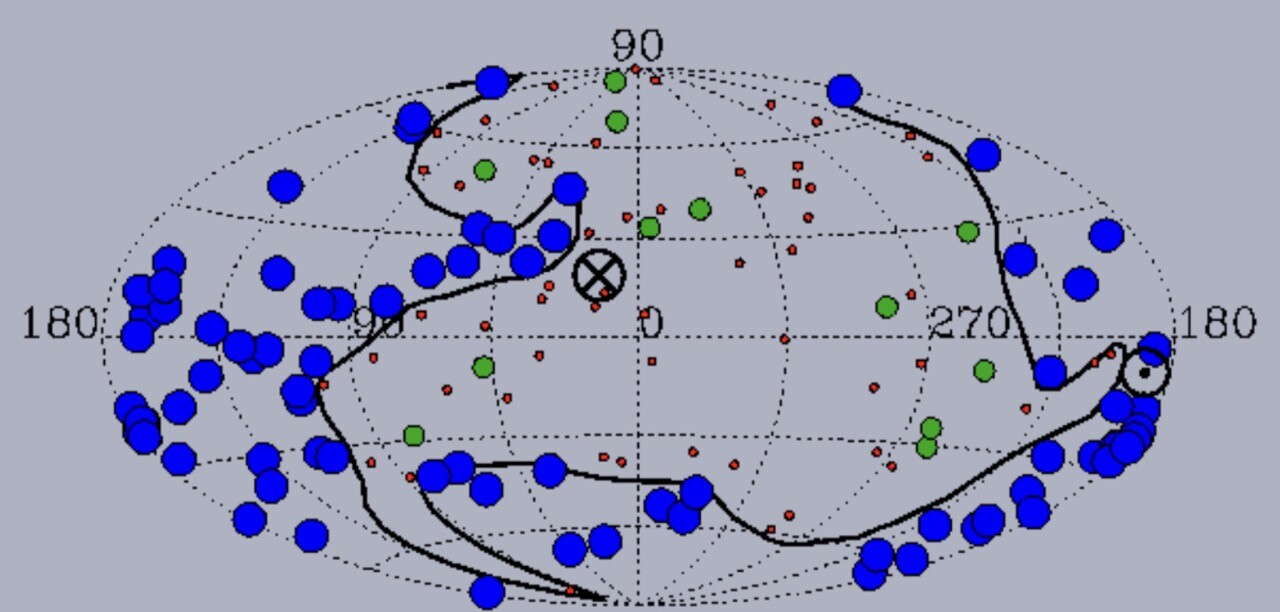
@bobbenjamin @crawfordsm @jegpeek @jradavenport @sandorkruk @rdrimmel @karenlmasters some great band names up there. Lockman Hole, Extended Groth Strip, astronomers are the best at nomenclature.
@crawfordsm @jradavenport @sandorkruk @rdrimmel @karenlmasters by eye they look askew by maybe 15 degrees? So 1 in 12 chance of being this well oriented or better at random?

@rdrimmel @karenlmasters @sandorkruk *cough* @HIprocessor *cough*