

@andrewg That headline was obviously written by AI. 🥸@DemocracyMattersALot

@KatM @andrewg @DemocracyMattersALot Indeed. The headline is silly in a way that the article is expressly not.
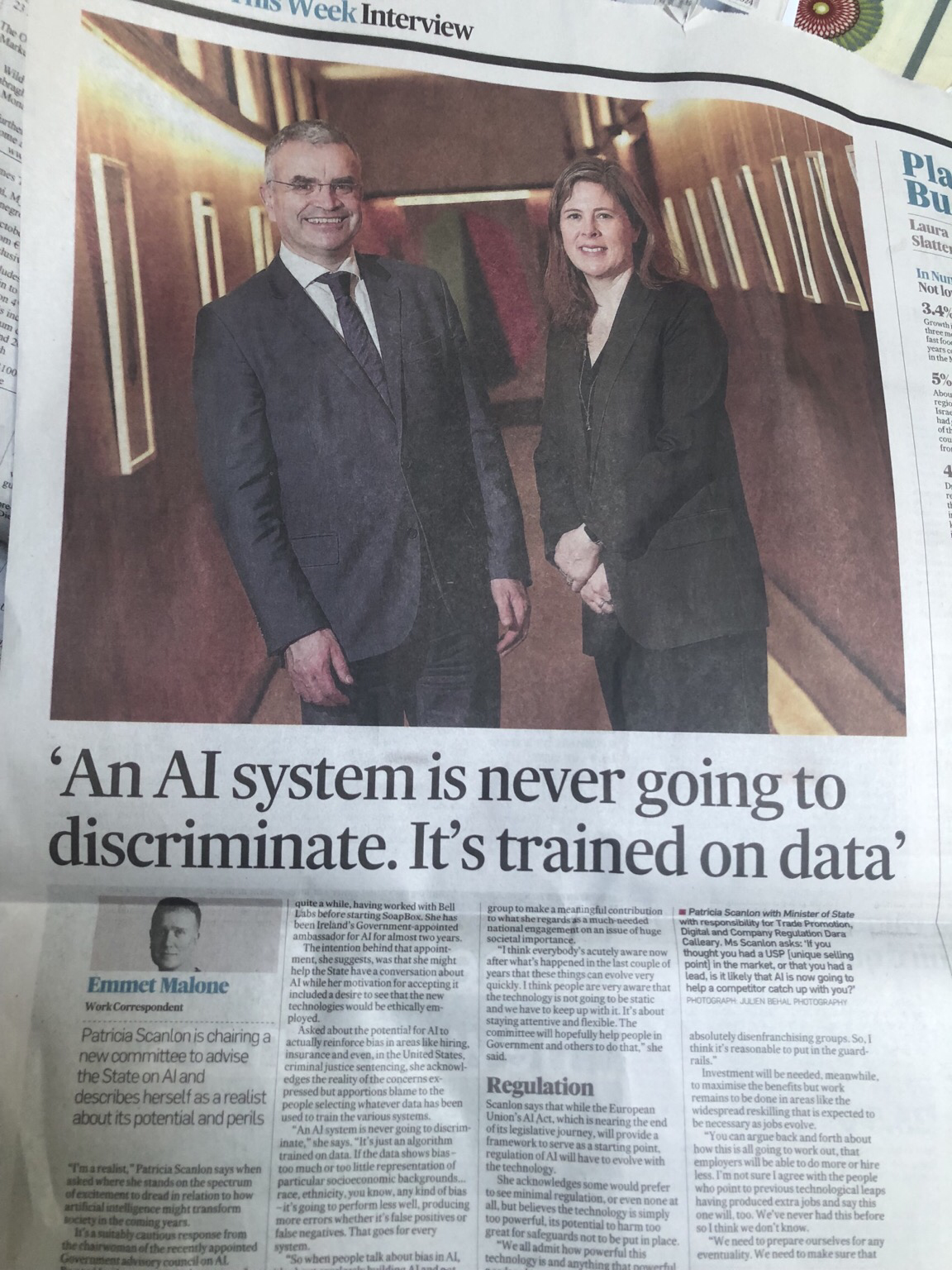
@martinvermeer @KatM @DemocracyMattersALot The headline was a direct quote from the interview.

@martinvermeer @andrewg @KatM @DemocracyMattersALot
The argument negates the premise. A really weird way to defend an argument.
@martinvermeer @andrewg @KatM @DemocracyMattersALot
True. But if you are a politician and make that kind of mistake, you are bound to be misquoted or worse, misunderstanded. People has a strong tendency of hearing only the most misquotable things you say when they are not really paying attention. If you say 'Hitler was a good guy, in an alternate reality where everything is the reverse', half of people is going to keep only the first half. So politicians need to speak very carefully to avoid that.

@martinvermeer @jgg @andrewg @KatM @DemocracyMattersALot It should be clear that the "Full quote" is *still* wrong; all data *is* biased, so an AI is *always* going to discriminate; that's the whole point of an A.I., especially a Machine Learning/Neural Net one trained on data.
It just can be hard to identify *what* the discrimination is in the data.

@AT1ST @martinvermeer @jgg @andrewg @KatM @DemocracyMattersALot Well said! I work in the field and this is the right answer.
@hosford42 @martinvermeer @jgg @andrewg @KatM @DemocracyMattersALot I don't work in the field, but have mostly learned that from seeing people in the field or commenting on academic research showing the cases where it takes "Unbiased" training data, and manages to exploit a unintended but existing bias in the training data that the trainer simply didn't notice (Sometimes as unsubtle than "The difference between a dog and a wolf is if there's snow in the photo", but sometimes way more subtle.).

@martinvermeer @jgg @andrewg @KatM @DemocracyMattersALot
Not so clear, maybe.
If the meaning is that an AI system has not a will of its own and thus can't have a will to discriminate, then it may be deemed right, but also elusive because if the AI system is used to support or, worse, implement automated decisions, then those decisions may be discriminatory for the very same reasons that are stated in the full quoted sentence.
@Eh__tweet @jgg @andrewg @KatM @DemocracyMattersALot Yes, the fallacy is implying that an AI system 'an sich' is free of these problems, which are brought in by the (human built) training data sets. But of course no AI system is ever, or can ever be, used 'an sich'.
@martinvermeer @jgg @andrewg Unfortunately, they can and they have been.
There are studies about how "smart cameras" led law enforcement entities to wrongly investigate and prosecute people on a racial bias due to the data sets that had been used for training. Just one example among many.
And if AI contributes to discrimination, that is the problem. It's about flaws, not sin. We all agree that "sin" does not apply to machines.
I call the "an sich" argument elusive because it's too focused [1/3]
@martinvermeer @jgg @andrewg
on a strictly "technical" point of view (machines have no own will and can't be held accountable) and it overlooks the impact of technology: we are pushing AI as a means to make pre-existing activities "more efficient", i.e. "doing more by means of automation" by orders of magnitude. That's how AI is sold to the public. Making systems capable of autonomous decisions, to the extent that organizations can "do without" actual workforce (or with much less workforce)[2/3
@martinvermeer @jgg @andrewg
All this hype overlooks the flaws of AI, incl. discriminatory biases caused by training data. And one thing I read, and agree with, in the interview is that there's no effective way to prevent data sets to inject discriminatory flaws into AI systems, only human-based post-training monitoring and mediation. But, again, that's not how AI is being pursued by many users. Probably because this would bring in accountability issues and diminish AI-systems profitability.

@martinvermeer @jgg@qoto.org @andrewg @KatM @DemocracyMattersALot
But, still, something interesting happens here: The discrimination (in the sense of "making an unwarranted difference") still happens, but now it is presented as an error, not as something unethical which implies guilt. The guilt has vanished, not even those selecting the data or those using a tool possibly unsuitable are guilty. The question of guilt has just silently gone out of scope. It's not just "an error".
@martinvermeer @andrewg @KatM @DemocracyMattersALot
A technical system is used to isolate the policy makers from the responsibility of the unethical consequences of the means that are chosen.

@glitzersachen @martinvermeer @andrewg @KatM @DemocracyMattersALot Similar to the way people often currently hide behind processes and procedures, blaming them for the responsibility of the consequences, ignoring the fact that the processes and procedures were created by people (often them) in the first place... and can be changed.
In this sense, AI is just a new way of passing the buck.

@jgg @andrewg @KatM @DemocracyMattersALot Clumsy perhaps, but it is clear what she means. The truncated quote misrepresents it.