

kemuri 🦀 @kemuri@social.cleverlibre.org
Joined Nov 2022
kemuri 🦀
boosted

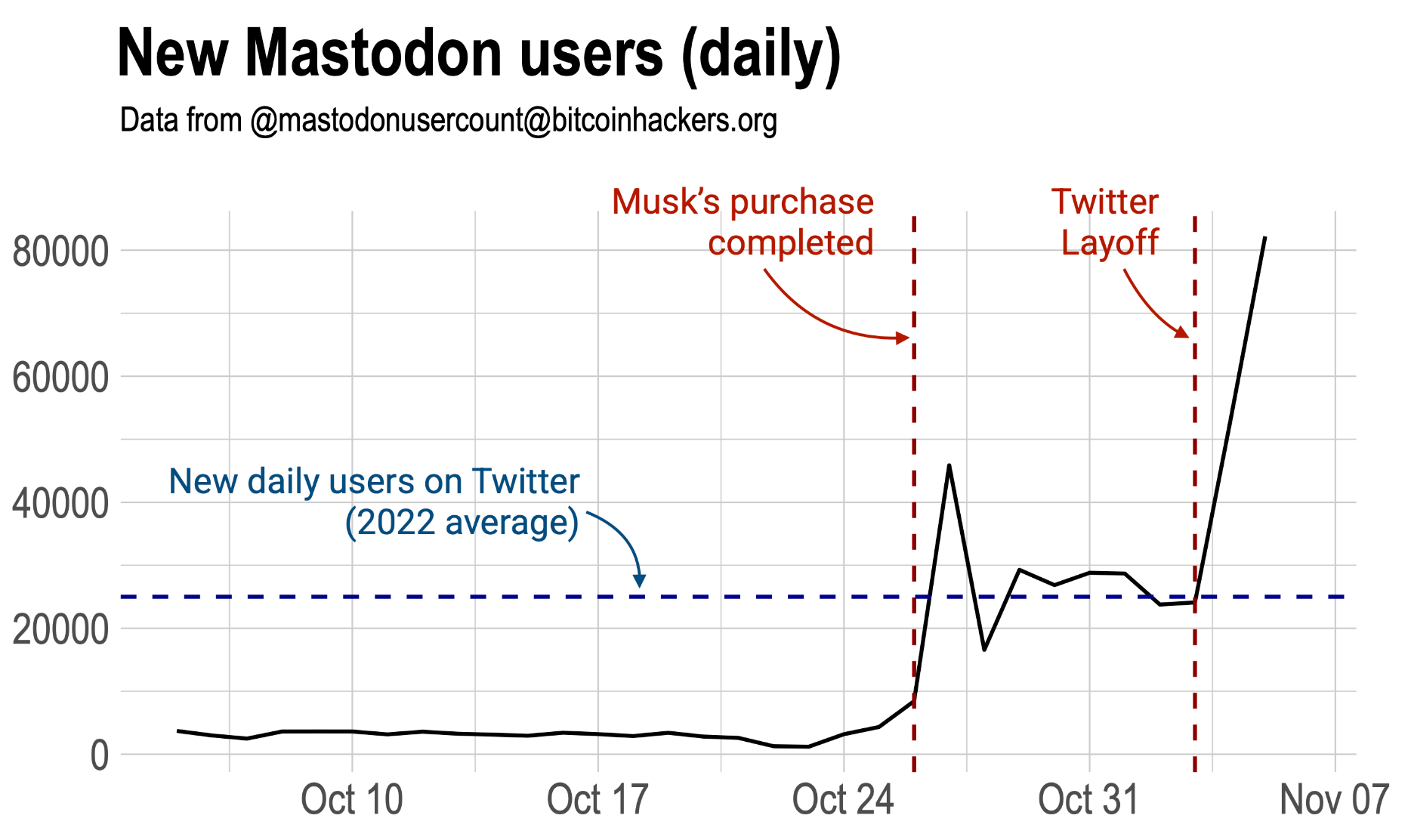
Something big is happening in Mastodon over the weekend. Here is my graph, updated. Right now Mastodon is growing ~3 times faster than Twitter.
kemuri 🦀
boosted

"Zero to Production in Rust" walks you through to the steps of how to execute a deployment to a real PaaS quite early in the book - in chapter 5.
There's a note of the end of the deployment chapter. It invites readers to email me a screenshot of the running app on DigitalOcean.
Those emails never get old. A little token to remind me, every other day, that I have written something useful and it was worth it.
@timClicks You put #rust in your post and I have #rust subscribed to my Home feed 🦀 so your post appeared just like that
kemuri 🦀
boosted

When it came time to reckon with social media’s failings, nobody ran to the “web3” platforms. Nobody asked “can I get paid per message”? Nobody asked about the blockchain. The community of people who’ve been quietly doing this work for years (decades!) ended up being the ones who welcomed everyone over, as always.
kemuri 🦀
boosted

Tip for the new folk:
Often Mastodon’s features work the way they do because it was first populated by people who had been harassed on FB and the Birdsite.
For instance (not sorry), you cannot search Masto for a simple term. Only #hashtags. Say you’re having a private conversation about iguanas. Anti-iguana trolls will not be able to search for “iguanas”, find your conversation, and drop into it to say, “Iguana luvers suck!”
But if you are wanting to connect with new iguana fanciers on Mastodon, slipping an #iguanas hashtag somewhere into your posts will allow people to search for and find them.
kemuri 🦀
boosted

Last night, out on the town at dinner, in a moment of questionable judgment* and weakness**, kid3 asked to post to my Twitter account. I figured she’d post something snarky and cute, but she asked all of my followers to follow her. Now people are trolling me by sending her links to local kittens that need adoption and urging her to add more cats to the household.
*three very god bourbons
**as I now recall she said “have a third one dad why not”
@jellycrystals
Unfortunately it seems the app doesn't support it yet. This seems to be the feature request for it. https://github.com/tuskyapp/Tusky/issues/89
@kkomaitis I don't think options and competition are the same. Mastodon is decidedly not competitive, but content as an alternative. To that end, the "exodus" doesn't seem to be that big per se, and seems to be limited to a circle of English speaking users.
As Ben Thompson has been noting, traditional anti-trust measures have been largely dysfunctional against aggregator platforms. Maybe more grants to non-profit protocol based alternatives is one way to go forward.
Curation Algorithms are Important, We Should Control It
Curation Algorithms are Important, We Should Control It
The curation algorithms, from search result ranking to timeline ranking to recommendations, may be the most impactful and useful algorithms humans have ever derived. They cut through vast amount of noise to deliver signal relevant to each user. The lack of them on Mastodon and other places is sometimes touted as a feature -- it's not, it's simply lack of an important feature.
That's not to say the algorithms deployed by Twitter et al are perfect. Much has been written about how they are not tuned for the benefit of the users, but the corporations; not tuned for the improvement of the users, but the addiction of them; etc. But a competititor must provide a fix for those problems to measure up to the existing networks.
In a sense, the curation algorithms are bubble creators, because curation is the process of creating bubbles. I hypothesize that there is a trade off among three desirable qualities of these bubbles: effort spent to curate, granularity of the boundary, coverage of the potentials. For the same effort, one must trade off granularity and coverage, as more granularity demands more effort for examining each item.
The importance of the curation algorithms then is to scale up the curation effort available beyond human limitations, leading to improvements in both granularity and coverage. Improvement in coverage is straightforward: Google Books enables searching in unprecedentedly many books in one query. Improvement in granularity is more subtle: recommendations are relevant to complex queries, not simple combination of source and recency. Except, instead of bothering the user to input the complex queries, the corporations choose to infer inputs from user tracking data.
Simply opting-out of tracking is not really taking back control of the curation algorithms from the corporations, as many have suggested. The control of the curation algorithms is in the complex queries. Currently, the corporations sell that control to their customers: advertisers. They can use a set of complex queries to control in what kind of rankings or timelines they want their ads to appear. But the users don't get to control what kind of rankings or timelines they want to view.
Curation algorithms are too important and beneficial to give up. To really take control of a machine learning based curation algorithm, there needs to be a language for both describing its learned parameters to users and for expressing complex queries by users to it.
@frayoshi I know right 😂 it feels kind of like if he is less vocal it wouldn't be as bad.
kemuri 🦀
boosted

Remember: trans rights are human rights
kemuri 🦀
boosted

Red Cross seeks digital equivalent of its emblems to mark some tech as off-limits in war -- via The Register https://www.theregister.com/2022/11/07/red_cross_digital_emblem/?utm_source=twitter&utm_medium=twitter&utm_campaign=auto&utm_content=article
The beginning of this wave. Wonder how long it lasts.

17,623 accounts +2 in the last hour +91 in the last day +148 in the last week
@Didida 你这叫 Imposter Syndrome
https://blog.rust-lang.org/inside-rust/2022/04/19/imposter-syndrome.html
努力找,找到为止,就找到了
kemuri 🦀
boosted

Hey, so, we've hit 1,028,362 monthly active users across the network today. 1,124 new Mastodon servers since Oct 27, and 489,003 new users. That's pretty cool.
kemuri 🦀
boosted

As of this evening, ALL TinyNES units have now been shipped out to Mouser Electronics for final order fulfillment. Everything. One hundred percent. Nothing’s left to do. That’s it. Amazing! Amazing. tinynes.com
kemuri 🦀
boosted

After sleeping on it, I think #Mastodon should rename ‘instances’ to ‘Communities.’
Instances feels too technical and I see even savvy people struggling to understand it.
I argue communities would make much more sense. It denotes much of the purpose behind _why_ this service has different instances, and many people will already be familiar with the concept from Reddit (the, what, sixth most popular site on the net?).
kemuri 🦀
boosted


A quick note of something that may be important for people to know: I already noted that DMs here are a bit sketchy security wise, but (THIS IS THE IMPORTANT BIT): if you mention someone else's account in a DM, Mastodon, yoinks them into the conversation.
So, you know, if you think you're talking about someone behind their back, you might be doing it to their face.
@ridt
With all due respect, that is not an explainer, that is a conflater. It conflates federated network the technology with federated network the concept, and put in some positive words to make fediverse people feel good.
To wit, different datacenter providers around the world exchange YouTube video data. Is YouTube a "federated network"?
Joined Nov 2022
