

kwitschas @kwitschas@social.cleverlibre.org
Biochemist and postdoc at Gent University
#neuroscience
#ScienceMastodon
#ionchannels
#Electrophysiology
#Biophysics
Joined Nov 2022
kwitschas
boosted

A brief chat with Dr Hunter on my panpsychism chapter in his book:
https://youtu.be/lyoy5NU2AUU
kwitschas
boosted

RT @meharpist
It felt like -40 in Quebec this past weekend. How do our brains process such cold temperatures? A recent @nature paper describes the cellular coding of temperature in mice. Perhaps unsurprisingly, they find different representations for cool and warm https://www.nature.com/articles/s41586-023-05705-5
kwitschas
boosted

Review at EJI
"Dysregulation or overproduction of IL-6 leads to autoimmune diseases such as multiple sclerosis (MS) and rheumatoid arthritis (RA), in which Th17 cells are considered to be the primary cause of pathology. Given the critical role of IL-6 in altering the balance between Treg and Th17 cells, controlling IL-6 activities is potentially an effective approach in the treatment of various autoimmune and inflammatory diseases."
#Immunology #Treg #Th17 #Autoimmunity
https://onlinelibrary.wiley.com/doi/full/10.1002/eji.201040391
kwitschas
boosted

New Ep out tomorrow!
Tomorrow, we discuss with assistant Prof Francesca Grisoni @fra_grisoni who leads @molecularML just how AI is improving drug discovery.
Follow so you don't miss it
https://open.spotify.com/show/4v05ZoBjLLIeUAtgGZIVZK?si=584ba76c319144de
#academia #PhD #phdlife #science #xp @OpenAcademics @AcademicChatter
kwitschas
boosted

Hi all! By way of #introduction, I'm a postdoctoral neuroscientist in the Axel Lab at Columbia University's Zuckerman Institute. I study information seeking, knowledge as motivation, and curiosity #inmice using olfactory stimuli
I hope to have my own lab soon to answer questions like "Why and how are humans and animals motivated to learn about the world?"
I care a lot about the structural issues keeping academic science from being inclusive and equitable.
kwitschas
boosted

Come and work with us in sunny ☀️🌴 and vibrant 💃🕺 Marseille!
PhD opportunity in my lab, together with
@laurentperrinet at the Turing Centre for Living Systems.
The deadline is 16 February, fast approaching!
kwitschas
boosted

PhD opportunity Abnormalities in proteins and lipids in Lewy body dementia
Newcastle University
Translational and Clinical Research Institute Dr Daniel Erskine, Dr F Lebeau, Dr Lee J. Higham https://www.findaphd.com/phds/project/abnormalities-in-proteins-and-lipids-in-lewy-body-dementia/?p154961
kwitschas
boosted

RT @Just_Bollinger
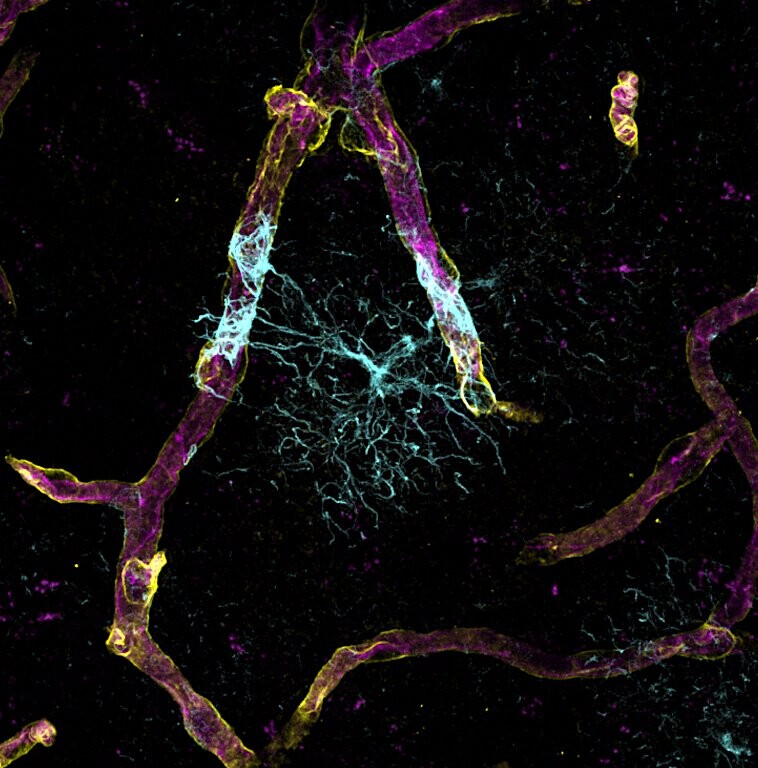
New research direction = new #FluorescenceFriday drop! Stunning astrocyte (GFAP, Cyan) wrapped around a branched blood vessel (Tomato Lectin, Magenta). Astrocyte endfeet in yellow (AQP4).
kwitschas
boosted

As I saw @nazgul point out, the tools for finding your Twitter friends’ Mastodon accounts will likely stop working next week, when Twitter API usage starts costing money.
You may want to run them again to find new accounts since you ran them last.
These are the four tools I’ve seen people use, in case you want to find your way back to the one you tried earlier:
kwitschas
boosted

Brexit causes collapse in European research funding for Oxbridge
https://www.theguardian.com/education/2023/feb/04/brexit-causes-collapse-in-european-research-funding-for-oxbridge-universities?CMP=Share_AndroidApp_Other
kwitschas
boosted

Tomorrow!
𝗙𝗼𝗿𝗺𝗮𝗹𝗶𝘇𝗮𝘁𝗶𝗼𝗻 𝗮𝗻𝗱 𝗲𝘅𝗽𝗹𝗮𝗻𝗮𝘁𝗶𝗼𝗻𝘀 𝗶𝗻 𝗯𝗶𝗼𝗹𝗼𝗴𝘆
Neuroscience & Philosophy Salon with Johannes "Yogi" Jäger @yoginho
Including brain network explanations, what do we learn?
Thu Feb 2 at 12pm US-EST.
Register here:
https://umd.zoom.us/meeting/register/tJElf-uqqzMpHdZQqKiND7esShcusj6ym-Hv
kwitschas
boosted

Together with the Zechner lab we have pushed live-cell quantitative lipid biochemistry to the single cell level. It works - but some lipids are weird. 🤓
Let us know what you think! https://www.biorxiv.org/content/10.1101/2023.01.27.525833v2
kwitschas
boosted

I had a very interesting discussion about #human #evolution with Jack, a 9-year-old from the UK. He has surprisingly tricky questions and a refreshing perspective.
In this exchange, we discussed #biology , #development , #crispr , #genetherapy , and some principles of #evolution .
He's doing a #podcast about #future perspectives in various fields, you can find it here:
https://anchor.fm/jacktothefuture/episodes/Episode-11--The-Future-of-Evolution-e1u29j8
kwitschas
boosted

1/2 https://doi.org/10.1162/jocn_a_01908
Does does the complex systems perspective, one that entails emergent properties, matter for brain science? This Special Focus begins with this precis of recent book, then proceeds with brilliant and challenging commentary from:
Jennings https://doi.org/10.1162/jocn_a_01930
Uddin https://doi.org/10.1162/jocn_a_01925
Sadaghiani & Alderson https://doi.org/10.1162/jocn_a_01951
Druckmann & Rust https://doi.org/10.1162/jocn_a_01950
Hayden https://doi.org/10.1162/jocn_e_01924
Boone, Van Rooy, De Brigard https://doi.org/10.1162/jocn_a_01931
kwitschas
boosted

Obesity-Related Neurodegeneration Mimics Alzheimer’s Disease
A new study led by scientists at The Neuro (Montreal Neurological Institute-Hospital) of McGill University finds a correlation between neurodegeneration in obese people and Alzheimer’s disease (AD) patients, suggesting that losing excess weight could slow cognitive decline in aging and lower risk for AD.
#Neuroscience #Brain #Neurology #NeurologicalDiseases #NeurodegenerativeDiseases #Neurodegeneration #Alzheimer #Aging #BrainAging #Obesity
https://neurosciencenews.com/obesity-neurodegeneration-alzheimers-22412/
kwitschas
boosted

Hi there! This is ACM, the world's largest computing society. As you might have noticed, we have opened not only our official #Mastodon account but also our own #instance!
Please consider joining @mastodon.acm.org, a community for #computing researchers & practitioners to connect & exchange ideas with each other, whether you are an ACM member or not.
You can use this link to join: https://mastodon.acm.org/invite/FbXaxAHg
Spread the word with your friends and colleagues! Happy tooting!
kwitschas
boosted

The UK #Microtubule Meeting will be on 12th May 2023 in Edinburgh. Organised by Julie Welburn, Andrew Carter and Mark Dodding. Nominal registration fee + green travel subsidies are available.
kwitschas
boosted

Neuroscience needs new ideas. So there is a whole summer school (in Waraw) on making them: https://nenckiopenlab.org/school-of-ideas-2023/ - such a wonderful idea
kwitschas
boosted

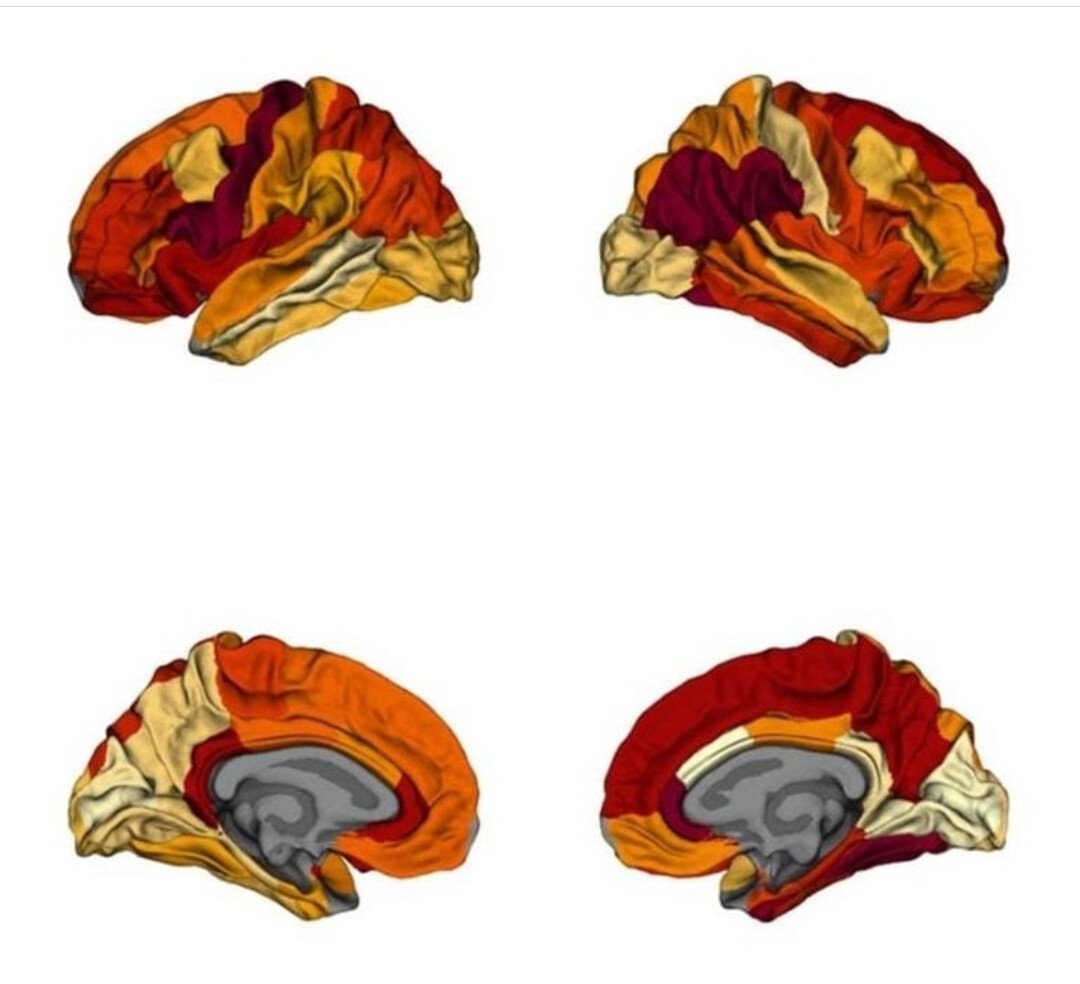
Looking for feedback on some new thoughts about Big Ideas in brain/mind research.
I've spent quite a long time researching and thinking about the history of brain/mind research in terms of the Big Ideas that have emerged. Pre-1960, it's pretty easy to list the big ideas that researchers had reached consensus around. Since 1960, that's harder to do. There's plenty of consensus around new facts (like umami is supported by receptor X on the tongue), but it's difficult to regard the things that brain researchers agree on as new, big ideas. At first, I (mis)interpreted this as a paucity of new ideas, but I no longer think that's correct - I've found a ton. Instead, I now believe that they are there but we haven't arrived at consensus around them.
I'm wondering: Why might have researchers arrived at more consensus around Big ideas introduced 1900-1960 vs 1960-2020? Obviously there's the filter of history and the fact that it takes time to work things out. But is there more to it than that? For example, have the biggest principles already been discovered? And so we are left with more of a patchwork quilt?
A sample of big ideas pre-1960ish with general consensus
*) Nerve cells exist (it's not a reticulum)
*) Neurons propagate info electrically and then chemically between them
*) DNA > RNA > Protein is a universal genetic code or all living things
*) Explaining behavior needs intermediaries between stimuli and responses (cognitive maps/minds)
A sample of big ideas with no general consensus introduced post-1960ish:
*) Cortical function emerges from repetitions of a canonical element
*) The brain is optimized for goal-directed interactions with the environment in a feedback loop (prediction/embodiment/free energy)
*) The brain is a complex system with emergent properties that cannot be understood via reductionist approaches
*) Fine structural detail in the brain (the connectome) matters for brain function
I'd love to hear your thoughts.


Biochemist and postdoc at Gent University
#neuroscience
#ScienceMastodon
#ionchannels
#Electrophysiology
#Biophysics
Joined Nov 2022
