

Léo Varnet @leovarnet@social.cleverlibre.org
- Institution
- CNRS, ENS Paris
- Research topics
- Auditory perception, psycholinguistics, hearing loss.
CNRS researcher at École normale supérieure Paris. Auditory perception, psycholinguistics, hearing loss. My toots are searchable #tootfinder.
Joined Oct 2022
Léo Varnet
boosted

A microscopic investigation of the effect of random envelope fluctuations on phoneme-in-noise perception https://www.biorxiv.org/content/10.1101/2022.12.27.522040v1?med=mas
@emkmiller @academicchatter @academicsunite @phdstudents @phdlife @PhD_Genie
3) So I also extract snippets from everything I read, like @jnyrose, and store them in a very large OneNote folder (sorry, I haven't found a suitable alternative) with many entries. I must say this is very satisfying, but I don't know if it is useful: I never had to go back to it to look for all the citations on a specific topic.
@emkmiller @academicchatter @academicsunite @phdstudents @phdlife @PhD_Genie
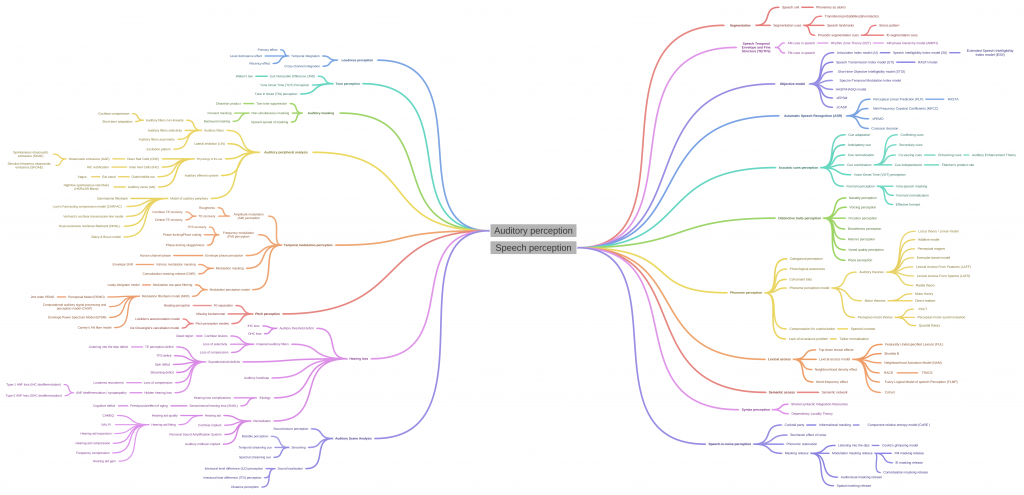
2) ...So I also keep a spreadsheet of all articles with columns "Authors", "Journal", "Year", but also "Stimulus content", "Task", "Analysis method", etc... The last column is a field "Topic" for which the keywords are organized in a tree to avoid duplicates (http://dbao.leo-varnet.fr/2022/05/20/a-mind-map-of-concepts-in-auditory-speech-perception/). This makes it easier to find a reference when you have only one fragment of memory about it. But to be honest, I think it's mostly useful to force me to organize my thoughts when reading.
However, this is only for article references ...
@emkmiller @academicchatter @academicsunite @phdstudents @phdlife @PhD_Genie
Personally, I use 3 parallel methods to organize and browse the articles/books I read:
1) #Zotero, like many people here. However, I use it mostly to facilitate the creation of bibliographies. However, the metadata system is not flexible enough for my taste...
Léo Varnet
boosted
Another very interesting piece in this museum is the Mini-componium, a replica of the original Componium built by Diederich Nikolaus Winkel in 1821. This remarkable mechanical music instrument can vary the music it plays using a randomizing mechanism! In fact, the Componium creates endless variations on a theme by selecting randomly one of the 8 possible melodies every two measures.
In a sense, this is a very early example of
#ComputerMusic #AlgorithmicComposition
(https://en.m.wikipedia.org/wiki/Componium)
(3/3)
#musicbox #music
@pixelfun wow this is cool and unexpected! Cheers
Léo Varnet
boosted

My periodic reminder that my book on the discrete Fourier transforms (incl. FFT, finite fields valued FT, representation theory, and more) is available for free. https://mathematical-tours.github.io/daft/
Another very interesting piece in this museum is the Mini-componium, a replica of the original Componium built by Diederich Nikolaus Winkel in 1821. This remarkable mechanical music instrument can vary the music it plays using a randomizing mechanism! In fact, the Componium creates endless variations on a theme by selecting randomly one of the 8 possible melodies every two measures.
In a sense, this is a very early example of
#ComputerMusic #AlgorithmicComposition
(https://en.m.wikipedia.org/wiki/Componium)
(3/3)
#musicbox #music
Léo Varnet
boosted
These music boxes were probably built at the end of the 19th century. An extra feature is the panorama of the horse race in the cabinet. By inserting a coin, the music is played and one can gamble on the winning horse. The machines were designed in such a way that the winning horse could not be predicted with any certainty.
I don't know how it works, but this is maybe one of the earliest random number generator! (2/2)
These music boxes were probably built at the end of the 19th century. An extra feature is the panorama of the horse race in the cabinet. By inserting a coin, the music is played and one can gamble on the winning horse. The machines were designed in such a way that the winning horse could not be predicted with any certainty.
I don't know how it works, but this is maybe one of the earliest random number generator! (2/2)
Yesterday I visited the Speelklok museum in Utrecht, an exhibition of an incredible number of self-playing instruments. Among them, I was particularly amazed by the "Horse Race" music boxes... (1/2)
Léo Varnet
boosted

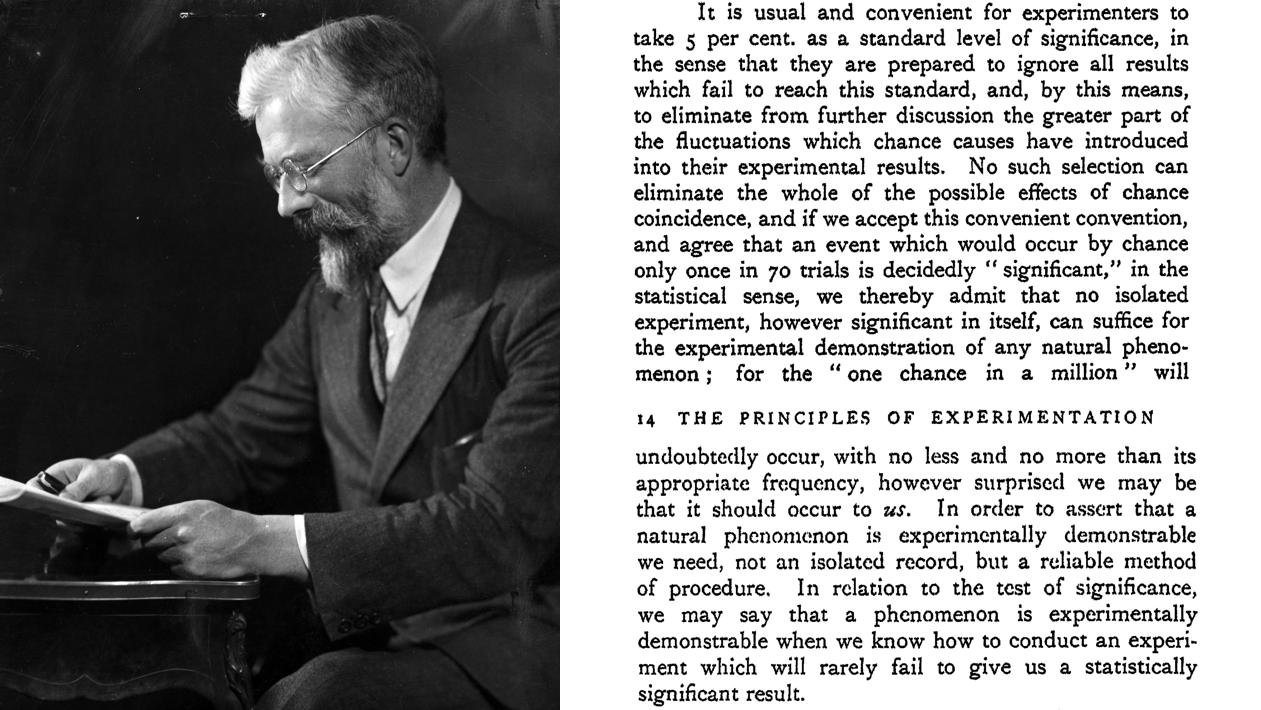
If you use frequentist statistics, you have to accept that 'no isolated experiment, however significant in itself, can suffice for the experimental demonstration of any natural phenomenon; for the "one chance in a million" will undoubtly occur, with no more or less than it's appropriate frequency, however surprised we may be that it should occur to us.' (Fisher). Replication is a core requirement of all frequentist statistics.
Léo Varnet
boosted

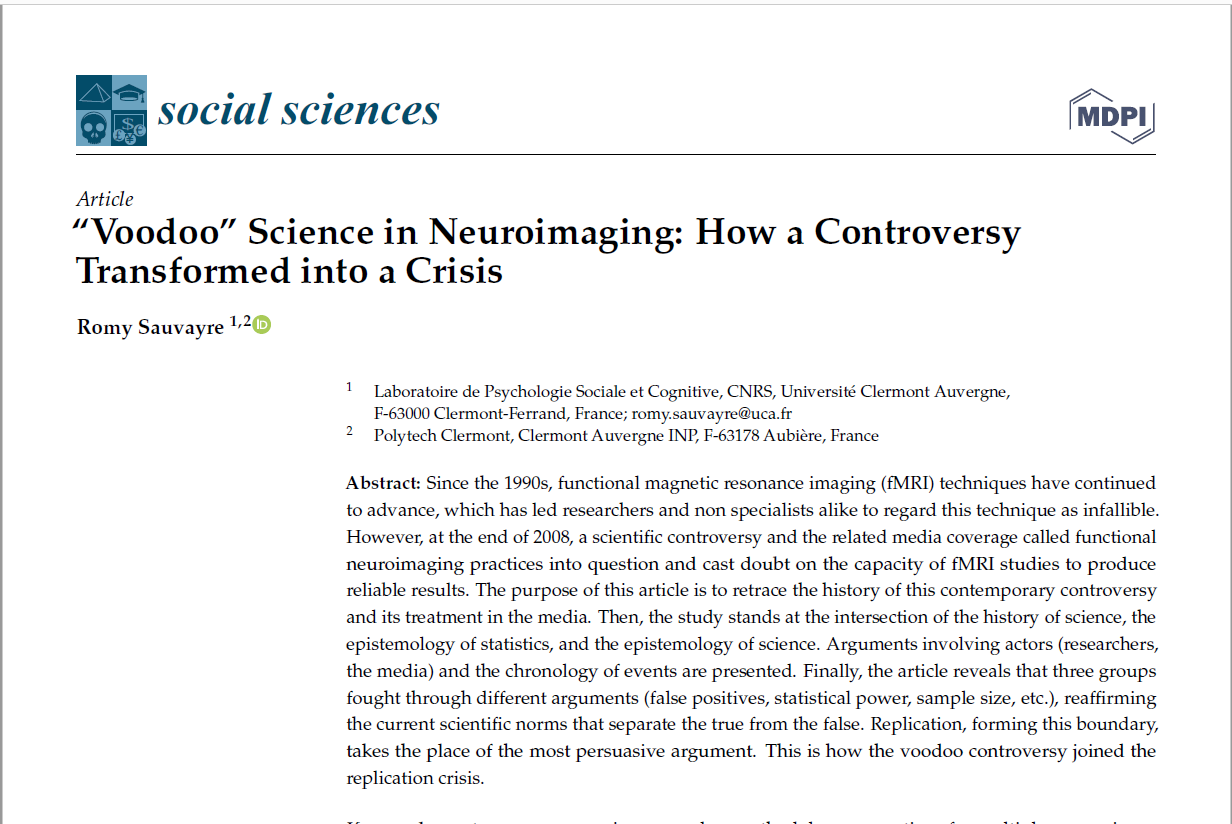
New paper provides a history of “voodoo science,” which discusses the controversy surrounding Vul et al.’s (2009) controversial article “Puzzlingly High Correlations in FMRI Studies of Emotion, Personality, and Social Cognition.”
Five quotes follow: 🧵👉
🔓 https://doi.org/10.3390/socsci12010015
#MetaScience
#Neuroscience
#Neuroimaging
#MetaResearch
#PsychMethods
#ReplicationCrisis
#PhilosophyOfScience
#PhilSci
#Fmri
#VoodooCorrelations
#UseNovelty
#MultipleTesting
Léo Varnet
boosted

There’s an absolutely astonishing story brewing in the medieval manuscripts world of a Potemkin Village scholarly institute built out of plagiarism and stock photos. I can scarcely do it justice except to link to Peter Kidd’s thorough deconstruction of #receptio #receptiogate
Part 1: https://mssprovenance.blogspot.com/2022/12/the-receptio-rossi-affair-part-i-staff.html
Part 2: https://mssprovenance.blogspot.com/2022/12/the-receptio-rossi-affair-part-ii.html
Part 3: https://mssprovenance.blogspot.com/2022/12/the-receptio-rossi-affair-iii-my.html
Part 4: https://mssprovenance.blogspot.com/2022/12/the-receptio-rossi-affair-iv-my.html
Part 5: https://mssprovenance.blogspot.com/2022/12/the-receptio-rossi-affair-part-v.html
Léo Varnet
boosted

Ce sera bientôt les 10 ans de la disparition du regretté Aaron Swartz, le 11 janvier 2013 à l'âge de 26 ans.
Trop peu connu des élèves, étudiants et professeurs, je me suis permis d'y recopier ci-dessous le clip réalisée par France Culture en 2020 qui constitue une excellente entrée pour découvrir sa vie, son œuvre et ses luttes qui demeurent ô combien d'actualité.
Le 11 janvier prochain, parlons d'Aaron Swartz tout autour de nous !
https://www.radiofrance.fr/franceculture/aaron-swartz-hacktiviste-des-savoirs-4602698
Léo Varnet
boosted
Au passage, ce petit exemple souligne le fait que la séparation entre les langues accentuelles (dont le français) et les langues à tons est plus subtile qu'on pourrait le penser de prime abord : en français aussi la mélodie sur laquelle on prononce une phrase peut en changer radicalement le sens. #psycholinguistique #linguistique
Au passage, ce petit exemple souligne le fait que la séparation entre les langues accentuelles (dont le français) et les langues à tons est plus subtile qu'on pourrait le penser de prime abord : en français aussi la mélodie sur laquelle on prononce une phrase peut en changer radicalement le sens. #psycholinguistique #linguistique
Effet de la prosodie sur la division d'une phrase en mots : petite démo #psycholinguistique #linguistique http://dbao.leo-varnet.fr/demo-cest-lamie-cest-la-mie/
Léo Varnet
boosted
A thread on ignorance in science.
It’s often claimed that science is about accumulating knowledge. But knowledge accumulation is only one side of the scientific coin. This thread contains 10 quotes from scientists, philosophers of science, sociologists, feminists, and statisticians who’ve highlighted the importance of *ignorance* in science, both as a precursor and a product. Enjoy!
#Science
#PhilosophyOfScience
#PhilSci
#SociologyofScience
#Statistics
#Feminism
#Knowledge
#Ignorance
1/11 🧵👉
Léo Varnet
boosted

A biological dispute with symbolic representation
"It seems astounding to me that the idea of correspondence between brain activity and ambient features has ever been taken seriously. To see a neuron as being responsible for a percept ... is straight vitalism or animism: It attributes to one component of a system all of the properties of a description..."
"...If a car undergoes a structural change because of bumping into a tree (the fender is twisted and the front tire scratched), we do not say that it remembers the accident by storing a memory, nor do we say that it learned from the event by changing its behavior via a representation of trees. These descriptions seem ludicrous because the car is so obviously a man-made artifact. Yet it seems that the same sort of mechanistic and operational description can be applied to highly plastic autonomous systems like the nervous system. Memory requires no record or storage, for it stands only for a history of structural coupling; learning requires no representation, for it stands for structural plasticity. Whatever the observer wants to see or needs to use in symbolic descriptions, such as storage, and representation as mapping, are not operational."
Francisco J. Varela
Principles of Biological Autonomy (1979)
#FranciscoJVarela #Memory #SymbolicRepresentation #biology #cognition #Cybernetics #philosophy @philosophy
P. 259






- Institution
- CNRS, ENS Paris
- Research topics
- Auditory perception, psycholinguistics, hearing loss.
CNRS researcher at École normale supérieure Paris. Auditory perception, psycholinguistics, hearing loss. My toots are searchable #tootfinder.
Joined Oct 2022
