


@niclas @lupyuen Well at least you got to use the load and store operations A LOT.
But yes I wouldn't have written nearly as much assembly if it had not been for my Amiga (and the demo scene).
At uni I also had the pleasure of generating code for a (if I recall correctly) MIPS...
3 operand math instructions are quite nice.
It also executed the next instruction after a branch instruction for "free", and who doesn't like free instructions?
It also had a quite ample supply of registers

@lupyuen I never saw a Z8000 in the wild, only in Zilog's datasheets, and that article provides some context as to why. There's the Captain Zilog comic at the Computer History Museum:
https://www.computerhistory.org/collections/catalog/102646293
@cstanhope I remember seeing a book on Z8000 a long time ago, similar to this...
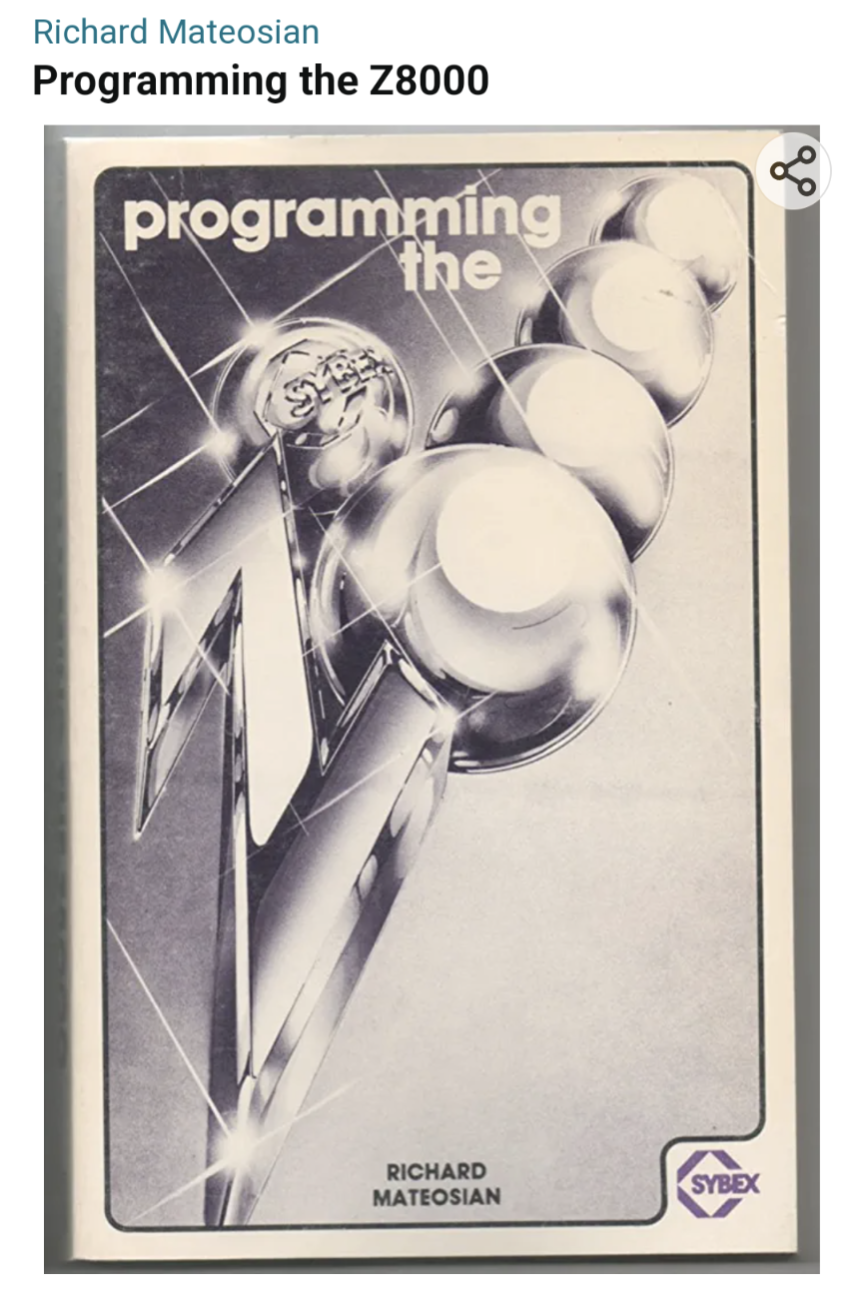

@lupyuen
Practically all applications that I wrote in those days were hampered by the 64kB segmentation crap. Very few programs would fit in the TINY (data+pgm < 64kB) and SMALL (data < 64kB, pgm < 64kB) memory models that the compilers offered. I made most in MEDIUM (pgm < 64kB), but a couple in LARGE.
It must have been one of the most costly decisions imposed on the programmers at the time.