

Martin Ruskov @mapto@social.cleverlibre.org
- Research
- https://www.zotero.org/mapto
- Games
- https://mapto.itch.io
- Account in Bulgarian
- https://masto.bg/@mapto
Studying how people interact, in the past (#CulturalAnalytics) and today (#EdTech #Crowdsourcing). Researcher at @IslabUnimi, University of Milan. Bulgarian activist for legal reform with @pravosadiezv. I use dedicated accounts for different languages.
My profile is searchable with https://www.tootfinder.ch/
Joined Nov 2022
@Daojoan hello, I really appreciated that you eventually found the time and I'm sure it would have demanded quite some more time then initially might appear. It's something that happens to me quite often. Thank you for the very encouraging feedback. It means a lot to my coauthor and me.
Martin Ruskov
boosted

Is ChatGPT the ultimate solution for modeling word meaning and semantic change? Check out our paper: https://arxiv.org/abs/2401.14040 . We show that: when used as an 𝘰𝘧𝘧-𝘵𝘩𝘦-𝘴𝘩𝘦𝘭𝘧 model, with a 𝘳𝘦𝘢𝘴𝘰𝘯𝘢𝘣𝘭𝘦 prompt from a human perspective, the 𝘤𝘶𝘳𝘳𝘦𝘯𝘵 (Chat)GPT model 🦇 doesn't outperform pre-trained BERT in capturing 𝒔𝒆𝒎𝒂𝒏𝒕𝒊𝒄 𝒄𝒉𝒂𝒏𝒈𝒆. #ChatGPT #BERT #SemanticChange #GPT
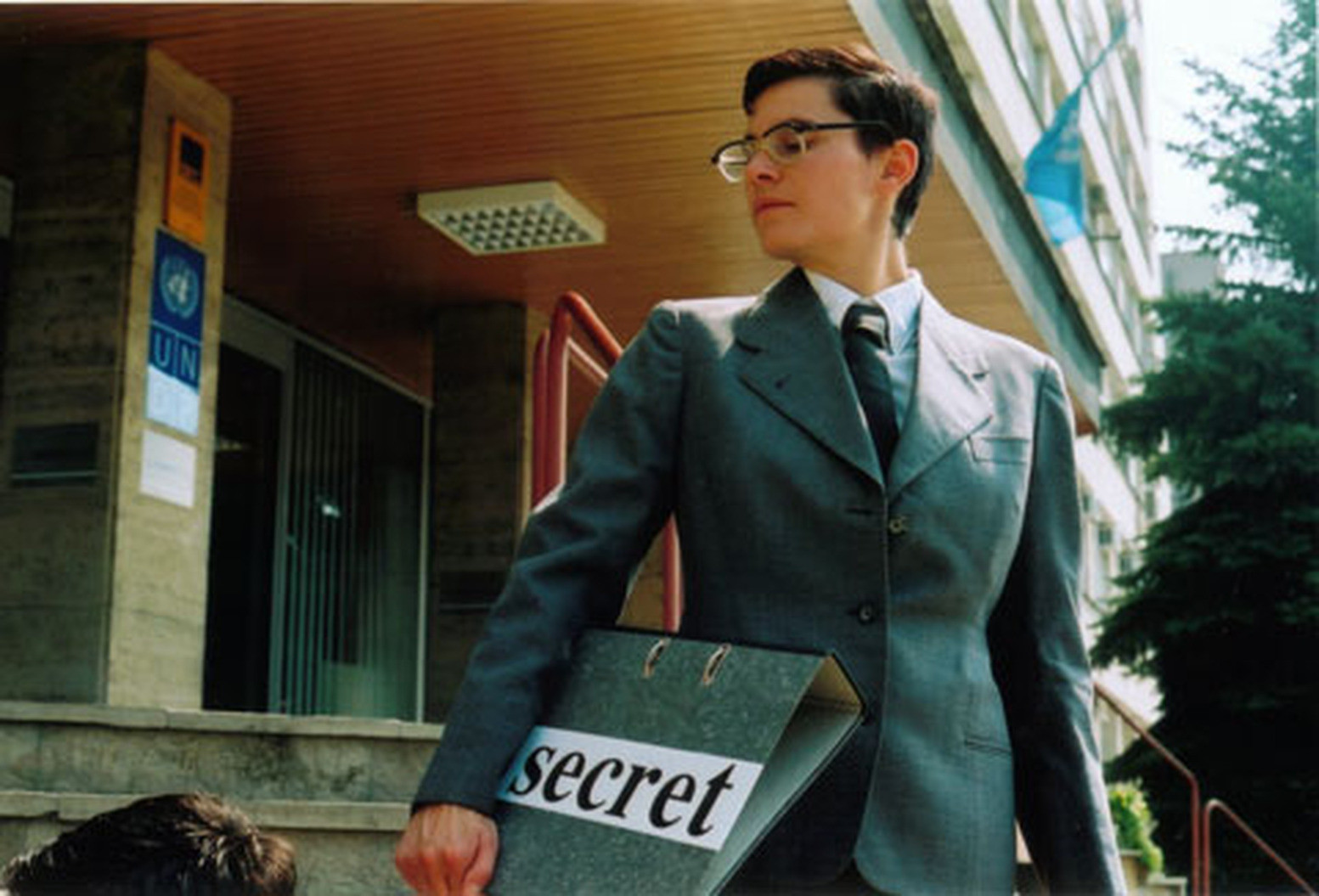
@bontchev I guess what you mean is well illustrated by this original image from the movie (the partly covered UNDP logo behind is probably my favourite).
Anyway, they certainly explored a very interesting feminist perspective and managed to sell it through Dark Avenger. I'd say it's very well done. Yes, close to nothing about security, but no void claims are made in the synopsis on their website, so it's fine by me.
A 20-years old documentary about the strange combination of #communism, #feminism, #piracy and #viruses, probably in the reverse order. The movie is multilingual (Bulgarian, German, English), with German subtitles. It is supposedly about #DarkAvenger, but actually about #Pravetz, or who knows what. Features @bontchev among other Bulgarian historical features.

@yuliyan попадал ли си на "Copy me - I want to travel" немски документален филм, излъчен навремето по ARTE? Доста интересна смесица от Dark Avenger...
Martin Ruskov
boosted
Със закъснение и огромна тъга научавам, че през март миналата година е починал проф. Драгомир Радев, един от пионерите в съвременната компютърна лингвистика и един от най-известните български учени в чужбина. Драго, когото познавах слабо, но на когото се възхищавам много, има огромни постижения, за които говорят множеството му публикации и поменът, написан от университета Йеил https://yaledailynews.com/blog/2023/04/04/dragomir-radev-computer-science-professor-and-ai-expert-dies-at-54/
1/3
Martin Ruskov
boosted

Voting is closing soon!
Remember to vote for your favourite proposals to make sure they make it into our schedule!
Head to: http://pycon.it/voting-info
@VoxDei @IslabUnimi That's a very good point. Makes me think: if we want to talk about values, it's inevitably with a positive spin. But could negative experiences also lead to a position towards values?
Martin Ruskov
boosted

An Empirical Investigation into How Users Make Email Response Decisions
Abstract: Despite technical and non-technical countermeasures, humans continue to be tricked by phishing emails. How users make email response decisions is a missing piece in the puzzle to identifying why people still fall for phishing emails. We conducted an empirical study using a think-aloud method to investigate how people make 'response decisions' while reading emails. The grounded theory analysis of the in-depth qualitative data has enabled us to identify different elements of email users' decision-making that influence their email response decisions. Furthermore, we developed a theoretical model that explains how people could be driven to respond to emails based on the identified elements of users' email decision-making processes and the relationships uncovered from the data. The findings provide deeper insights into phishing email susceptibility due to people's email response decision-making behavior. We also discuss the implications of our findings for designers and researchers working in anti-phishing training, education, and awareness interventions

"Why People Still Fall for Phishing Emails: An Empirical Investigation into How Users Make Email Response Decisions" (PDF): https://arxiv.org/pdf/2...
Dear @QOTO , I'm an academic and as such I try to stay on the watch about what other academics are doing. I am generally convinced that qoto.org is an outstanding platform to do that.
Recently, I've had 3 instances of not being able to follow people on scholar.social which makes me think there's been some sort of defederation between the two instances.
Having quickly examined the local feeds of the two instances, I can imagine that there are some cultural differences between the way these instances are administered. However, from some accounts I am aware of on both instances, I believe both have positive and well intended communities.
I wonder whether there's anything I, as a user, could do to help resolve any possible issues with defederation? In general, what are the organisational mechanisms behind such collective processes? What are the possibilities for mitigation, mediation or whatever?
And last, but not least, is there a mechanism to verify my assumption that this is an issue about defederation?
@Sustainable2050 wouldn't it make sense to judge good from bad not based on rate of growth in the context of the past, but on rate of closing the gap in the context of (future) need. I realise this is more difficult and probably meaningful only after a certain threshold, but it appears to me that we are overdue with this threshold
@eugenia_diegoli @Rainer_Rehak @linguistics how about "I appreciate your help, and I see how I can return the favour " - my blind guess of course
@eugenia_diegoli @academicchatter as painful as the process is, remembering that once the article is out it will always be accessible with my name on it, helps me keep my motivation to go through all the necessary rounds
@mmin @upol just like in rapid prototyping, I view short papers as probing for potential research directions. Being able to fuse the ideas of two short papers already opens up a potential mid-term research direction. Yet, I often underestimate the fact that a direction is not an agenda, but a prerequisite for it.
@aka_quant_noir @davidho could you please elaborate on how exactly any of us is doing this?
Martin Ruskov
boosted

@davidho wouldn't it make sense to work towards making carbon credits functional? Just as an example, despite long-term insecurity, responsibly planting and protecting trees is undoubtedly beneficial, not only in terms of carbon credits.
@BenjaminHCCarr as seen in many contexts like transportation, housing and raw materials, the more impactful and challenging goal is not shifting production, but increasing the efficiency of energy consumption
@natematias @datasociety @williamrfrey from the described it appears this is an extraordinary case of one community reaching out in an uncoordinated way to help another community. Certainly worth investigating tactics and strategies to align such energy. Sounds like an exceptional opportunity for awareness development and campaigning for interventions that are desirable.
One question: would you consider that the algorithms have anything beyond a catalyst effect in these events?



- Research
- https://www.zotero.org/mapto
- Games
- https://mapto.itch.io
- Account in Bulgarian
- https://masto.bg/@mapto
Studying how people interact, in the past (#CulturalAnalytics) and today (#EdTech #Crowdsourcing). Researcher at @IslabUnimi, University of Milan. Bulgarian activist for legal reform with @pravosadiezv. I use dedicated accounts for different languages.
My profile is searchable with https://www.tootfinder.ch/
Joined Nov 2022
