

Martin Vinck @martin_a_vinck@social.cleverlibre.org
PI at #ESI with Max Planck Society, Frankfurt | Professor at #Donders Institute, Nijmegen | Systems and Computational #Neuroscience
www.martinvinck.com
Joined Nov 2022
Martin Vinck
boosted

Gude, hallo & hello! The Ernst Strüngmann Institute (ESI) for #Neuroscience #Frankfurt just joined the platform #neuhier 👋 🐘 It is our mission to perform excellent fundamental #brainresearch. Join us on our journey to find out how the many parts of the #brain work together to bring about our #behaviour 🔬 🧠
Martin Vinck
boosted

Cool new paper from Zador Lab:
Martin Vinck
boosted

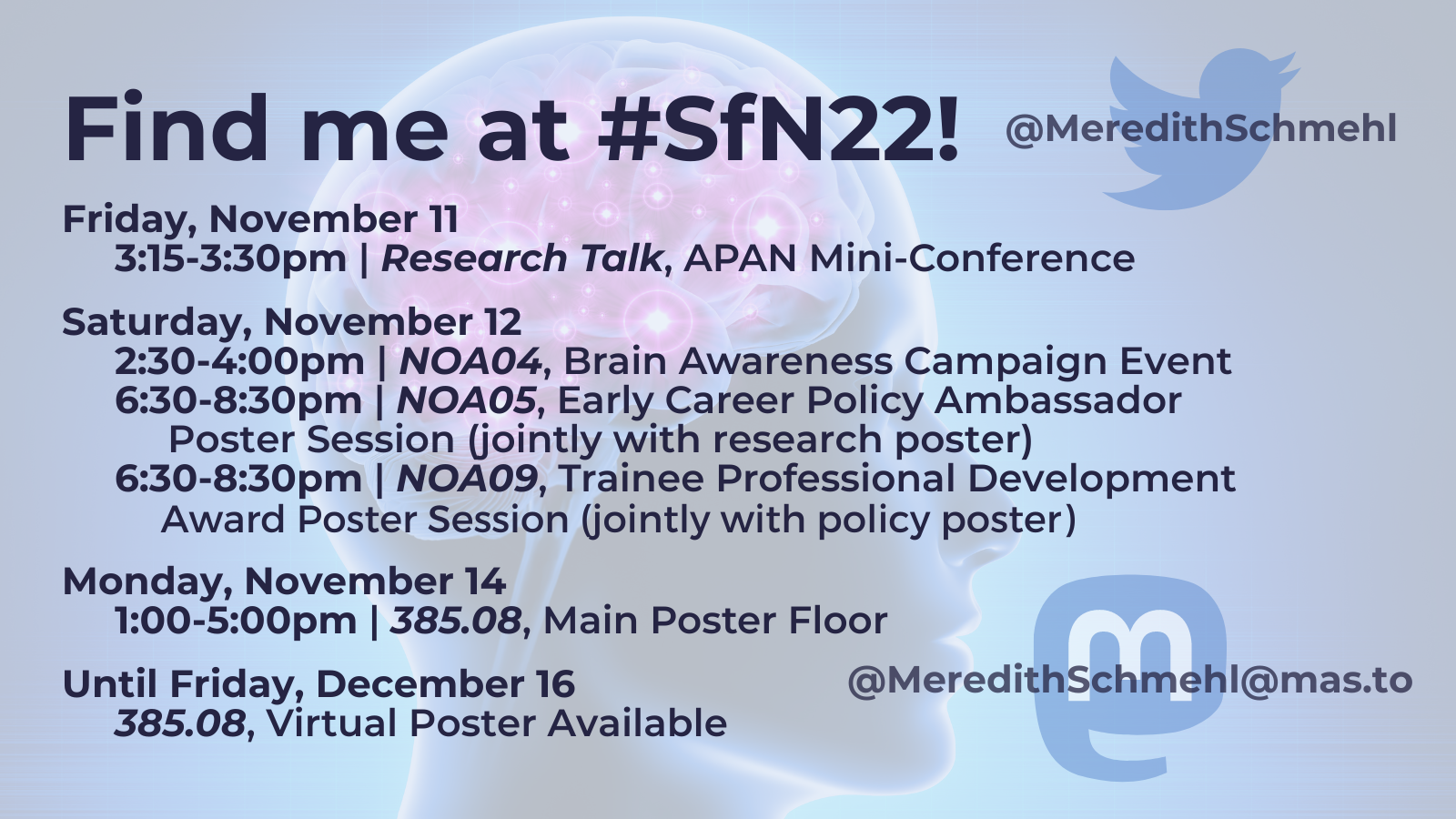
Spent my day preparing for my 6 (!) presentations at #SfN22! Come visit me and say hello if you're also attending!
#SfN2022 #Neuroscience #NeuroscienceMigration #NeuroscienceMastodon #NeuroMigration #NeuroMastodon #TwitterMigration #TwitterExodus #NeuroTwitter #NeuroscienceTwitter #ScienceMastodon #ScienceTwitter
Martin Vinck
boosted

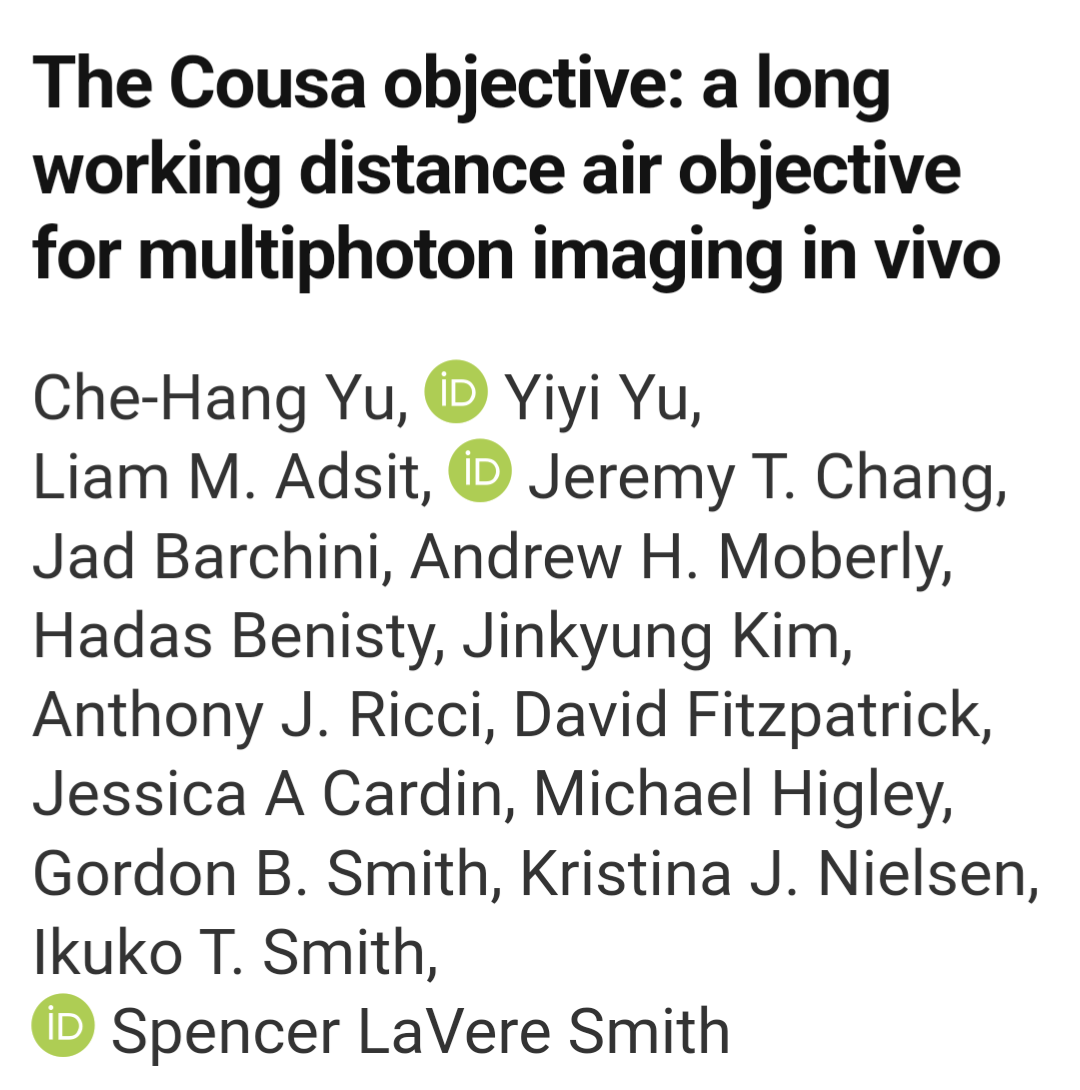
This seems like a step improvement in 2-photon microscopy
https://www.biorxiv.org/content/10.1101/2022.11.06.515343v1
Spencer has a nice thread on it on Twitter (I don't think he's on Mastodon yet?): https://mobile.twitter.com/Labrigger/status/1589471340356333568
About 25 years ago, Crick and Koch wrote a very thought-provoking paper,
https://www.nature.com/articles/34584
It tries to answer the question, why do feedforward (FF) and feedback (FB) projections have such different properties in terms of terminating in different cortical layers and physiological impact — something that's ignored in many recurrent network models of cortex.
i.o.w.: Why do higher areas talk so differently to lower areas than lower areas talk to higher areas?
@csdashm very cool work - if I would start my career again it would be in EM 4sure
Martin Vinck
boosted

Time for an #introduction. Nervous systems — yours, mine, those of mice, fish, and insects and worms — are made up of populations of different kinds of neurons that communicate with one another. Current electron microscopy generates millimeter-scale volumes with the morphology and synaptic connectivity of up to 10^5 neurons. As a scientist at the Allen Institute, I am mapping out the cell types and connectivity rules found in cortex and building computational tools to help others do the same.
Martin Vinck
boosted

@martin_a_vinck @NeuroVenki Definitely... And that's understandable for those who made a lot of effort to build a large flock of followers.
Martin Vinck
boosted

Well let’s do another round of #introduction then! Hi, I’m a Prof at the Centre for Cognitive Neuroimaging (CCNi), UofG, Scotland, studying human memory. My lab uses a range of tools, including behaviour, EEG/MEG, fMRI and intracranial (single unit + LFP) EEG recordings, trying to understand how the human brain reconstructs past experiences from memory, how it forgets, and how our memories change over time and when we repeatedly remember something.
@neuroecology not without LSD, no
Martin Vinck
boosted

i'm adam
I used to study the neuroscience of animal behavior in academia
https://scholar.google.com/citations?user=tN1MHQ8AAAAJ&hl=en
now I work on building a neural interface at Meta Reality Labs
https://www.youtube.com/watch?v=Kx_nVrEKwTE
I've also been accused of studying punctuation
https://medium.com/@neuroecology/punctuation-in-novels-8f316d542ec4
@markgbaxter I think this is probably because the most visible PIs that are doing the bOoOoOing - with the most followers - are probably not doing any of the things you have listed here anymore.
Martin Vinck
boosted

Neuroscientists
- literally do brain surgery
- perform complex analyses of high-dimensional neurophysiology data
- code in MedState notation
- get mice to bury marbles
- bOoOoO mAStOdOn iS sO hARd
Martin Vinck
boosted

Cross-posted tweet
This looks great!
#moa
---
RT @martin_a_vinck
Excited to share our new preprint w. Giorgos Spyropoulos, @Mars_Schneider, Thiele Lab. We contrast — in 🐭& 🐵 — the physiological relevance and mechanisms underlying two effects of attention: 1. enhanced inter-areal coherence & 2. firing rates🧵👇1/15
https://www.biorxiv.org/content/10.1101/2022.11.04.515185v1
https://twitter.com/martin_a_vinck/status/1589234246958579713
@NeuroVenki @RaphaelGrandin
😀 I think it's rather, $E = \exp(-aN)$...that gives us some nice bound on enthusiasm in $[0,1]$ and there must be some exponential law here, $a \approx 10^-4$. That seems about right, I still see some enthusiasm with people having 10^4 followers.
Martin Vinck
boosted
Proposed model: {number of followers on Tw1tter} = 1 / {enthusiasm for #Mastodon}.
Martin Vinck
boosted

I am researcher working at the interface of artificial intelligence and neuroscience. I really wear two hats.
🎩 I work at Meta Reality Labs, thinking about neuromotor neural interfaces.
🤠 I am also an adjunct professor at Stanford, where I think about neural dynamics and how they give rise to computation and behavior.




PI at #ESI with Max Planck Society, Frankfurt | Professor at #Donders Institute, Nijmegen | Systems and Computational #Neuroscience
www.martinvinck.com
Joined Nov 2022
