
A kid was recently shot and killed by a 'homeowner' in DC.
The rightwing Supreme Court helped do this. The Fed Soc has blood on their hands.
DC tried to ban guns. But the FedSoc judges—Scalia, Roberts, Clarence Thomas—overturned DC's gun ban in Heller v. DC.
FedSoc judges are chosen because they are willing to flood our streets with guns (for votes and to help billionaires.) But here if as alleged, it’s even worse: Scalia and Thomas allowed this killer to have that gun.

 🇳🇱
🇳🇱
@protecttruth I am no fan of the right in general.. but we already know well from past bans on guns in america that it has had the unfortunate result of increasing homicides.. Not banning guns is the reason more people arent murdered.
Yes there is a problem that needs to be addressed with crime and homicies.. banning guns has never been shown to be the solution however, and only results in more deaths. Lets look for real, science-based solutions.
@freemo No.
Fewer guns means fewer gun homicides.
Here's a paper that shows that. This is science showing fewer guns means fewer homicides and fewer deaths.
Ban handguns and weapons of war. Like Canada does.
https://www.nber.org/digest/feb01/fewer-guns-mean-fewer-gun-homicides
@protecttruth Thats like saying "fewer vaccines means fewer vaccine death", while technically true its also very poor logic. Sadly no, banning guns generally means more homicides overall.
Also who said anything about Canada. Sadly the body of the american data on this clearly disagrees with the assesment.
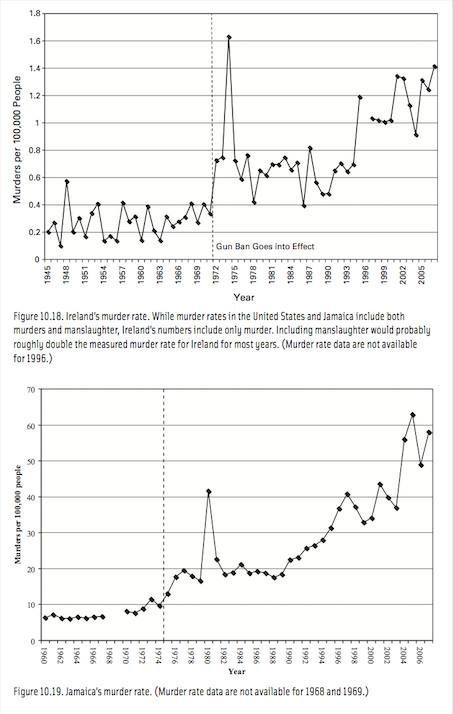
Here is an image of ther effects of one such gun ban within Jamaica.. sad to say this isnt na isolated pattern. If you really want to get into the nitty gritty I can show a dozen or two similar charts across many countries. The pattern is quite obvious sadly.


@freemo @protecttruth
My other question would be that economists often use "natural experiments" comparing similar states in the USA with different laws and seeing how things evolve.
Do you have data on that? I am curious. I have been following Daniel Webster at Hopkins' work and he seems to draw different conclusions than you.
My understanding, I am not an economist, is that they look for states with similar trends and social make up until the law implementation. Then they see how the trends progress in the two states after the change.
That seems to me to make sense.
As long as they are comparing a state against itself both pre-law change and post, and they do that analysis correctly, then yes that would be fine science.

@rrb
thats just bad science.. To get accurate date you must monitor the same state before and after a law change.. comparing similar states results in us statisticians doing our best to guess at what "similar" even means and even if can define all the datapoints you the states will be far from identical and simply not the way we do this sort of science.. again, the only way you can truly show causation is with stuff like granger causality.
@protecttruth