
A kid was recently shot and killed by a 'homeowner' in DC.
The rightwing Supreme Court helped do this. The Fed Soc has blood on their hands.
DC tried to ban guns. But the FedSoc judges—Scalia, Roberts, Clarence Thomas—overturned DC's gun ban in Heller v. DC.
FedSoc judges are chosen because they are willing to flood our streets with guns (for votes and to help billionaires.) But here if as alleged, it’s even worse: Scalia and Thomas allowed this killer to have that gun.

 🇳🇱
🇳🇱
@protecttruth I am no fan of the right in general.. but we already know well from past bans on guns in america that it has had the unfortunate result of increasing homicides.. Not banning guns is the reason more people arent murdered.
Yes there is a problem that needs to be addressed with crime and homicies.. banning guns has never been shown to be the solution however, and only results in more deaths. Lets look for real, science-based solutions.
@freemo No.
Fewer guns means fewer gun homicides.
Here's a paper that shows that. This is science showing fewer guns means fewer homicides and fewer deaths.
Ban handguns and weapons of war. Like Canada does.
https://www.nber.org/digest/feb01/fewer-guns-mean-fewer-gun-homicides


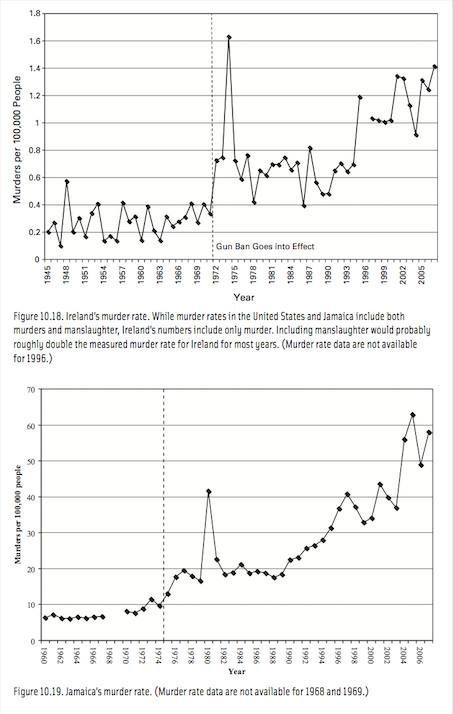
@freemo @protecttruth
So, if I get the causality model correct, it seems that if 2 time series are correlated you assume that the one time series that started earlier is a good predictor of the second. This makes a lot of sense. I would worry about using that for social science, though, since you will have limited independent samples and you can have multiple other factors.
For example, the 2 examples you provide is Northern Ireland during the "troubles" and I would suspect that the deadly violence may have been more influenced by "Bloody Sunday" than a dun control bill.
Similarly, the Jamaica data you present is tied to a period of increased drug dealing and gang violence.
But, this is always a problem with social science as a whole. I think it forces analysts to be "creative" which can lead to cherry picking data.

@rrb
In social sciences there is no perfect analysis. But this is still superior to simple corelation in this case. That said there are more advanced techniques that are arguably even better. But those are hard to explain to people.
@protecttruth