

Phil Landmeier @shuttersparks@social.cleverlibre.org
- Website
- https://shuttersparks.net
So. Cal. engineer (hardware/software, retired, he/him), born at 313 ppm, musician, chef, now living in West Virginia. KW2P ham radio (the original social network), father of three, grandfather, astronomy, solar dynamics, photography, writing, birding, birdwatching, eBird, fountain pens, cats and dog, reader of banned books, Chairman of the Charcuterie Board, Whisk Manager, Compuserve refugee, founder of The Church of The Unwarranted Assumption. Crypto is short for cryptography. Blog: shuttersparks.net
#HamRadio
#Morse
#MorseCode
#Birding
#BirdWatching
#eBird
#wv
#WestVirginia
#food
#cooking
#astronomy
#physics
#engineering
#photography
#FountainPens
"To hold a pen is to be at war." --Voltaire
Joined Nov 2022
Phil Landmeier
boosted

This is America😤😤😤😤
Denver council member dragged himself onto stage before a political debate due to a lack of wheelchair accessibility - CNN https://apple.news/ArQjXZUV1QYy6n4oZYcT9zQ
@kitchen Love the photo but where is "this place"? ;-)
Phil Landmeier
boosted

@tomcuchta Oh, one more thing I'll say. The big secret is that Morse is a LOT of fun once you get the hang of it. This is not obvious because it's hard to learn, just like learning to play musical instrument. Very steep learning curve and learning is very hard and not fun.
But there'a huge reward waiting for you if you persist, get on the air, and work 500 or more contacts. It becomes fun, effortless, addictive. Morse will become as easy to copy as speech. But until you get there, it seems like the worst brain-busting nightmare you've ever encountered. So just be aware of that.
@maxkennerly And, of course, NS is going to appeal to the government to help bail them out when the lawsuits come.
@TheOldGuy@newsie.social Good. I sure would if I were them. I mean, there are various ways I can look at this. Yes, those guys should have known better and not gotten anywhere near this stupid nonsense.
On the other hand, I can argue that if the President of the United States encourages you to do something then you may want to seriously consider doing it. That's a valid argument.
Bottom line is that if Trump hadn't encouraged it, Jan 6th would never have happened. And so, the finger points to him first, the Proud Boys second.
@fatsam The steepening of the curve is obvious to old geezers like me. Look at where medical science was in 1990 versus today. Hah! We were wondering how we might sequence the human genome. If we line up hundreds of machines and also build a supercomputer to crunch the data, and let it run for six months we might be able to sequence most of one genome. Maybe. In a few years. We hope.
In the early 90s I was designing some specialized hardware for number crunching and working with the latest chips from TI that could churn through 40 million floating point operations per second, whoo hoo, phenomenal, and they consumed a lot of power. But it was basically a Cray I on a chip. Stunning.
The machine I'm typing on right now is nothing special and it's 325 times faster on floating point calculations than one of those amazing chips from TI. Wat?
The curve is breathtaking and accelerating.
Phil Landmeier
boosted

You know what’s amazing? When a new Mastodon user with no followers says hello into the void and gets several welcoming replies. Try doing that on Twitter.
@EmmaKelley Hahaha. Yeah, that's never worked on Twitter.
@tomcuchta The key (no pun intended) is regular practice. Five or ten minutes a day but every day.
Get on the air as soon as you can. That's the fastest way to improve. Even if you can only go at 3 words per minute, get on the air. Don't be embarrassed, just get over it.
A big help for this is SKCC. We have 27,000 members and virtually all of them will slow down as slow as you need to go. I've had the privilege of being the first ever CW QSO for several people. It's also very easy to set up skeds in real time. There's a real-time message board for doing just that.
Check it out. You won't be sorry: https://www.skccgroup.com/
@tomcuchta Yeah, the hills here are problematic. VHF and UHF work was good in California. Here I don't bother with it and focus on HF CW.
@thomasfuchs @mekkaokereke Agreed. That's what it was. Ham radio people like me have been doing this for many years. The balloons are small and equipped with a radio beacon. Some of them circle the planet several times before wearing out.
@DroidEngineer @malwaretech Yes, this is poor people in West Virginia.
Phil Landmeier
boosted

@malwaretech
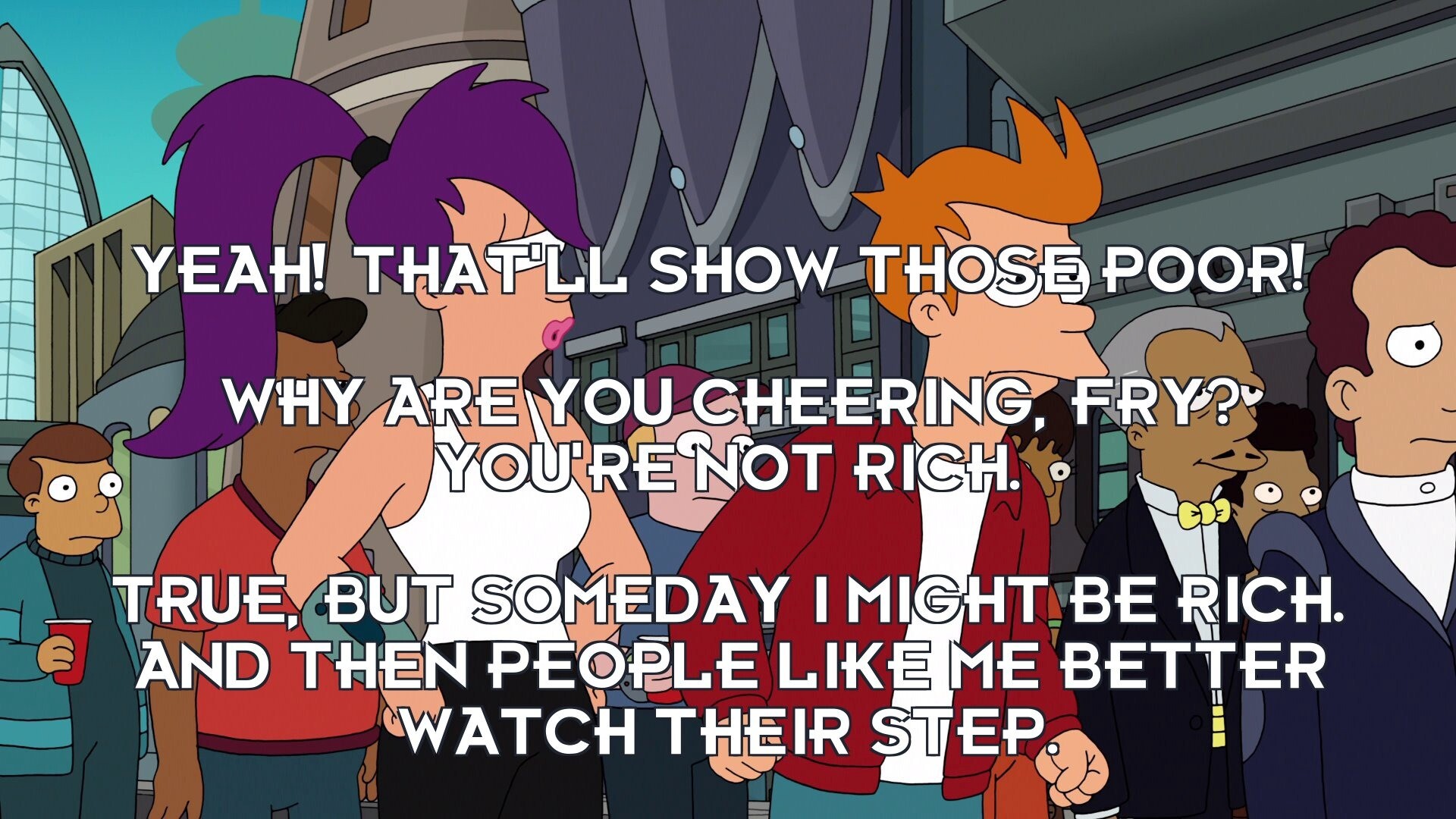
This is how I see those billionaire stans.
Fry: Yeah! That'll show those poor!
Leela: Why are you cheering, fry? You're not rich.
Fry: True, but someday I might be rich and then people like me better watch their step
Phil Landmeier
boosted

Award-winning NASA mathematician and computer programmer Melba Mouton is being honored with the naming of a mountain at the Moon’s South Pole. Mouton joined NASA in 1959, just a year after the space agency was established. She was the leader of a team that coded computer programs to calculate spacecraft trajectories and locations. Her contributions were instrumental to landing the first humans on the Moon.
She also led the group of "human computers," who tracked the Echo satellites. (tumblr)
Phil Landmeier
boosted

The robots aren't taking over. They're not falling in love. They're not feeling. They don't want to be alive. They're not evil masterminds. They create word patterns based off text on the internet. Is what journalists should be saying, not gee-whiz sci-fi LARPing about fancy autocorrect.
Phil Landmeier
boosted


@ai6yr Hah! I read the Russian first and thought "sportsmen"? That can't be right. (I don't speak Russian. Wish I did. But I learned to read it phonetically a little long ago.)
@tomcuchta Oh yeah. QRP works fine.
Antenna efficiency always matters but QRP makes you more *aware* of efficiency. This is good.
The thing is that efficiency works both ways, sending and receiving. It's always important regardless of your transmit power level because if you can't hear 'em you can't work 'em. Legal limit power doesn't help you hear any better!
If you look at a monster contesting setup like Frank's (W3LPL) you'll see 200 and 300 foot towers, each with stacked monobanders. Whoo hoo! The first thought is wow, legal limit into that and I'm gonna BE LOUD.
Yes, you will be. But the secret is that those high-gain antennas and hardline feeds that cost a fortune, everything possible done to maximize efficiency is not about being loud. It's to enable you to hear stations that others cannot. That's what wins contests. LPL can hear those rare multipliers, barefoot stations in tiny countries halfway around the world that you cannot hear at all.
Antenna gain and efficiency of your antenna system are king, more important than anything else.
@tomcuchta To bring the radiation pattern down closer to the horizon, horizontally polarized antennas want to be about 1/2 wave up. So 20 meter wavelength, half is 10 meters or about 30 feet. It's not critical.
With makeshift setups you usually can't get perfection. Just get as much of that antenna as high off the ground as possible, especially the highest current portion, which for a dipole is usually the center, the feedpoint where the coax connects.
You can do a good job with a single support by setting the dipole up as an inverted-vee. If you have a 30 foot support like a squid pole or painter's pole get the feedpoint up at the top of the pole and let the two ends angle down towards the ground.
The far ends of a dipole are the low current, high impedance part, which radiates little. Being close to the ground doesn't hurt much. Most of the radiation somes from the center of a dipole which is up nice and high at the top of the pole.
- Website
- https://shuttersparks.net
So. Cal. engineer (hardware/software, retired, he/him), born at 313 ppm, musician, chef, now living in West Virginia. KW2P ham radio (the original social network), father of three, grandfather, astronomy, solar dynamics, photography, writing, birding, birdwatching, eBird, fountain pens, cats and dog, reader of banned books, Chairman of the Charcuterie Board, Whisk Manager, Compuserve refugee, founder of The Church of The Unwarranted Assumption. Crypto is short for cryptography. Blog: shuttersparks.net
#HamRadio
#Morse
#MorseCode
#Birding
#BirdWatching
#eBird
#wv
#WestVirginia
#food
#cooking
#astronomy
#physics
#engineering
#photography
#FountainPens
"To hold a pen is to be at war." --Voltaire
Joined Nov 2022
