

Greg Spradlin @spradlig@social.cleverlibre.org
Math guy, computing wannabe, classical music lover, politico. Same handle on Instagram.
Joined Nov 2022
@WaxRatchet @emptywheel
😂 Reality: Xitter ad revenue and reputation are waaaay down.
Greg Spradlin
boosted

What a great evening to have a good #USPolitics list!
Some good follows: @emptywheel, @Teri_Kanefield, @wendysiegelman, @GottaLaff, @pbump, @dangillmor, @taylorlorenz, @w7voa, @chrisgeidner, @heidilifeldman, @rbreich, @lawfare, @maxkennerly, @uspolitics, @ProPublica, @icymi_law
Here is a webpage of a decent list of active #news, #journalist and #analyst accounts: https://docs.google.com/spreadsheets/d/e/2PACX-1vTycDCTRZtH1Biv3KA43L9k1qeuDLdd0Y6Cr81tNziUkJUnyaRKQEKZ8UZ3N-zvjdiH_zTpwm76eXdT/pubhtml?gid=0&single=true
You can follow the entire list by downloading this .csv file and importing it: https://docs.google.com/spreadsheets/d/e/2PACX-1vTycDCTRZtH1Biv3KA43L9k1qeuDLdd0Y6Cr81tNziUkJUnyaRKQEKZ8UZ3N-zvjdiH_zTpwm76eXdT/pub?gid=0&single=true&output=csv
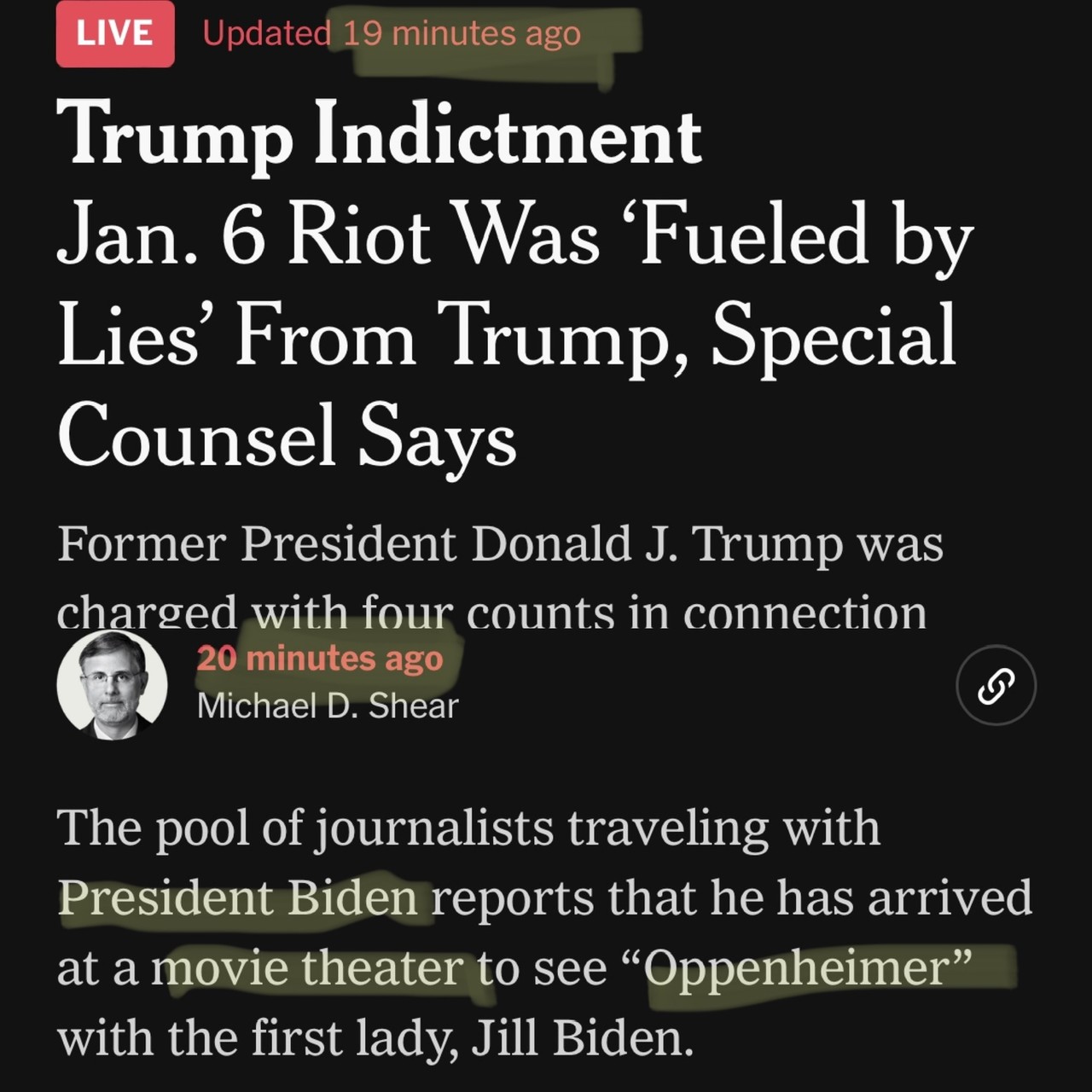
Why do such baseless smears and speculations belong in print?
Greg Spradlin
boosted

Once, Twice, Three Times an Indictee
Legal Commodore Jack Smith thinks convicting Trump will be easy like Sunday morning, but the Donald’s document snatch is more Guy Richie than Lionel Richie.
by Maureen Dowd
It’s the economy, Stupid Washington Post.
Greg Spradlin
boosted

Microsoft just released a demo of BigGPT-Large, which they define as "a domain-specific generative model pre-trained on large-scale biomedical literature, has achieved human parity, outperformed other general and scientific LLMs, and could empower biologists in various scenarios of scientific discovery."
Here's the response to the first question that I asked: @ct_bergstrom @emilymbender
They can say this as often as they want by renaming the service over and over again.
Sorry, I meant what does *he* mean, since E**n wrote it. But LY did retweet it.
I’ve read that there’s a tradition of appointing women to lead failing companies and then blaming them when things go south.
I suspect she’ll get a nice golden parachute if/when she gets fired.
Greg Spradlin
boosted

The Right to Lie: Google's "Web Environment Integrity" Proposal is a Geyser of Badness Threatening to Swamp the Open Web.
If your computer can’t lie to other computers, then it’s not yours.
This is a fundamental principle of free and open source software. The World Wide Web abides by this principle, although we don’t often think of it that way. The Web is just an agreed-on set of programmatic interfaces: if you send me this, I’ll send you that. Your computer can construct the “this” by whatever means it wants; it’s none of the other side’s business, because your computer is not their computer.
Google’s so-called “Web Environment Integrity” plan would destroy this independence. “Integrity” is exactly the wrong word for it — a better name would be the “Browser Environment Control” plan.
In the normal world, you show up at the store with a five dollar bill, pick up a newspaper, and the store sells you the newspaper (and maybe some change) in exchange for the bill. In Google’s proposed world, five dollar bills aren’t fungible anymore: the store can ask you about the provenance of that bill, and if they don’t like the answer, they don’t sell you the newspaper. No, they’re not worried about the bill being fake or counterfeit or anything like that. It’s a real five dollar bill, they agree, but you can’t prove that you got it from the right bank. Please feel free to come back with the right sort of five dollar bill.
This is not the Open Web that made what’s best about the Internet accessible to the whole world. On that Web, if you send a valid request with the right data, you get a valid response. How you produced the request is your business and your business alone. That’s what software freedom is all about: you decide how your machinery works, just as other people decide how their machinery works. If your machine and their machine want to talk to each other, they just need an agreed-on language (in the case of the Web, that’s HTTP) in which to do so.
Google’s plan, though, steps behind this standard language to demand something no free and open source software can ever deliver: a magical guarantee that the user has not privately configured their own computer in any way that Google disapproves of.
The effrontery is shocking, to those with enough technical background to understand what is being proposed. It’s as though Google were demanding that when you’re talking to them you must somehow guarantee, in a provable way, that you’re not also thinking impure thoughts.
How could anyone ever agree to this nonsense? Must all our computers become North Korea?
The details of your own system’s configuration are irrelevant to — and unnecessary to accurately represent in — your communications with a server, just as your private thoughts are not required to be included, in some side-band channel, along with everything you say in regular language.
If a web site wants to require that you have a username and password, that’s fine. Those are just a standard part of the HTTP request your browser sends. But if a web site wants your browser to promise that it stores that username and password locally in a file named “google-seekritz.txt”, that’s not only weird and creepy, it’s also something that a free software (as in libre) browser can never reliably attest to. Any browser maintenance team worth its salt will just ship the browser with a default configuration in which the software reports that to Google when asked while, behind the scenes, storing usernames and passwords however it damn well pleases.
Indeed, the fundamental issue here is the freedom to have a “behind the scenes” at all. Environments in which people aren’t allowed to have a “behind the scenes” are totalitarian environments. That’s not an exaggeration; it’s simply the definition of the term. Whatever bad connotations the concept of totalitarianism may have for you, they come not from the fancy-sounding multi-syllabic word but from the actual, human-level badness of the scenario itself. That scenario is what Google is asking for.
My web browser (currently Mozilla Firefox running on Debian GNU/Linux, thank you very much) will never cooperate with this bizarre and misguided proposal. And along with the rest of the free software community, I will continue working to ensure we all live in a world where your web browser doesn’t have to either.
(Cross-posted at https://rants.org/2023/07/the-right-to-lie-and-google-wei/ .)
@WaxRatchet @emptywheel Does she mean *for* 2023? What is exactly is a “monthly user”? How many of them are real people?
That tweet is useless by itself.
@ChemicalEyeGuy @emptywheel Dammit I just made almost the same comment 😂
How do you pronounce “Xitter”? I can suggest a way.
Greg Spradlin
boosted

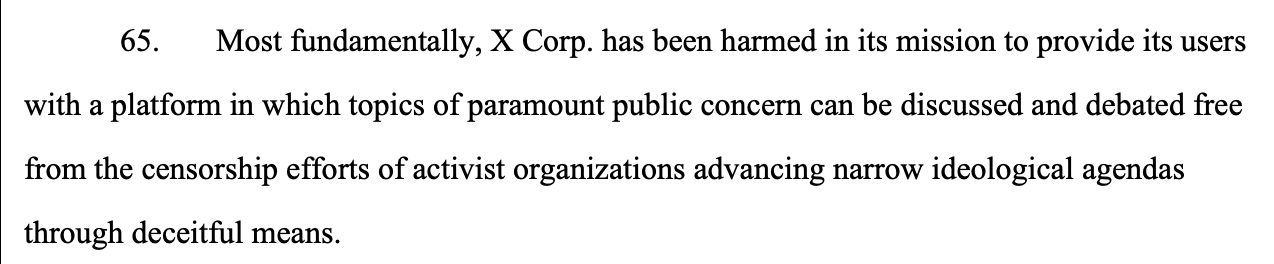
Read in context, Xitter says that it's mission is to provide a platform for hate speech, a topic of paramount importance, unfettered by observations that it is hate speech.
Greg Spradlin
boosted
Discoveries in the Stolen Document Discovery
https://www.emptywheel.net/2023/08/01/discoveries-in-the-stolen-document-discovery/
Greg Spradlin
boosted



A game of Go on a hyperbolic manifold, played in the HyperRogue discord server, ended like this.
#noneuclidean #noneuclideangeometry #rogueviz #bringsurface #baduk

Math guy, computing wannabe, classical music lover, politico. Same handle on Instagram.
Joined Nov 2022
