
Most people are so binary in their thinking,
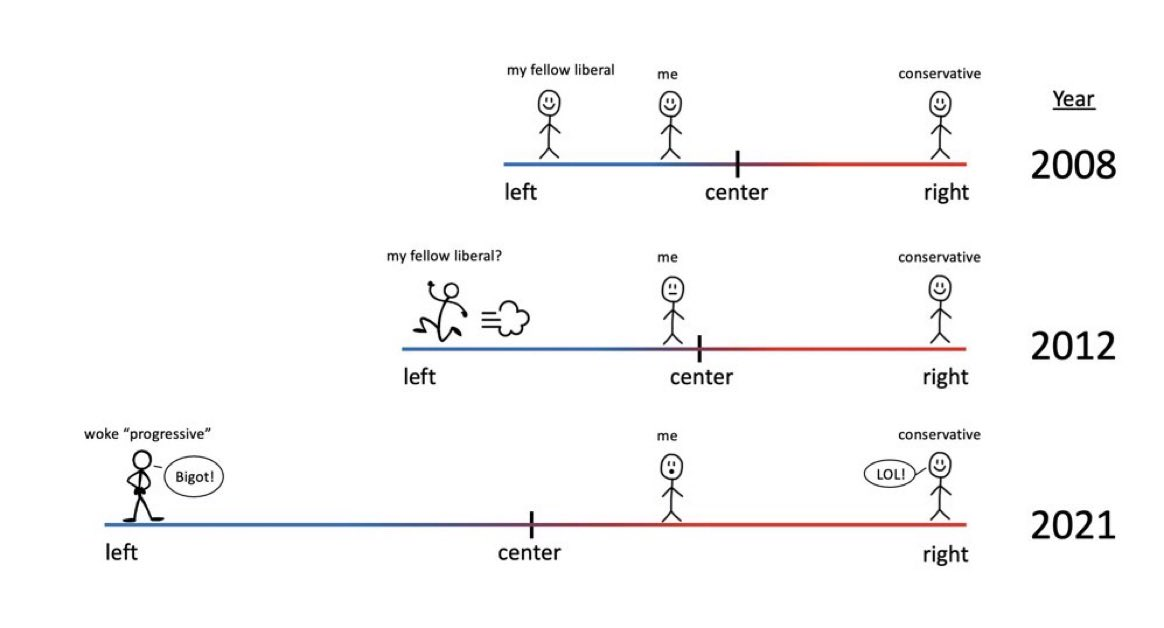
and the tenets of “the #left” and those of “the #right” have shifted so much (sometimes even exchanging places) in the last couple of decades,
that I want to write a post titled “Am I on the Right?”
(kind of [like #BrendanOneill did](https://medium.com/@burntoakboy/which-of-these-is-a-right-wing-position-4118046d7765))
listing all the views I have that would be automatically considered left-wing by many people today.
And then perhaps “Am I on the Left?”, too.

That, yes. I liked how Scott Alexander interpreted that meme:
https://www.astralcodexten.com/p/which-party-has-gotten-more-extreme


@tripu I'd go so far in agreeing that i would say only the origins of the words make sense anymore. So if left or right are used, i ask myself: "Is this person a monarchist or opposed?".
I think monarchism is just one of many threads, I wouldn't boil things down to that.
But you're right about the labels being almost useless. I listened to a couple interviews with the authors of this book, and I am quite convinced of their thesis now (although it's very US-centric; it might be different in other countries):
https://www.goodreads.com/book/show/62871369-the-myth-of-left-and-right

 🇳🇱
🇳🇱
@tripu I agree on all your bullet points except for "no subsidies for churches", churches should have all the same benefits as any other nonprofit so long as they operate as a nonprofit. Being religious should no more disqualify them for subsidies than it should qualify them for it. That should be determined (and granted) based on the same criteria as any other group.
I'm surprised you're in favour of subsidies for churches (or “any other nonprofit so long as they operate as a nonprofit”). I'm against subsidies for all those institutions in general — churches are just one category.
In fact, I take it even further: no subsidies for non-profits _nor_ for-profits, in principle. One possible exception (there may be others): industries that are vital for national security or for long-term survival etc.
I think government issued grants have a place. To me its simple, when the investment benefits everyone it is worth spending money on.
I also support tax-paid free education at every level of education. My argument is similar, a smarter population makes more money and makes more taxes.
Yes, I may be with you wrt education (it's an issue I haven't made up my mind about yet).
What other “government-issued grants” do you have in mind?
@admitsWrongIfProven Im not sure id quite go that far.. But i dont disagree... it should only be a safety net if your in need, not provided for free to everyone even if they can afford it.
@freemo Well, the "to everyone" idea is efficiency. Much less trouble to spread the minimum for a decent life around than scruitenizing billions of people. Same principle as why foodstamps are bad.
@admitsWrongIfProven I would argue it doesnt prouce effiency at all, but quite the opposite as there is no free market competition to optimize the resrouce.
@freemo Well, before we get market competition we would have to clean house... we do agree on the monopolies are bad thing, right? As long as they exist (and in most countrys, thx globalization) there is no real competition.
I mean yeah, a good social system would also be a target for monopolists, squeeze all they can out of it. If you for example control the housing market, you can increase rents to negate the good that has been done.
I guess we would need both, and the free market for non-survival critical stuff please.
Because if gouvernment fails to regulate monopolies, i want to at least have water and electricity etc.
@freemo Um, i just read this again, and it makes no sense whatsoever.
Stuff guaranteed by the state as a minimum is not subject to any market competition, by principle. It is a guaranteed minimum, and all you could do is see that only those that need it get it. Which is where inefficiency comes in, determining that is hard. Thus blanket payment is more efficient.
If some stuff can be optimized is an entirely different question, one which makes sense to ask for variable things.
> Stuff guaranteed by the state as a minimum is not subject to any market competition
Right which i s exactly what I am saying, since these things cant fall under market pressures, which can improve the quality and cost of the service, we should be reluctant as providing them to everyone, as opposed to just the poor who cant afford it.
> It is a guaranteed minimum, and all you could do is see that only those that need it get it.
Which is why I am saying it shouldnt be a garunteed minimum, it should be viewed as something you get only if you cant afford the minimum, if you can afford the minimum then you dont get it unless you pay for it. You are explaining exactly why universal minimums for everyone is a bad idea
@freemo > Right which i s exactly what I am saying, since these things cant fall under market pressures, which can improve the quality and cost of the service, we should be reluctant as providing them to everyone, as opposed to just the poor who cant afford it.
Well, then you are for inefficiency? I don't get it.
> Which is why I am saying it shouldnt be a garunteed minimum, it should be viewed as something you get only if you cant afford the minimum, if you can afford the minimum then you dont get it unless you pay for it. You are explaining exactly why universal minimums for everyone is a bad idea
With this, i get a vibe that you seem to define "get it" as some kind of service, not money.
🤷 If you want to do away with money based society, who am i to tell you to stop?
It sounds a bit like you love the "free market" tool so much, everything looks like a nail. It's just not applicable everywhere.
And providing for who needs it is an absolute basis for me while we do have enough. Anything else is unethical.
> Well, then you are for inefficiency? I don’t get it.
No the opposite, giving everyone a fixed amount of a resource is ineffecient as it doesnt have market pressures which optimize the cost of a service and quality.
While I do support fixing the healthcare problem around the world if we gave it to everyone and forced them to have it then the quality and cost of service has no pressure. If you arent competing for customers then you have no motivation to lower costs to draw in customers and/or improve the service.
This is seen in healthcare in much of europe where time to care can be abysmal to the point of causing people (like myself) to get surgery that isnt needed due to easier and cheaper treatments being too slow to be practical.
> With this, i get a vibe that you seem to define “get it” as some kind of service, not money.
Both money and service. Free money has all the same market pitfalls as free services. Free money devalues money and ultimately drives inflation requiring ever more free money. It doesnt solve the problem, it makes the problem worse. We want to make it so people are skilled and dont need the money and actually contribute by generating wealth in exchange for thevalue they get back.
> If you want to do away with money based society, who am i to tell you to stop?
Nothing wrong with money, as long as it isnt free.
> It sounds a bit like you love the “free market” tool so much, everything looks like a nail. It’s just not applicable everywhere.
Nope the key is understanding your tools and its limits. I have pointed out cases where free markets dont work (health care is one of them in fact but thats a bit nuanced).. But even in cases where free markets dont work that doesnt mean you just print money and give it away. Solutions tend to be more nuanced.
> And providing for who needs it is an absolute basis for me while we do have enough. Anything else is unethical.
Never disagreed with that. I said we dont give it away for free and to everyone. I am perfectly ok giving it to the people who need it **conditionally**. Free food if you cant afford it, but only if you are willing to also get a free education so you only need help temporarily.
@freemo Well... sometimes a fixed amount is better.
With water, i want a pretty fixed amount. I want it to be drinking quality (*cough* *cough* Flint, MI) and it costs what it costs. Nothing to me, a private citizen and tax payer, that would be the idea. I already payed the state to keep this service operational, or maybe i did not because i am poor. In any case, it should be there, in household-typical amounts. Any industrial use, that would cost, sure. Can't open a water park on public dime.
Internet is surprisingly similar. What do i, a customer, gain from multiple providers? I want a good upload, download, nice ping times. All they do is try to sell me on their walled garden.
So i reject the optimization for basic services that allow for a generally defined quality most people want.
To the "draw in customers", i say this stopped in many areas due to monopolies. I am sure you know about cory doctorovs term "enshittification", which revolves around market saturation and the perversions that follow by trying to increase profits even if one has already captured most customers. Do you disagree?
I'd say here that you talk about advantages of competition but neglect that competition often is not actually there anymore. You once told me monopolies need to be stopped - that is right, and your arguments would make a lot more sense if they were.
> Both money and service. Free money has all the same market pitfalls as free services. Free money devalues money and ultimately drives inflation requiring ever more free money. It doesnt solve the problem, it makes the problem worse. We want to make it so people are skilled and dont need the money and actually contribute by generating wealth in exchange for thevalue they get back.
On this, i already ceded that as long as monopolies exist, it gets yucky. Again it is the monopolies that need to go. Almost sounds like i don't like living in an oligarchy, right?
> Nope the key is understanding your tools and its limits. I have pointed out cases where free markets dont work (health care is one of them in fact but thats a bit nuanced).. But even in cases where free markets dont work that doesnt mean you just print money and give it away. Solutions tend to be more nuanced.
Yep, sounds sensible.
> Never disagreed with that. I said we dont give it away for free and to everyone. I am perfectly ok giving it to the people who need it conditionally. Free food if you cant afford it, but only if you are willing to also get a free education so you only need help temporarily.
Sounds ok, i just think the concept of sniffing after who needs what is inefficient. Oh well, i pointed out what i think the real problem is (do i need to say the m word again?).
A nice discussion, thank you so far.
Many things that are vital for survival are in private hands, and that's right: most housing, most land used for agriculture, grocery stores, companies producing and selling clothing, etc.
/cc @freemo

@tripu I want more and freer migration
I want the Sate to provide safety nets
Those two are contradictory, like it or not. The rest of the world does not provide a free ride. If almost anyone can come into your utopia and sign up for benefits, you will have several billion people to support. Unless you have actual Fully Automated Luxury Communism (in which case just ship the hardware to wherever those people are coming from) that will not work.
> Those two are contradictory
Not at all. “More and freer” doesn't mean “anyone can enter anytime with no conditions attached”.
Many prosperous countries could admit more migrants and also have a higher positive net impact on the economy.
Countries can impose waiting periods for welfare, reduced benefits, or a combination of both for migrants. Or they can let more of the most productive ones in.
Just a few ideas, it's by no means exhaustive.

I don't understand. I said “more and freer” migration. Not “unlimited” or “completely free”. Of course there are trade-offs and sweet spots. You are criticising a straw man, or someone else's view on this.
/cc @mike805
I haven't laid out my “moral case” here, you don't know what that is.
I just answered to one specific objection, related to the economics of migration (ie, that “more and freer migration” and “the Sate providing safety nets” are “incompatible”).
/cc @mike805
@tripu OK that I agree with. Some sort of "can you contribute?" test. What worries me is unlimited asylum. That is where you get overrun, and some of the "asylum seekers" will be the very people who caused the refugee problem in the first place.
Immigration for skilled people is already pretty open. Yes it's a pain, but it is not impossible.
> What worries me is unlimited asylum
But of course. Who's defending “unlimited” anything? I surely didn't.
> Immigration for skilled people is already pretty open
Where, outside of the Schengen Area (and that benefits “only” 420M people, most from countries that are quite wealthy already), is that?
I guess it depends on what one understand by “pretty open”.

@tripu "Defend legal rights"
"Get rid of all legal restrictions on speech"
"Defend due process."
"Diminish official interference into people’s personal and family lives."
"The United Kingdom is unusual in having no single written constitutional document that can be enforced by the courts. Instead it has a political constitution, which relies heavily on norms and conventions. When challenges arise, it rests on a shared understanding of the rules and the principal actors being willing, for the most part, to abide by them—the “good chaps” theory of government."
A Constitution would be one way to achieve that.
@olives Interesting, thank you.

A teaser:
* I want abortions to be not only legal but also publicly subsidised
* Ditto about euthanasia
* Ditto about hormone therapy and sex-reassignment surgery
* I am pro same-sex marriage
* I want more and freer migration
* I want the Sate to provide safety nets
* I am against the death penalty
* I want all drugs to be legal for adults (but also regulated)
* I think the State should be completely secular (no official religion, no subsidies for churches, no mentions of god)
* …