
CSS input styling antics.
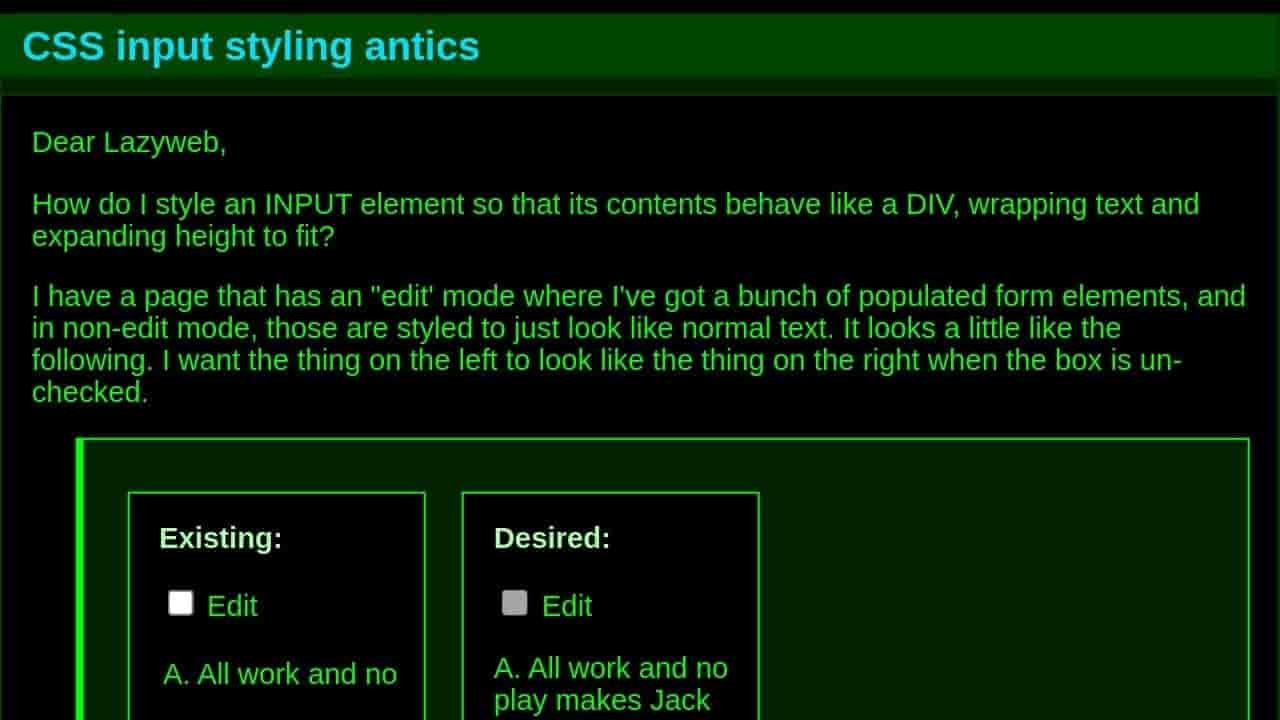
Dear Lazyweb, How do I style an INPUT element so that its contents behave like a DIV, wrapping text and expanding height to fit? I have a page that has an "edit' mode where I've got a bunch of populated form elements, and in...
https://jwz.org/b/ykEU

<Input> is for one line of plain text only, with no wrapping.
If you need multiline and line wrapping too, you should use <textarea>.
If plain text is not enough, there is contenteditable; but usually is a pain to manage, so if you can't avoid this requirement, you better use one of the many libraries for editing rich text.
@jgg As you can see from my example, textarea also doesn't work, as it does not auto-size height like div does.
"Include half a megabyte of some bullshit framework" is about the most useless of all possible suggestions.
Sorry, missed that point. You may find this helpful: https://css-tricks.com/the-cleanest-trick-for-autogrowing-textareas/
Why are you so hostile to using libraries? It is what everybody has been doing for rich text editing since rich text editing on the web became a thing. Reinventing the wheel never was a good engineering practice.
@jgg Why am I so hostile to libraries? Because I'm not the kind of person who buys a new car because the "check engine" light came on.
But please, lecture me on good engineering practices. I'm sure you have a lot to teach me.

Adding a big library only to get something as trivial as a resizable panel makes as much sense as buying a car to cross the road. Adding a small one is like buying a skate.
I find the same issue with that kind of libraries. You take something that seems standard and easy, find a nice library for it, and it never does exactly as you want/need, unless you are willing to write more code to coerce it than you would have to write first place.
I try to avoid using big UI frameworks; they make easy the easy things, but harder the hard ones, so they are the opposite of what I want. They end feeling like a straitjacket.
The libraries I find really useful are the ones that give very specialized functionality that would be crazy to implement by myself (e.g. 3D engines) or are really flexible (jQuery in its time, Vue, React...). I want freedom and being more capable, not more limitations.

@jgg @jwz
It would be nice if there were libraries of "do only one thing and do it well" (such as AutoGrowTextArea), but instead we seem to have "frameworks" (I though that Taligent showed the folly of that approach). On the other hand, the trick I found at Mozilla's website depends on a combination of HTML, CSS, and JS and it's not obvious how to turn that into a library function (the autoGrow() is only a couple of lines, so cut&paste seems to be reasonable here).
The code I wrote for a resizeable panel might be a candidate for turning into a library function but it assumes a particular way of building the page - there's probably a way to make it more general but it'd start to look like a "framework".
If you're interested in my resizeable panel, the code is here (the page is built dynamically by renderPage() using async callbacks (yuck), within a skeleton of HTML <div>s).
https://github.com/kamahen/pykythe/blob/475b51fd9478b2ed22b317f53cee45127e6901d2/browser/static/src_browser.js#L171