

sojournTime @sojournTime@social.cleverlibre.org
- GitHub (Personal)
- https://github.com/dataNerd23
Data Science PhD Student
Likes math, stats, space, and board games (especially Dominion: https://dominion.games/).
⬛️⬛️⬛️⬛️⬛️✨⬛️⬛️⬛️⬛️⬛️⬛️
⬛️✨⬛️⬛️⬛️⬛️⬛️⬛️⬛️⬛️✨⬛️
⬛️⬛️⬛️⬛️🛰️⬛️⬛️⬛️✨⬛️⬛️⬛️
⬛️⬛️⬛️⬛️⬛️🌎⬛️⬛️⬛️⬛️⬛️⬛️
⬛️⬛️🌒⬛️⬛️⬛️⬛️⬛️⬛️✨⬛️⬛️
⬛️⬛️⬛️⬛️⬛️⬛️✨⬛️⬛️⬛️⬛️⬛️
Joined Apr 2022
sojournTime
boosted

The simulation hypothesis is just creationism for nerds who are too cool for church
sojournTime
boosted

Wow, this proposed approach to drawing districts without gerrymandering is fascinating! In the spirit of "I cut you choose", the proposal is "One party defines 2N equal-population sub-districts, and the other party chooses pairs of adjacent sub-districts to combine, to form N districts."
The analysis in the body of the paper focuses on simulations of each party's optimal strategy in the context of some real-world maps of US voting precincts, while an appendix proves a few theorems giving bounds in the alternate context where the pairs of districts that get combined don't need to be geographically adjacent. (If this idea catches on, I'd bet someone will produce theoretical bounds in the presence of the geography constraint.)
A Partisan Solution to Partisan Gerrymandering: The Define–Combine Procedure
sojournTime
boosted

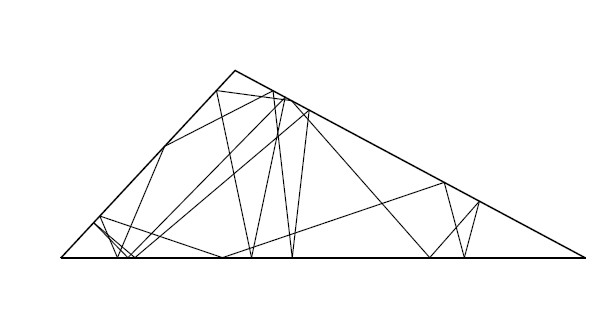
Some geometry problems are easy to state but hard to solve! For any triangle, can an ideal point-sized billiard ball bounce around inside in a 𝑝𝑒𝑟𝑖𝑜𝑑𝑖𝑐 trajectory - a path that repeats?
The answer is "yes" for acute triangles, and this has been known since 1775. It's also "yes" for right triangles. But for obtuse triangles, nobody knows!
In 2008, Richard Schwartz showed that the answer is "yes" for triangles with angles of 100° or less. He broke the problem down into cases and checked each case with the help of a computer. Then progress was stuck... until 2018, when Jacob Garber, Boyan Marinov, Kenneth Moore and George Tokarsky showed the answer is "yes" for triangles with angles of 112.3° or less.
Beyond that we're stuck.... except for triangles with all 𝑟𝑎𝑡𝑖𝑜𝑛𝑎𝑙 angles (measured in radians). For them too the answer is "yes".
The picture here is from
George Tokarsky, Jacob Garber, Boyan Marinov, Kenneth Moore, One hundred and twelve point three degree theorem, https://arxiv.org/abs/1808.06667
and for more check out this article on Quanta:
https://www.quantamagazine.org/the-mysterious-math-of-billiards-tables-20240215/
sojournTime
boosted

valentine's day
I personally think that Valentine's day is really stupid, but my kids feel obligated to give out cards at school, so this year my partner printed out some of the hilarious ones made by @rosemarymosco, like these:
https://rosemarymosco.com/comics/bird-and-moon/flappy-valentine
https://rosemarymosco.com/comics/bird-and-moon/wood-frog
https://rosemarymosco.com/comics/bird-and-moon/nature-valentines-3
...I hope my kids' friends have the same kind of farm-kid humour as them! Thanks for sharing these, Rosemary!
sojournTime
boosted

Up and at 'em, people! These cards aren't going to punch themselves!
sojournTime
boosted

Today I was reminded of something that used to confuse me when I was an undergrad mathematics major.
Calculus:
\(\int_a^b f(x)dx\) is the *signed* area of the region bounded by the curve \(y=f(x)\), the x-axis, and the lines \(x=a\) and \(x=b\). The parts of the function above the x-axis contribute positive area, the parts below contribute negative area.
Linear algebra:
For a \(2\times 2\) matrix \(A\), the determinant of \(A\) is the *signed* area of the oriented parallelogram spanned by the two column vectors of \(A\).
Me, circa 1983: Ah! Surely, these two ways of finding signed areas are related somehow. This will likely be explained in the next course.
Multivariable calculus:
Line integrals, Jacobian determinants, yadda yadda yadda...
Me: Uh, that's great, but...
Years later, I came up with this: Think of one of the subintervals \([a_i,a_{i+1}]\) used to define the Riemann integral of \(f(x)\), where the corresponding rectangle has (positive or negative) height \(f(a_i^*)\) for some \(a_i^*\) in the subinterval. Think of the rectangle as spanned by two column vectors with their tails attached to the point \( (a_i,0)\), namely \( (a_{i+1}-a_i, 0)^T\) and \( (0,f(a_i))^T\). The determinant is the signed area of that rectangle. Adding those up and then taking the usual limit gives the integral. This is how I made sense (to myself) of how the integral's signed area interpretation relates to the determinant's signed area interpretation.
Strangely, in my 32 years of professoring, I've never taught multivariable calculus. Although I'm pretty sure it was never explained when I was a student, it wouldn't surprise me if the above can be found in textbooks. But it was fun to figure out for myself!
sojournTime
boosted

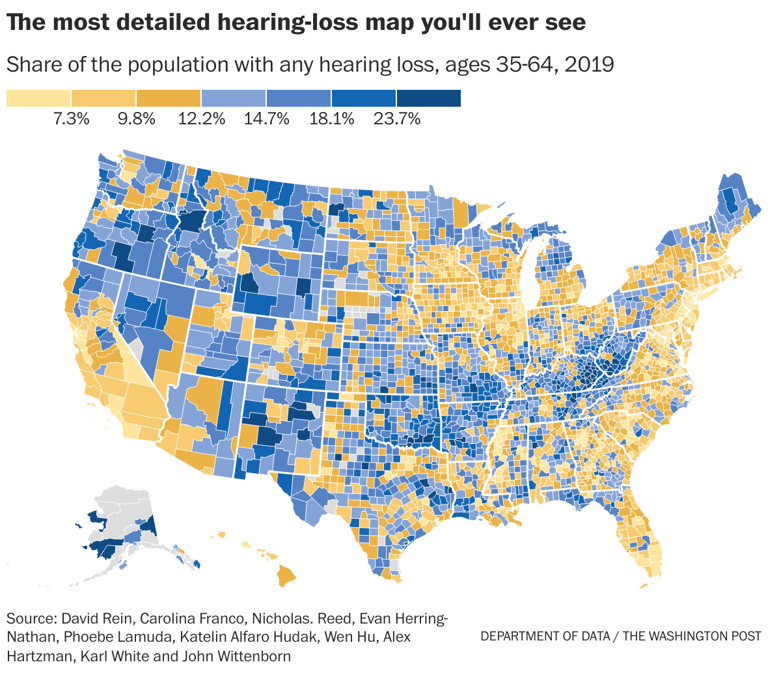
Why are Republicans more likely to suffer hearing loss?
There is a very strong correlation with one factor discovered by these researchers. What do you think it is? Does the map below help?
https://www.washingtonpost.com/business/2024/02/09/hearing-loss-republicans/
https://www.msn.com/en-us/health/other/why-are-republicans-more-likely-to-suffer-hearing-loss/ar-BB1i1oCb?ocid=socialshare
1/n
sojournTime
boosted

Oh hey, the Attorney General of Indiana has published a snitch line for schools who teach LGBTQ+ issues, or make Woke materials available to their students!
Here’s the URL. Use it responsibly. Don’t use it to report Godzilla flying the Trans flag or anything like that, ok?
https://in.accessgov.com/attorneygeneral/Forms/Page/attorneygeneral/education-transparency-form/1
sojournTime
boosted

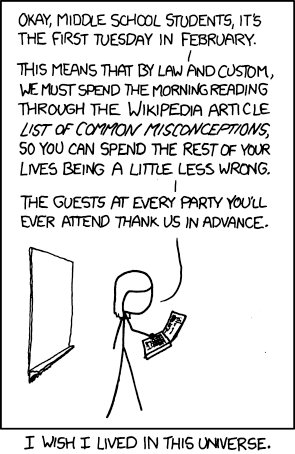
Good morning! It’s the first Tuesday in February, and so you’re all invited to look through Wikipedia’s List of common misconceptions (https://en.wikipedia.org/wiki/List_of_common_misconceptions) per xkcd custom.
sojournTime
boosted

sojournTime
boosted
... and is a comma a California stop?
sojournTime
boosted

sojournTime
boosted

Ever wondered how to programmatically drawing planar knots in SVG? Wait no more https://prideout.net/blog/svg_knots/
sojournTime
boosted

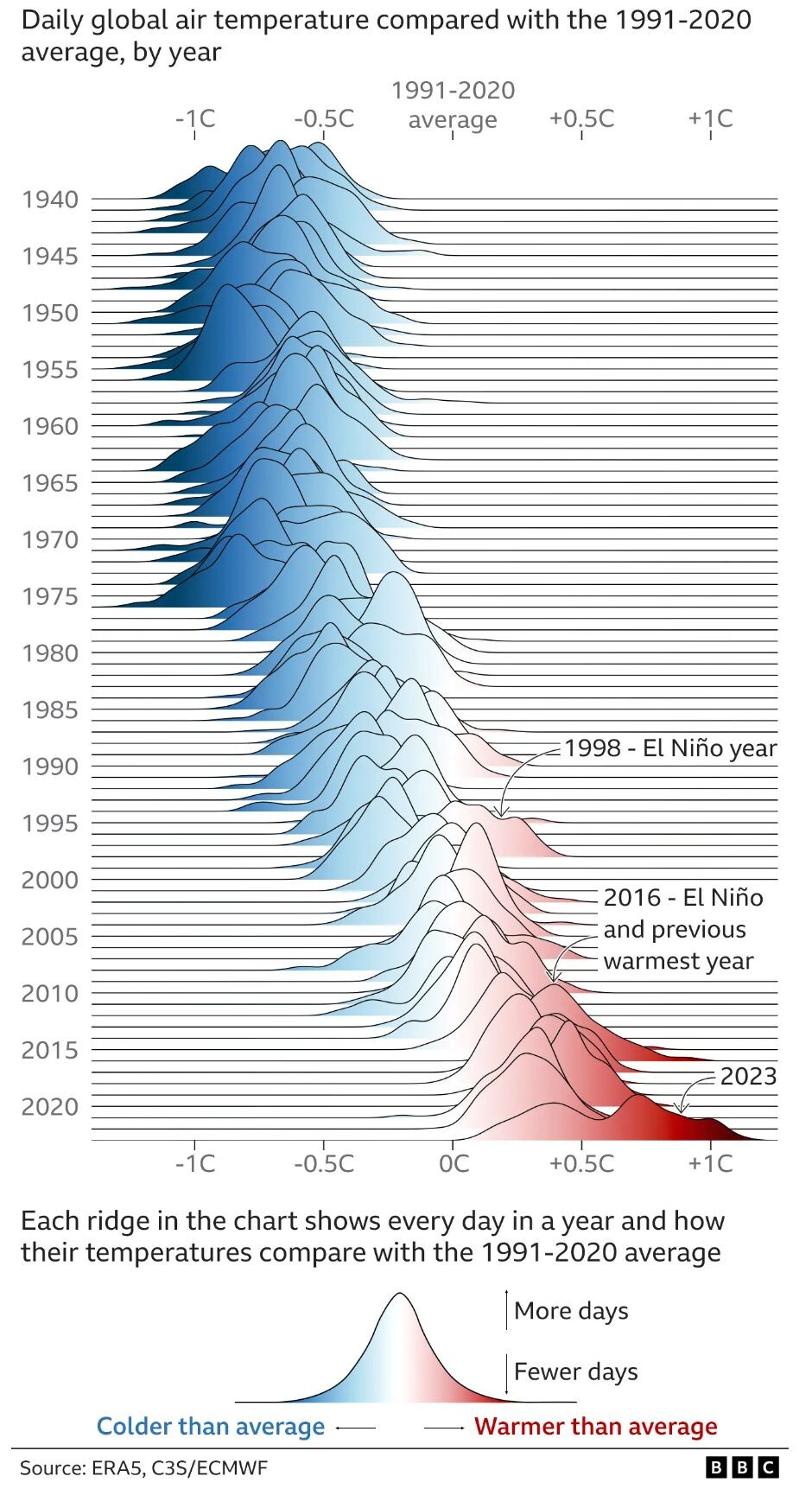
I'm rather taken with this elegant visualization of @ClimateChange from the BBC. Particularly as it clearly shows how anomalous 2023 was.
It's a Ridgeline plot (also sometimes called a joyplot, after the iconic album cover from the band #JoyDivision).
I just wish they'd used a pre-industrial average as the baseline. 2023 was 1.48°C warmer than pre-industrial times according to the Copernicus data.
sojournTime
boosted

[new paper] A widespread belief about county splits in political districting plans is wrong, with Maral Shahmizad and Soraya Ezazipour https://austinlbuchanan.github.io/files/A_widespread_belief_about_minimum_county_splits_is_wrong.pdf
sojournTime
boosted

“Halt! Before you cross the bridge you must answer these questions three, lest you fall into the pit of eternal damnation.”
“Ask me the questions bridgekeeper, for I am not afraid.”
“What is your quest?”
“To find the Holy Grail.”
“What is your favorite color?”
“Blue.”
“What is the terminal velocity of an iPhone falling from 16,000 feet from a Boeing737Max?”
“iPhone Max or iPhone Pro Max?”
“I…I…don’t know! Aaaaahhhhhhhhh…”
🌉🎢🤸♂️🌋🔥
sojournTime
boosted

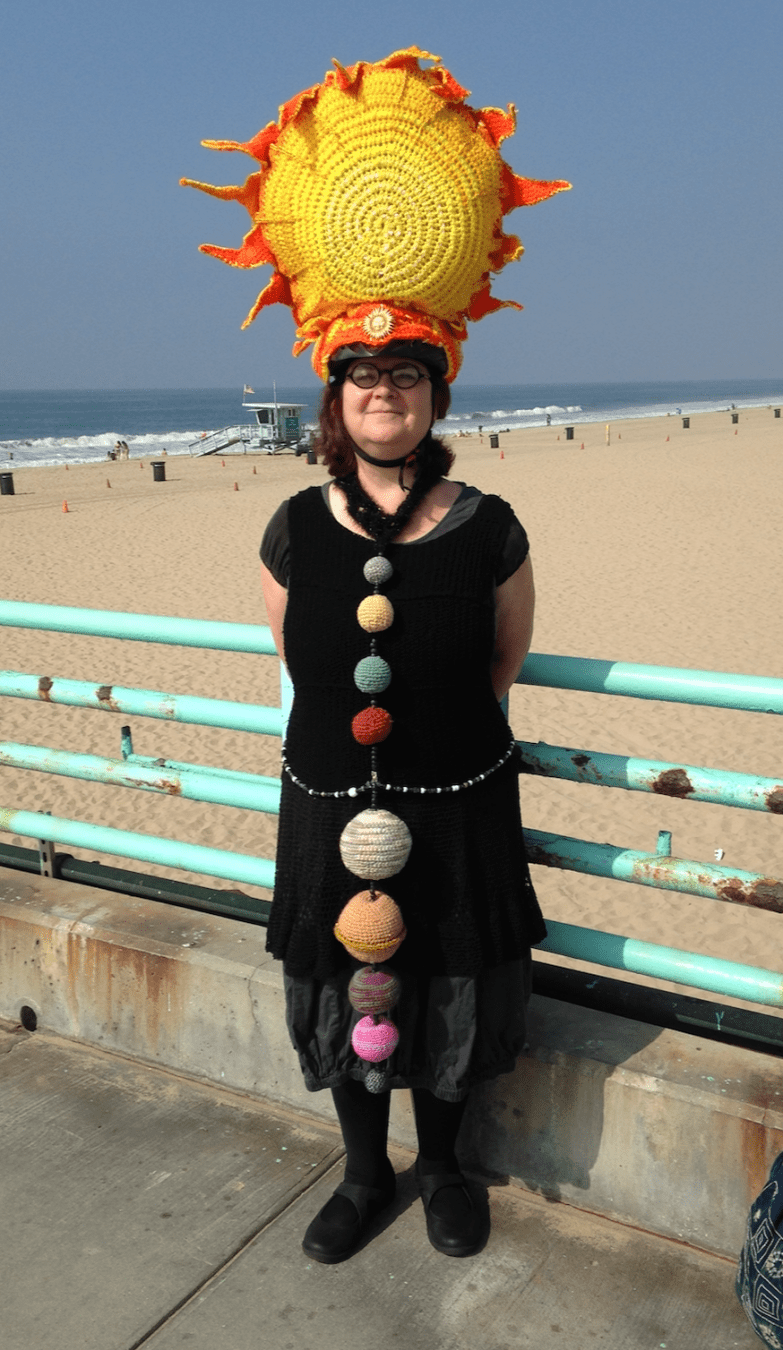
In 2017, I crocheted myself a solar system costume. The headpiece is mounted on a bike helmet for stability (I got that tip from some folks who build showgirl costumes). The tunic is made from fine black linen yarn, very matte, very tedious, much like I imagine space is most of the time. The planets are made using an online sphere pattern generator, so that I could vary the sizes in a predictable way; they are strung on a fishing line with beads, and suspended from an elastic collar, also crocheted. They are also kept in place with a beaded "asteroid belt", located between Mars and Jupiter, of course. Photographed at Manhattan Beach Pier. All second-hand yarns, though I had to ask around for enough yellow to make the sun so large. #solarsystem #crochet #costume #planets #sun #astronomy #planetary #yesplutotoo
sojournTime
boosted

sojournTime
boosted

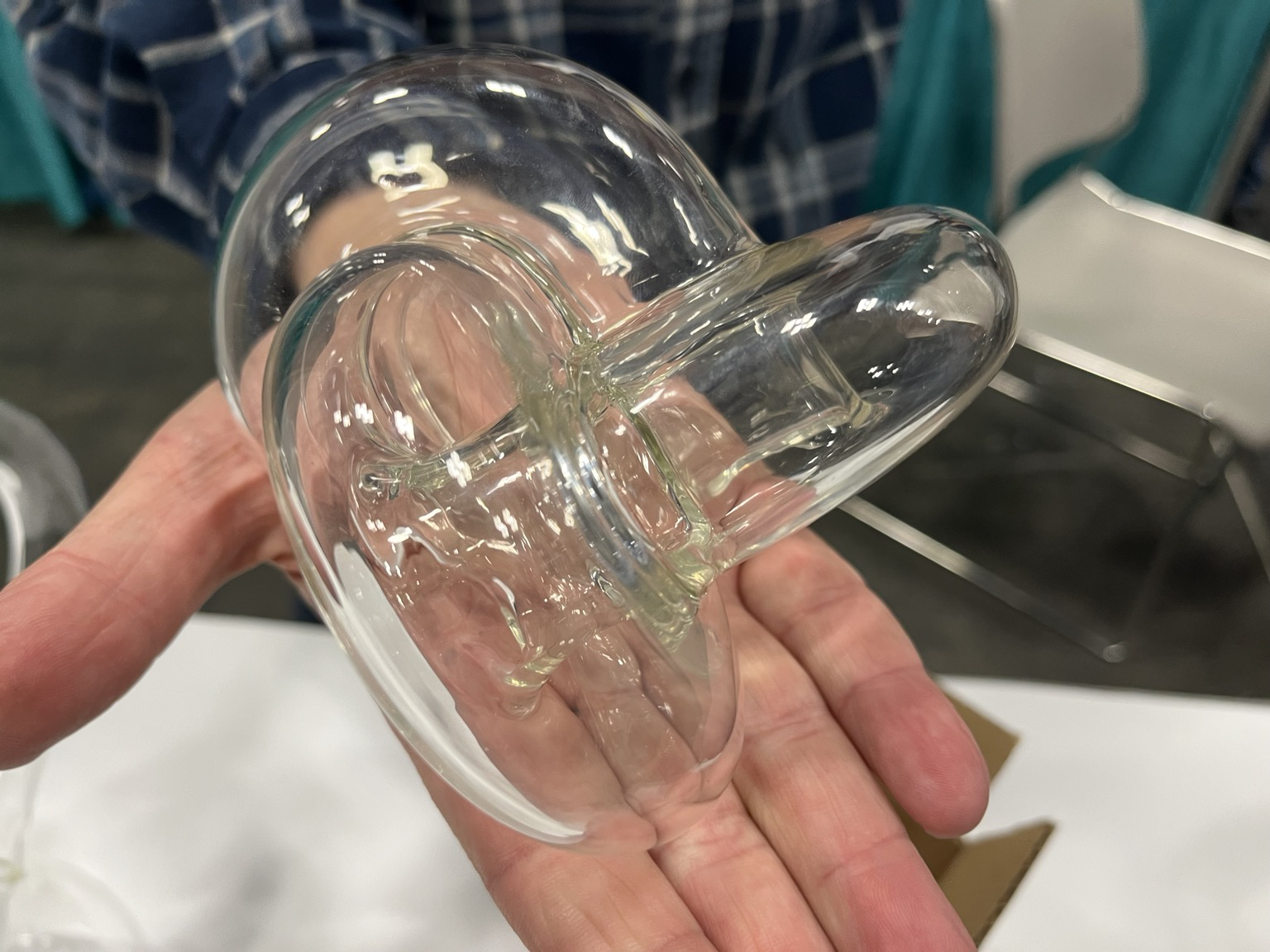
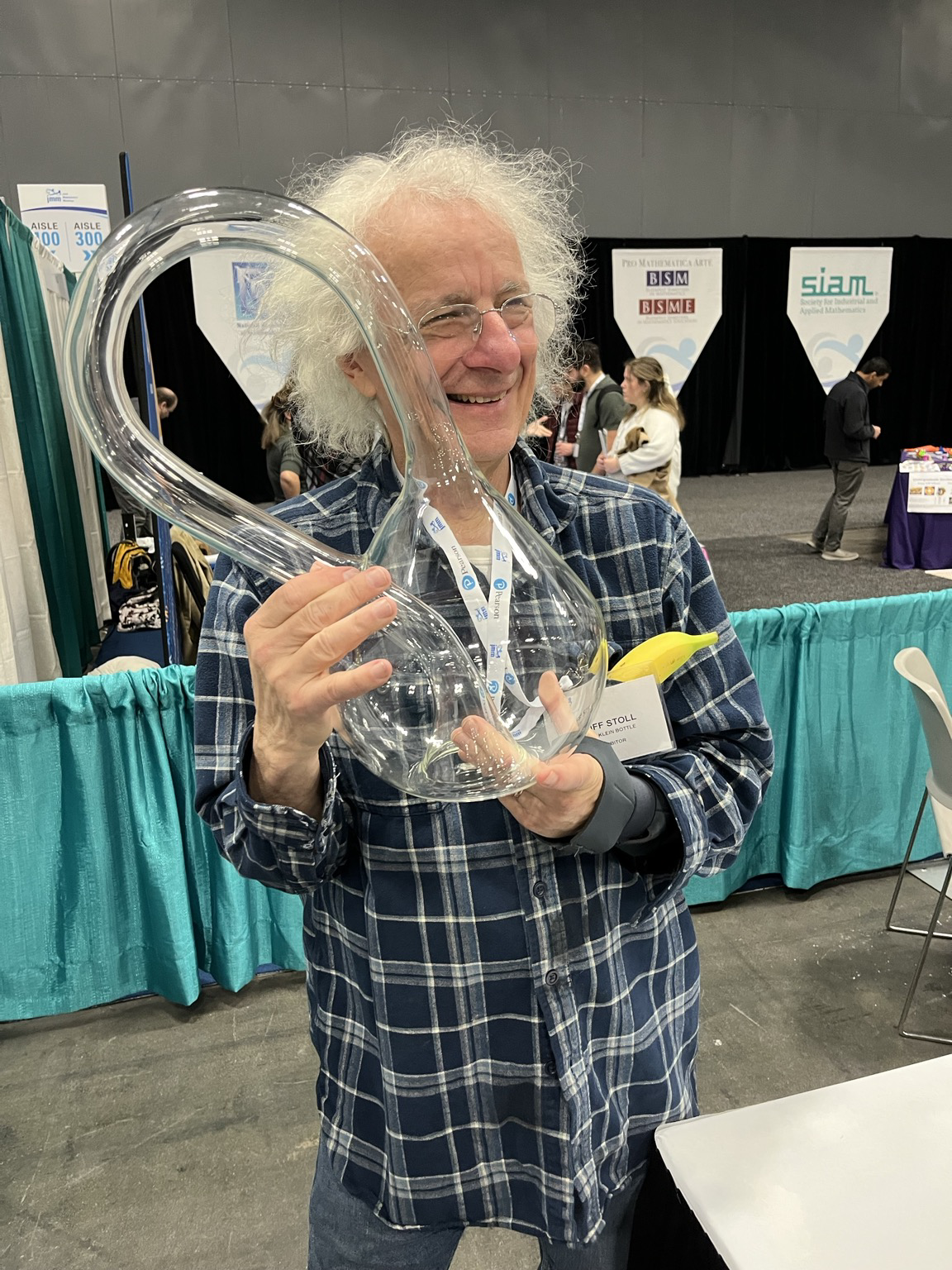
Got to see the glass-blown Boy’s surface by Lucas Clarke (brought by Cliff Stoll) at the JMM.
sojournTime
boosted



A totally normal candidate.
Click the link, not the preview, to skip the paywall
- GitHub (Personal)
- https://github.com/dataNerd23
Data Science PhD Student
Likes math, stats, space, and board games (especially Dominion: https://dominion.games/).
⬛️⬛️⬛️⬛️⬛️✨⬛️⬛️⬛️⬛️⬛️⬛️
⬛️✨⬛️⬛️⬛️⬛️⬛️⬛️⬛️⬛️✨⬛️
⬛️⬛️⬛️⬛️🛰️⬛️⬛️⬛️✨⬛️⬛️⬛️
⬛️⬛️⬛️⬛️⬛️🌎⬛️⬛️⬛️⬛️⬛️⬛️
⬛️⬛️🌒⬛️⬛️⬛️⬛️⬛️⬛️✨⬛️⬛️
⬛️⬛️⬛️⬛️⬛️⬛️✨⬛️⬛️⬛️⬛️⬛️
Joined Apr 2022
