


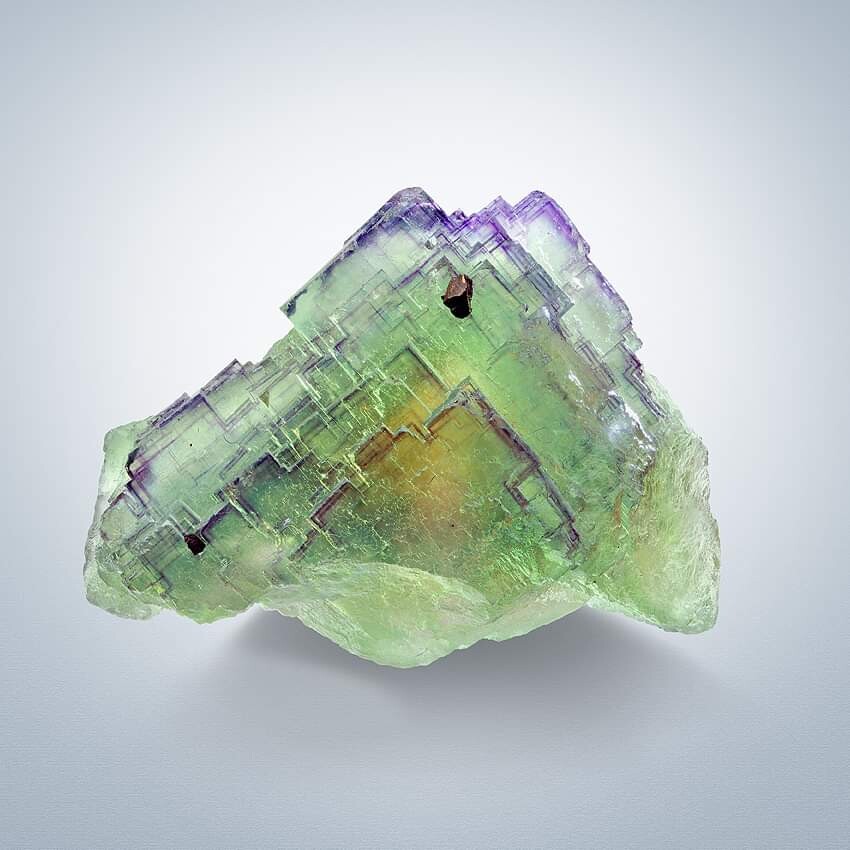
@SteelFolk @sarahc That actually looks like a single crystal. But that doesn’t really make the answer to your question any easier.
@SteelFolk @sarahc Not so very different. Fluorite can be masses of interpenetrating crystals. But this piece is the result of unrestricted growth from some substrate into a fluid space. It could be a crack, or some kind of geode/cavity. If there is still space once crystallization ends, then you see these accretionary faces preserved. It happens with any mineral. Even pure metals. When the growth conditions allow it, you get crystal growth faces preserved.

@SteelFolk @sarahc I assume that means you can make use of “seed” crystals to influence the accretion pattern? In nature, pure metals are considerably rarer, since most seem to like bonding with Oxygen (always have a date for the crystal party). When they are pure ( like noble metals) the same rules apply.

@SteelFolk @sarahc I think metals, with their “unique” valence electron shell, have an easier time finding acceptable substrate and thus form vastly more nucleation sites, so it’s much more common to see them intergrowing, as you say. A fluorite or Tourmaline “molecule” will be more selective because its charge field is more intricate.
@SteelFolk @sarahc Wow! That’s pretty freaking advanced. One can only imagine how microgravity will open the door to even more advances. In my head, I see huge L-point rotating induction furnaces “digesting” billets of titanium being shot from lunar magnetic guns. 😁
@SteelFolk @sarahc Curious: Has anyone in the industry ever examined metal meteorites to theorize how these metal bodies formed. Can we simulate say a widmanstätten structure conventionally? Is there any value in that?

@CWilbur @sarahc@mas.Good thought. It's common enough in steels but it's brittle. It's formed from a solid state transform and is a displacive one so indicates low temperature and fast cooling. tbh usually a rolling cock-up!
@SteelFolk makes sense.
@CWilbur I believe there is evidence of them having solidified extremely slowly as well, giving lots of time for diffusion. They're the only iron we had before we reduced oxides.
@SteelFolk @sarahc Both the Fluorite and the Tourmaline crystals here exhibit color zoning, which I find fascinating. The simple explanation is that the fluid composition changes slightly over time as the crystals grow. The minor elements get caught up in existing crystal lattice. However, it’s very clear that, at least in the case of tourmaline, that there is some limited ion movement in the crystal AFTER it solidifies.

@SteelFolk I wish I had an answer for you, but I don't have the training to make even an informed guess.