
A particularly fine specimen of fluorite, made up of several crystals. One of my favorite minerals!
Locality: Bergmännisch Glück Mine, Frohnau, Annaberg-Buchholz, Erzgebirge, Saxony, Germany
Size: 3 × 4.1 × 3.2 cm (1.2 x 1.6 x 2.3 in.)
Photo: © Wittig-Minerals /e-rocks. com
H/T: www.geologypage.com

@sarahc Do we know what are the nucleation sites for the crystals or is it homogenous?

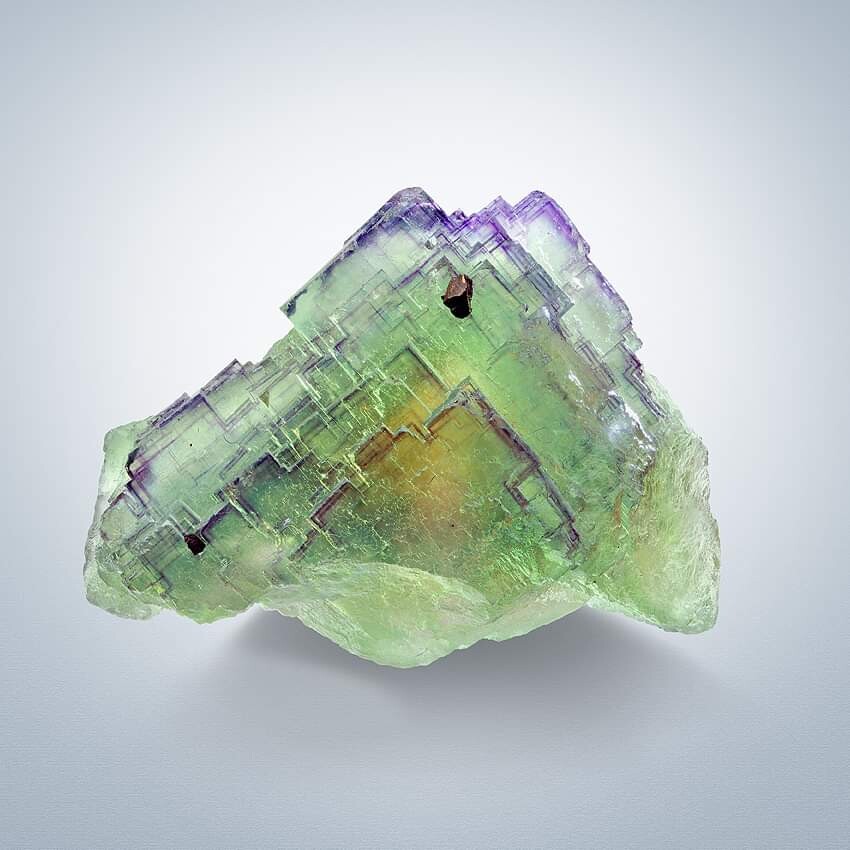
@SteelFolk @sarahc That actually looks like a single crystal. But that doesn’t really make the answer to your question any easier.
@SteelFolk @sarahc Not so very different. Fluorite can be masses of interpenetrating crystals. But this piece is the result of unrestricted growth from some substrate into a fluid space. It could be a crack, or some kind of geode/cavity. If there is still space once crystallization ends, then you see these accretionary faces preserved. It happens with any mineral. Even pure metals. When the growth conditions allow it, you get crystal growth faces preserved.


@CWilbur I believe there is evidence of them having solidified extremely slowly as well, giving lots of time for diffusion. They're the only iron we had before we reduced oxides.

@SteelFolk makes sense.