

Thiago Carvalho @cyrilpedia@social.cleverlibre.org
I've worked on all of science, from B cells to T cells.
https://fellowsherpa.com
Joined Nov 2022
@minimammoth It's going to be difficult to work out - because Science and Nature for example have great science journalism in the front matter (again with the disclosures, I also write front matter for Nature Medicine) the work of people like Kai Kupferschmidt (hope I spelled that right) and Amy Maxmen was amazing during the pandemic (or in her case, with the great writing on Ebola before, pandemics). But that certainly does not apply to the endless trickle down of journals in the Ikea now you can't get out of here model
@brembs @minimammoth Sorry for jumping on to thread without reading it first.
@brembs @minimammoth I hope we could recover/reboost the diverse ecosystem of academic run journals.
@minimammoth @brembs For me the important thing is having the competition for funds public funds based on quality. But, to paraphrase the Dude, "that's just, like, my opinion"
@brembs @minimammoth I think one way to view it is through the public contracts bidding system. We offer X amount for the publication of Y. This is not dissimilar from build a rocket for the Apollo program, and now lets see the price bids from private companies and the quality on offer. Authors would be free to publish anywhere, but publishing outside this system would not be permitted with public funds, for example.
@minimammoth A consistent pair that turn up is "journal help me find content and my readers/community find my own work" and "I know the bar/value the QC of certain journals". (note that this last does not at all imply valuing glamour mags)
@minimammoth We also have to be careful not to just by extreme cases - as my courtroom drama TV and film education taught me "hard cases make bad law". But what journals are for, in the age of preprints is a question we've been systematically asking authors on the EMBO Podcast and on the RC blog https://www.reviewcommons.org/blog/
@minimammoth In my (obviously biased) opinion, people underestimate how much works goes into curating proper peer review. Making sure you have the right expertise, screening for conflicts of interest, arbitrating the result and chasing reviewers
@minimammoth I think most editors would agree that the function of peer review is not to detect fraud (though if it does, wonderful). But good publishers have image, data and text screens for manipulation and plagiarism that run parallel to and are independent of the peer review process
Thiago Carvalho
boosted

👋 OK, slowly learning Mastodon norms! My #introduction: I'm Kirsten. I'm a postdoc at @reutersinstitute and a senior researcher with the Geena Davis Institute for Gender in Media. I use lots of methods to study #journalism and #politicalcommunication, with a focus on morality, identity, and their implications for how people feel about and engage with politics and news.
💟 Things I love: reading and talking about reading on #bookstagram, my golden retriever Darcy, and exploring #oxford!
@minimammoth In the middle ground you have refereed preprints like Review Commons at EMBO (again, to be clear, I have worked for EMBO and I still do freelance for them, including the podcast) https://www.reviewcommons.org
@minimammoth I just think that this needs to be asked at the individual journal level - in the interest of full disclosure, I've been (but am not anymore) an editor at J Exp Med. In my opinion some editors and journal do add a great deal. Many do not, and just drain cash from a system that requires "peer reviewed" publications without carefully monitoring the quality of the process at different journals
@minimammoth I think that is one underestimated (or understudied) value of preprints: we can finally ask, with data, the question: what value do journals add to the scientific process?
Thiago Carvalho
boosted

Just your irregular/occasional reminder that I maintain a list of #ScientificWriting #Writing resources here: https://scientistseessquirrel.wordpress.com/writing-resources/. Always happy to have folks leave their favourite additions in the Replies.
@minimammoth I think the main resistance would be political lobbying by big publishers. It also has the advantage of moving the discussion away from "journals" as a unitary category: there are good journals, bad journals and mediocre journals.
@minimammoth I know that it comes up in the second half of the episode (we discussed prions in the first half, publishing and preprints in the second - also with Thomas Lemberger of EMBO). I think if you remove the lobbying component from publisher's, it's not that hard to see the general framework: ban the use of funds for APCs, mandate preprints, and fund only publications in journals that accepted the public competition model, which would include a cap on either profit margins or total cost per paper (or some version of both)
Thiago Carvalho
boosted

RT @DanielJDrucker
Careful how you mess with Acetyl-CoA carboxylase. A critical role for ACC in metabolic regulation of the innate immune response in macrophages @ScienceAdvances https://www.science.org/doi/10.1126/sciadv.abq1984
@minimammoth @brembs To have publishers compete for public/philanthropic funds on the basis of quality & cost was an interesting idea that we discussed with Adriano Aguzzi on the #EMBOPodcast https://www.embo.org/podcasts/from-prions-to-preprints/
@marcdionne @b_longdon @jocelyn_etienne As a card carrying, dues paying member of the Marc's Minions fan club, I don't see that I have any choice in the matter
Thiago Carvalho
boosted

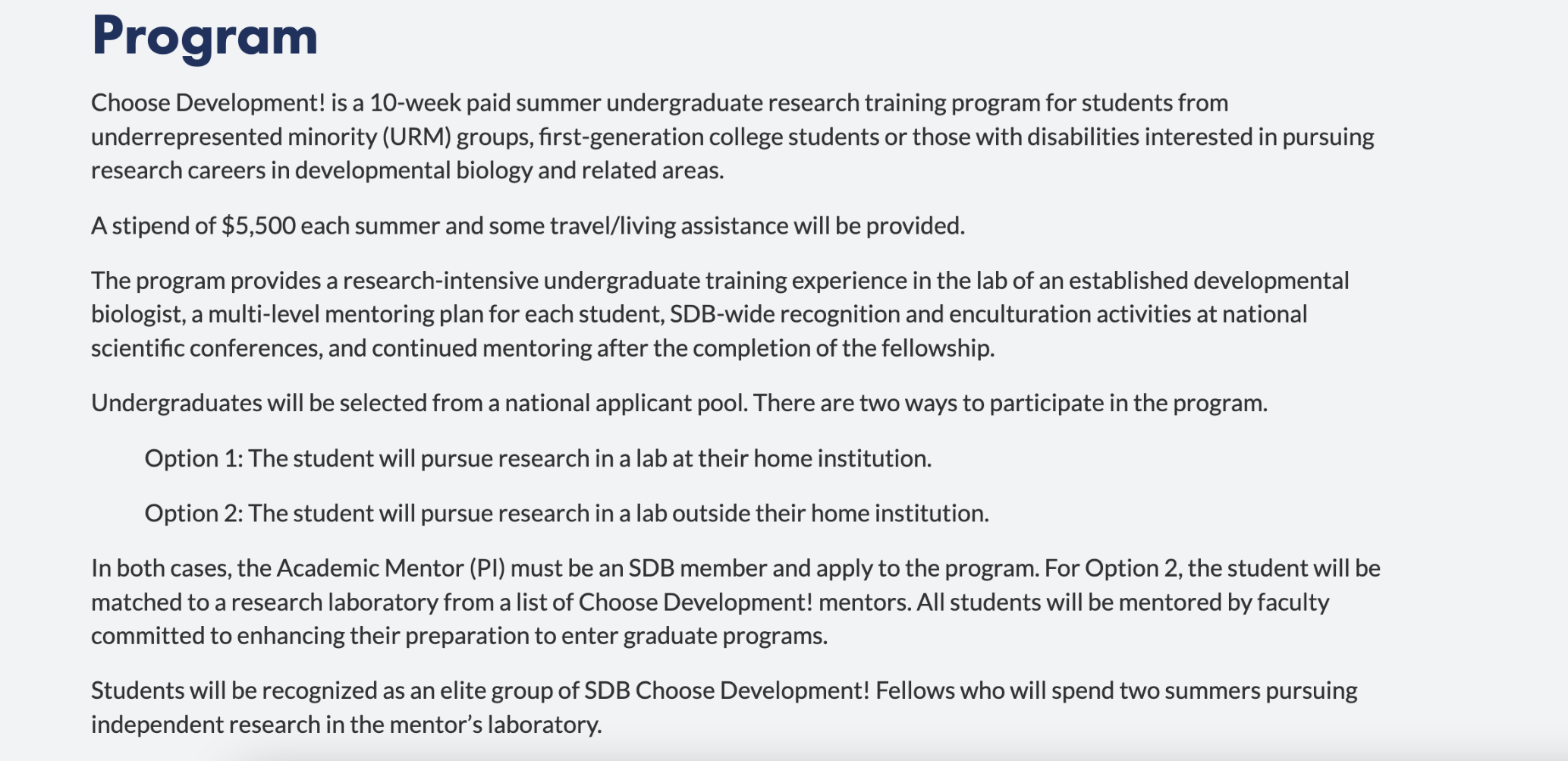
Applications for the Society for Developmental Biology Choose Development! Program are open! Send your people our way, and RT for maximum reach. This is a fantastic (paid!) opportunity for URMs, First-Gen and Disabled People.
https://www.sdbonline.org/choose_development
#DevBio #CellBio #Neuroscience #Science #URM #FirstGen #Disability #UndergraduateResearch #Undergrad
I've worked on all of science, from B cells to T cells.
https://fellowsherpa.com
Joined Nov 2022
