

Thiago Carvalho @cyrilpedia@social.cleverlibre.org
I've worked on all of science, from B cells to T cells.
https://fellowsherpa.com
Joined Nov 2022
Thiago Carvalho
boosted

#Doonesbury: #Trump’s classified #documents edition.
Trudeau is so damn good.
Entire strip here: https://www.gocomics.com/doonesbury/2023/09/24
Thiago Carvalho
boosted

Deckard study. It needs refining, but I might work this up into a painting.
#Tealcartoons #adrianteal #caricature #artistsonmastodon #bladerunner
Thiago Carvalho
boosted

@beneuroscience @karihoffman @elduvelle_neuro @deboraha I’m a cognitive neuroscientist and I primarily use animals. The history I’m aware of is through my 20+ years training and working in the field, and random books like from Gazzaniga who I think claims to have originated the term. So read the below as an experiential take. The intro here is pretty good and matches my previous definition more or less: https://en.m.wikipedia.org/wiki/Cognitive_neuroscience
Some history: fMRI is undoubtedly the major force that envigorated the movement toward Cognitive Neuroscience proposer programs, which before were more likely to be called something like psychobiology from ~1960-1990+. Ogawa first demonstrated BOLD fMRI in 1990 and it only took a couple years for the first human studies to appear—the technique radically transformed experimental psychology departments. fMRI led to professors and students rushing (like a gold rush, a phrase used at the time) to the field of cognitive neuroscience (1990-present). They could now use cognitive research tools developed over decades and study the brain too. https://www.ncbi.nlm.nih.gov/pmc/articles/PMC55275/
Sometimes there were undertones in this rush to think maybe animals were no longer needed in brain research. That was great to some because what they thought really mattered was humans. I have experienced this explicit position from faculty during my training and job interviews (2003-2013), and it still sometimes (though rarely now) comes up at conferences. Some cognitive scientists hold an undertone view that only humans truly posses cognition—this view persists today. For example, see my take with N. Fortin on the neurobiology of episodic memory which necessarily stands in contrast to the scientist’s view that coined the term (Tulving, who we sadly lost recently). https://www.pnas.org/doi/10.1073/pnas.1301199110. Notably, I don’t think coining a term means you have it right or own it necessarily, you just the right to define what you meant when you said it. Science is the pursuit of natural truths after all.
Only if you think the proposition that only humans possess real cognition would you equate cognitive neuroscience with human neuroscience. In fact, cognitive neuroscience that prefers the term human neuroscience often does so to claim the scientific value of their territory so to speak. This wrongheaded view has seriously diminished in the last decade in part because of the growing recognition of the limitations of fMRI and in part because of the huge gains animal neuroscientists have contributed to cognitive neuroscience which seems to have no end in sight at the moment.
Notably human neuroscience is a term that covers far more than cognition of course. It can be reasonably used to simply say one studies the human nervous system in any way, and cognitive neuroscience uses many tools besides fMRI.
I could go on but I feel like I’ve written a brief report! Apologies.
Thiago Carvalho
boosted

Alu transposable elements rewire enhancer-promoter network through RNA pairing https://www.cell.com/molecular-cell/fulltext/S1097-2765(23)00686-X?rss=yes&utm_source=dlvr.it&utm_medium=mastodon
Thiago Carvalho
boosted

Inside the race to stop a deadly viral outbreak in India | Ars Technica
Thiago Carvalho
boosted

Please see below for an exciting opportunity to join microbiology at Newcastle, and help us build target-based antibiotic discovery!
https://www.jobs.ac.uk/job/DCX827/lecturer-senior-lecturer-in-antimicrobial-drug-discovery
Thiago Carvalho
boosted

Question for #plant #ecologists and #botanists out there. Are there any examples of plant species where the male phase has no nectar (only pollen), and the female phase has nectar? I'm asking for any reproductive system (e.g. dioecious species with different male & female plants- or protogynous or protoandrous species where individual flowers change over time). Thanks!
Thiago Carvalho
boosted

Many thousands were on the #RejoinEU march yesterday, the press barely mentioned it.
Thiago Carvalho
boosted

Born on this day in 1889, Walter Lippmann – one of the most incisive minds this civilization has produced – gave us his staggeringly timely insight into the manipulation of public opinion (and how to protect against it) https://t.co/0pUrB0bRjs
Thiago Carvalho
boosted

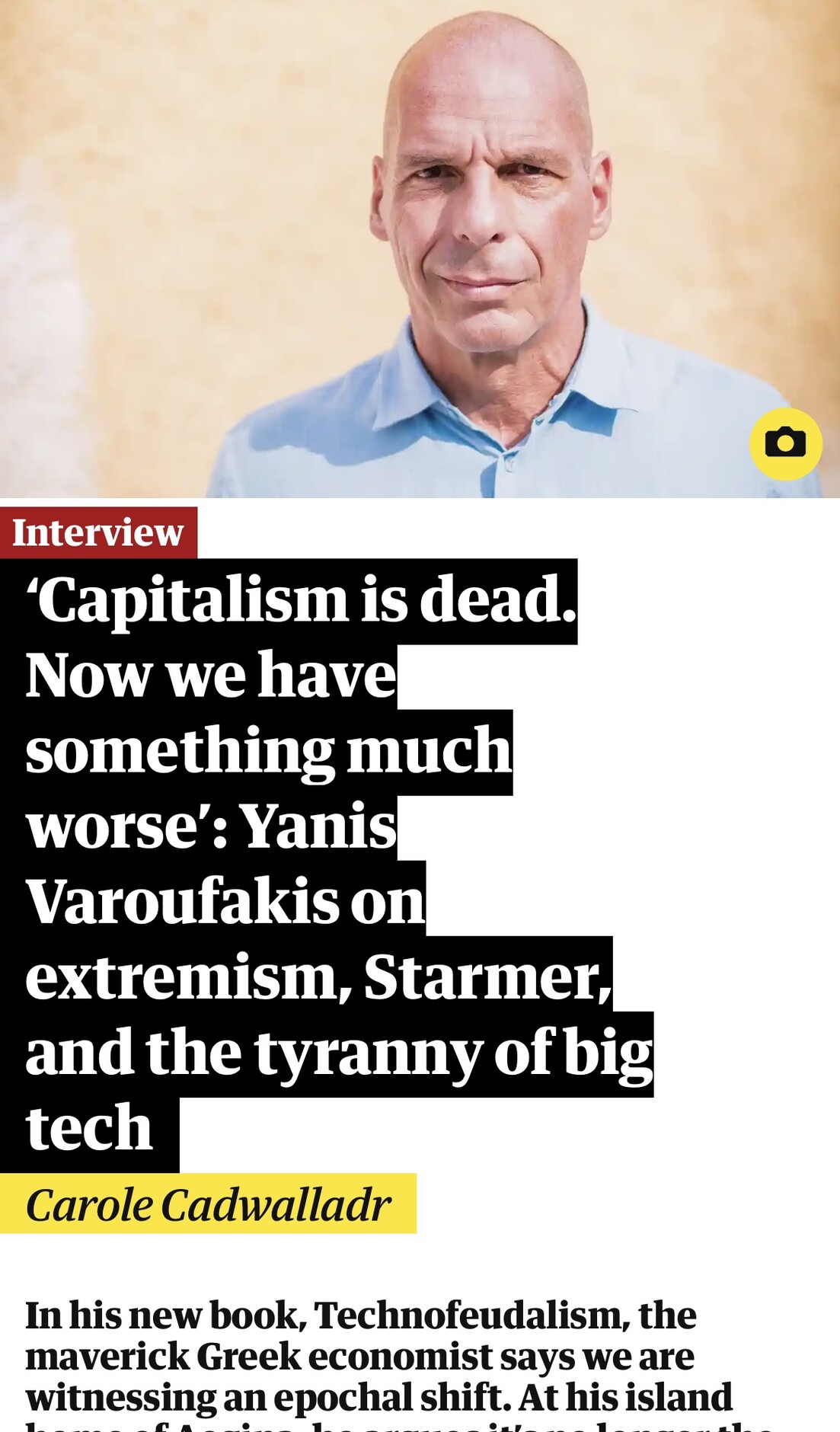
Interesting piece by Carole #Cadwalladr on Yanis #Varoufakis’s latest book, “Technofeudalism: what killed capitalism”.
Maybe #Technofeudalism is its latest reincarnation rather than the end of #Capitalism, but a good term nonetheless to describe our age. Just a shame that neither Varoufakis nor Cadwalladr seem to have made it to #Mastodon yet (maybe not even left #X? I don’t know) - maybe soon
Thiago Carvalho
boosted

Pretty concerned that this news story suggests police officers think they should be above the law and won't do their jobs unless they are. I can't say I'm terribly surprised that this story concerns the Met Police. Frankly, we are better off without those police officers (and the Met should be disbanded and then remade). #ukpolitics https://www.independent.co.uk/news/uk/crime/chris-kaba-police-murder-police-b2417108.html
'That these three new RSV shots are coming out at once is no coincidence. They succeed where others failed because they all target a specific weak spot in the virus, first identified in 2013.'
https://www.theatlantic.com/health/archive/2023/09/tripledemic-virus-rsv-vaccine/675417/
'We are in a time of eroding trust, as people realize that their contributions to a public space may be taken, monetized and potentially used to compete with them. When that erosion is complete, I worry that our digital public spaces might become even more polluted with untrustworthy content.'
https://www.nytimes.com/2023/09/23/opinion/ai-internet-lawsuit.html
Thiago Carvalho
boosted

Cells in the brain undergo molecular changes when we get the flu that can persist for longer than the virus. https://elifesciences.org/digests/87515/how-the-brain-responds-to-influenza?utm_source=mastodon&utm_medium=social&utm_campaign=organic
Now I cant stop singing "more than a spike gene" to the tune of the BeeGees (protein didnt fit the meter).
'We assessed the role of ORF6 during infection using recombinant viruses carrying a deletion or loss-of-function (LoF) mutation in ORF6. ORF6 plays key roles in interferon antagonism and viral pathogenesis by interfering with nuclear import and specifically the translocation of IRF and STAT transcription factors.'
#Covid #Covid19 #SarsCov2 #Interferon #Virology #Immunology #InnateImmunity
https://www.sciencedirect.com/science/article/pii/S1931312823003281
'Using an inbred line from a natural population with high diapause plasticity, we demonstrate that diapause is determined epigenetically: only a subset of genetically identical individuals enter diapause and this diapause plasticity is epigenetically transmitted for at least three generations'
https://journals.plos.org/plosgenetics/article?id=10.1371/journal.pgen.1010906
Thiago Carvalho
boosted

The lipid Gb3 promotes germinal center B cell responses and anti-viral immunity https://www.biorxiv.org/content/10.1101/2023.09.23.559132v1?med=mas
Thiago Carvalho
boosted

#BBCNews - What you need to know about #Covid as new #variant rises
https://www.bbc.co.uk/news/health-66848549
Thiago Carvalho
boosted
Sex-specific differences in DNA methylation and gene expression in late-gestation mouse placentas https://www.biorxiv.org/content/10.1101/2023.09.23.559106v1?med=mas
Thiago Carvalho
boosted






Los dinosaurios eran endotermos como las aves actuales
Un trabajo internacional publicado en Nature utiliza por primera vez marcadores metabólicos de especies animales actuales y extintas. Sus altas tasas metabólicas sugieren que los dinosaurios eran endotermos como las aves actuales y permite desechar la hipótesis de que la ectotermia pudo estar detrás de su extinción.
Los dinosaurios y los pterosaurios tenían tasas metabólicas altas, lo que sugiere que eran endotermos –capaces de autorregular su temperatura corporal–, según concluye una investigación internacional publicada en Nature, liderada por la Universidad de Yale y en la que participa la Universidad Complutense de Madrid (UCM).
Este trabajo demuestra que los dinosaurios eran endotermos reales, rechazando ideas anteriores como que tenían una condición intermedia –mesotermia– entre los ectotermos y los endotermos o que podían mantener su temperatura corporal constante gracias a los grandes tamaños corporales, puesto que hay dinosaurios pequeños con altas tasas metabólicas.
En esta investigación se utiliza por primera vez un índice que permite evaluar directamente las capacidades metabólicas de los amniotas – mamíferos, aves, reptiles y grupos extintos como los dinosaurios o los pterosaurios–, tanto actuales como extintos, ya que utiliza marcadores metabólicos que se pueden encontrar fosilizados.
La producción de calor en endotermos se debe al metabolismo, que quema grasas y azúcares. En este proceso, se libera energía (calor) pero también otros productos.
Algunas de las moléculas que se producen pueden fosilizar, y esto está abriendo un nuevo campo en la paleontología, en la que geoquímicos y geoquímicas como Jasmina pueden obtener información de los tejidos originales. En este caso, se miden las señales que dejan molecularmente las altas tasas de metabolismo.
Lee la entrada completa en el blog https://lasendadeapolo.es/2022/06/14/los-dinosaurios-eran-endotermos-como-las-aves-actuales/

I've worked on all of science, from B cells to T cells.
https://fellowsherpa.com
Joined Nov 2022
