

Léo Varnet @leovarnet@social.cleverlibre.org
- Institution
- CNRS, ENS Paris
- Research topics
- Auditory perception, psycholinguistics, hearing loss.
CNRS researcher at École normale supérieure Paris. Auditory perception, psycholinguistics, hearing loss. My toots are searchable #tootfinder.
Joined Oct 2022
Léo Varnet
boosted

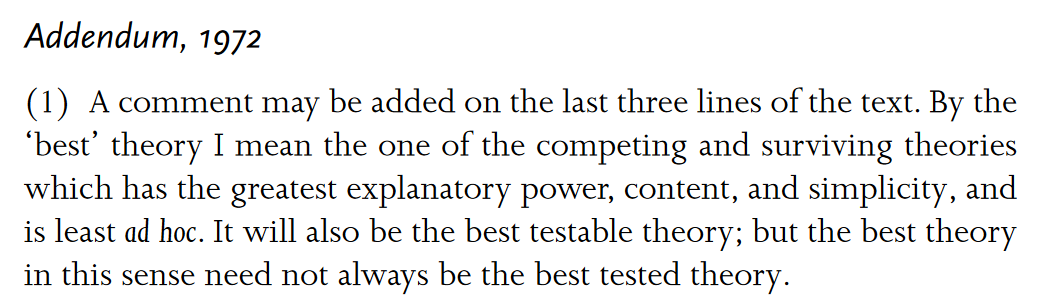
Popper on 'best theories'. As opposed to what people often think, Popper is clear theories often have 'ad hoc' assumptions introduced to 'fix' a theory when original predictions do not pan out. He just prefers ad hoc assumptions to be testable and as few as possible. If your preregistered analysis seems like a bad idea afterwards, you can ad hoc your analysis. It is better if you don't have to, and you should not do it to escape falsification. But it can be fine (and future tests will tell us).
Léo Varnet
boosted

Parmi ces recommandations, le colloque propose d'ailleurs que les agences adoptent les méthodologies employées par les revues systématiques de la littérature ou les méta-analyses.
En effet à la lecture des rapports de l'EFSA ou de l'EPA on est parfois assez surpris par la légèreté de la méthodologie.
Comme dans cet exemple, où une valeur est choisir parce qu'elle est « bien au milieu ».
https://factsory.org/2020/glyphosate-sous-estimation-aigue-de-notre-exposition-chronique/
12/
Accordingly, speech dynamics are extremely complex, and this complexity needs to be encoded by the human brain. We will use psychophysics and neuroimaging to relate the actual information content in speech at an utterance-by-utterance level, and the corresponding brain rhythms that may be able to encode these features. (3/4)
We are interested in how rhythmic parameters of the speech signal may engage brain rhythms at similar temporal rates, a currently topical idea in the auditory neuroscience of speech processing. However, we wish to challenge the view that these rhythmic patterns are fixed: at the level of individual utterances, there can be many pauses and variations in speech rate. (2/4)
Alessandro Tavano and I were were recently awarded an #ANR-#DFG joint grant for a comparative project on the dynamics of speech tracking in French and German. (1/4)
#psycholingistics #neurolinguistics
#BrainRhythms #AuditoryCortex
⬇️
@jm_favreau @regisrob je confirme... J'ai essayé de mettre mon labo sur Mastodon mais la réponse a été "attendons que les tutelles définissent une politique à l'échelle de l'institution".
Léo Varnet
boosted

Je me demande s’il existe des listes d’institutions (notamment #GLAM, universités et centres de recherche) ayant migré vers #Mastodon… et curieux de savoir si certaines d’entre elles ont mis en place une instance (plutôt au niveau d’un réseau national/international, d’un ministère, d’une fédération quelconque etc.).
Pour l’ESR français, ça pourrait pas être un service de Renater par exemple ? 🤷🏻♂️
Est-ce que je suis le seul à être gêné par le podcast "Votre cerveau" d'Albert Moukheiber sur @franceculture? Le thème et le principe de l'émission sont enthousiasmants, et les illusions auditives toujours fascinantes, mais le résultat est un peu décevant à mon goût car les interprétations sont parfois un peu douteuses, voire à rebours des expériences originales... Je sais que le concept est de faire de la vulgarisation scientifique en 9 minutes, mais quand même... https://www.radiofrance.fr/franceculture/podcasts/votre-cerveau-avec-albert-moukheiber
Léo Varnet
boosted

Just tried the magic that is https://anystyle.io/ and... it works! Paste any reference list and get a complete .bib file in return
@tamar_sofer @academicchatter very good point! So you would say there is no way to make this "potential-based evaluation" an objective thing, e.g., by using predefined criteria as in the case of achievements?
@danielyuksek Unfortunately, I am afraid that these biases and stereotypes are deeply rooted and that you cannot just decide to be gender-blind or color-blind... Worse, this approach may have the opposite effect, because it makes you less aware of your own biases...
Léo Varnet
boosted
To continue on the issue of #discrimination in selection committees, it seems to me that there are two levels on which to act. First, to reduce the influence of biases in the decision, for example by choosing the selection criteria before looking at the applications. However, this kind of tools is not enough: even if we manage to eliminate judgment biases, blindly basing the decision on merit is unfair for candidates facing discrimination or coming from countries where research is less developed, and who did not have the same opportunities as others. Complementary tools are therefore proposed, for example, considering the potential of candidates and not their achievements. I think this aspect is important, but more difficult to implement: Given that not all members of the jury are sensitive to the issue of discrimination, it can be tricky to argue that we want to put forward a candidate with a lesser CV because we think he or she has greater potential... assessing achievements is a bit like "counting points", whereas assessing potential seems more subjective. Do any of you have a concrete experience of how to deal with this in a jury? @academicchatter #AcademicMastodon #genderbias
To continue on the issue of #discrimination in selection committees, it seems to me that there are two levels on which to act. First, to reduce the influence of biases in the decision, for example by choosing the selection criteria before looking at the applications. However, this kind of tools is not enough: even if we manage to eliminate judgment biases, blindly basing the decision on merit is unfair for candidates facing discrimination or coming from countries where research is less developed, and who did not have the same opportunities as others. Complementary tools are therefore proposed, for example, considering the potential of candidates and not their achievements. I think this aspect is important, but more difficult to implement: Given that not all members of the jury are sensitive to the issue of discrimination, it can be tricky to argue that we want to put forward a candidate with a lesser CV because we think he or she has greater potential... assessing achievements is a bit like "counting points", whereas assessing potential seems more subjective. Do any of you have a concrete experience of how to deal with this in a jury? @academicchatter #AcademicMastodon #genderbias
@tengelen fantastic, thanks Tahnée. I looked up in the DEC E&D website, but not in the right section apparently...!
Léo Varnet
boosted

@leovarnet Our committee put together a list of tips on this here (section "You are on a selection committee and want to avoid bias in your admission/hiring procedure"): https://equalityanddiversity.dec.ens.fr/en/am-i-biased-15020
Hello #AcademicMastodon @academicchatter ! I am part of a jury that selects students for our master program (application review + interviews). What are your tips for reducing #genderbias and all forms of #discriminations to a minimum? (@jesswade maybe?)
@freemo @academicchatter Fantastic! Thanks!
@mtriclot Merci de m'avoir permis de découvrir Chatonsky, un travail fascinant !
Léo Varnet
boosted


- Institution
- CNRS, ENS Paris
- Research topics
- Auditory perception, psycholinguistics, hearing loss.
CNRS researcher at École normale supérieure Paris. Auditory perception, psycholinguistics, hearing loss. My toots are searchable #tootfinder.
Joined Oct 2022
