

Neurofrontiers @neurofrontiers@social.cleverlibre.org
We're a neuroscience blog trying to make neuroscience accessible for everyone! Check it out here: https://neurofrontiers.blog
Joined Nov 2021
Neurofrontiers
boosted

It's strange how as you get better at something, the world conspires to have you spend less time doing it.
Neurofrontiers
boosted


Shared by my Daughter
"I need privacy, not because my actions are questionable, but because your judgement and intentions are"
In response to "if you have nothing to hide you have nothing to fear"
On day 7 of #ScienceAdvent we do a little imagination exercise and picture what would’ve happened had fMRI been invented 100 years earlier: https://neurofrontiers.blog/if-fmri-had-been-invented-100-years-earlier/
Spoiler alert: it might’ve given phrenology the wrong kind of boost.
What do you think would’ve happened?
#neuroscience #WhatIf #AlternateHistory #brain #science #discussion
Neurofrontiers
boosted

𝗗𝗼𝗲𝘀 𝗯𝗿𝗮𝗶𝗻 𝗮𝗰𝘁𝗶𝘃𝗶𝘁𝘆 𝗰𝗮𝘂𝘀𝗲 𝗰𝗼𝗻𝘀𝗰𝗶𝗼𝘂𝘀𝗻𝗲𝘀𝘀?
**Tomorrow**
Neuroscience & Philosophy Salon discusses Matthew Larkum's lab's paper.
Please join @cdj and I and help solve consciousness!
Here's the paper that will be the focus of our discussion:
https://journals.plos.org/plosbiology/article?id=10.1371/journal.pbio.3001651
Please register.
Dec 8, noon EST-US:
https://umd.zoom.us/meeting/register/tJIldeypqDIrHtDWRbiFp6Dm58yw60AVehKD
@sophiebarton I remember seeing a retoot of your poster and thinking "that's the kind of content I want on my feed!", so then I followed you 😅
Really cool work and I'm looking forward to seeing more of it!
@samlitzinger Cool, I'll check it out! Thanks a lot!
On the sixth day of our #ScienceAdvent, we would like to talk about a debunked concept in neuroscience: learned helplessness. In short, it turns out that helplessness is not actually learned, but it's the default response when faced with prolonged inescapable adversity.
What we find really cool is also the fact that some of the researchers who popularized the concept and conducted a lot of research on it are the same who realized they had gotten it backwards.
Read more here:
https://neurofrontiers.blog/helplessness-is-not-learned/
Neurofrontiers
boosted

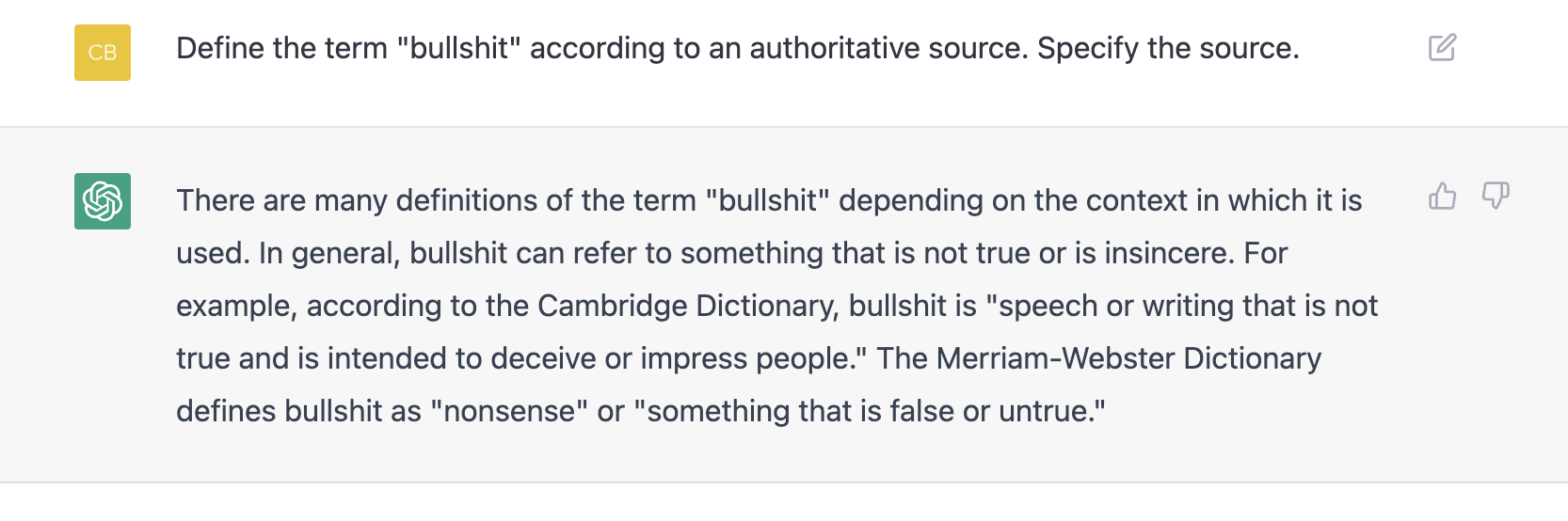
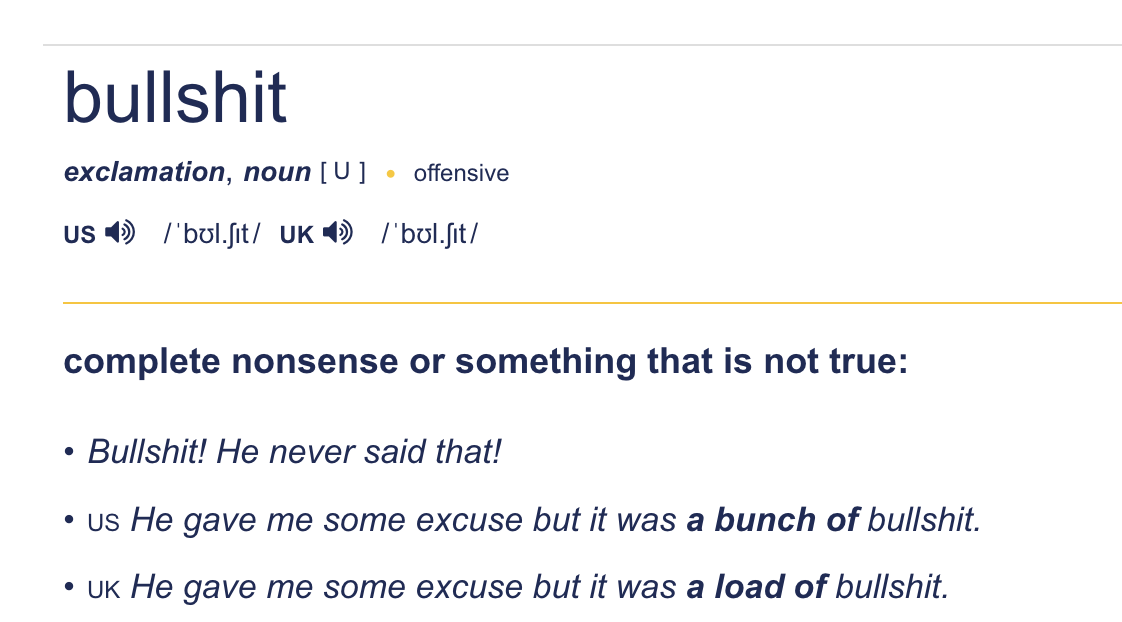
At this point it will surprise no one, but I asked #ChatGPT to define bullshit and to cite its sources.
It provided definitions from the Cambridge English Dictionary and the Merriam-Webster Dictionary.
The definitions it provided were entirely reasonable, but they were decidedly not from the sources it claimed.
This highlights the fact that ChatGPT and other LLMs are not knowledge models, they are themselves engines trained to produce convincing bullshit.
Below: ChatGPT, CED, MW.
Neurofrontiers
boosted

I blogged about why I enjoy #scicomm on Mastodon! https://dantheclamman.blog/2022/12/02/why-i-like-scicomm-on-mastodon/
Day 5 of #ScienceAdvent is a bit late, because somehow the academic end of the year implies doing a year's worth of work in three weeks 😅 But it's a good one.
I recently found out that awake dog fMRI is something that we can do and there's basically an entire subfield of "dog neuroscience". I also recently discovered Gregory Berns' book, "How Dogs Love Us", and I'm looking forward to a wholesome Christmas read.
Did you know about this? Have you read the book? Do you know any cool insights from this field? Would love to discuss.
https://neurofrontiers.blog/brain-activity-of-dogs/
#DogNeuroscience #neuroscience #neuro #dogs #fmri #CoolScience #brain
Neurofrontiers
boosted

Howdy Mastodon, #introduction time 🤠
I am the PI of the Lifespan Neural Dynamics Group (LNDG) at the Max Planck UCL Centre for Computational Psychiatry and Ageing Research in Berlin.
Using comp. models and in vivo methods, we study how and why the brain fluctuates so markedly across moments, and what those fluctuations tell us about cognition, development, and disease.
If you write the word "noise" in a post, my ears will probably ring 😅
Looking forward to the 🎢 that is  !
!
Neurofrontiers
boosted

Dear fellow scientists, I know it's been said many times before but please please make a Google Scholar page and make it public? It makes life so much easier when going through tens and tens of unknown names (like I'm doing right now to help select symposia for a conference): one can find your latest papers, your most cited papers, etc. And if you have some principled objection to Scholar or to their stock-market-style citation counter, I get it and that's fine, but at least do orcid.org?
Neurofrontiers
boosted

With #Galactica and #ChatGPT I'm seeing people again getting excited about the prospect of using language models to "access knowledge" (i.e. instead of search engines). They are not fit for that purpose --- both because they are designed to just make shit up and because they don't support information literacy. Chirag Shah and I lay this out in detail in our CHIIR 2022 paper:
https://dl.acm.org/doi/10.1145/3498366.3505816
>>
Neurofrontiers
boosted

Been looking for strong networks of #scicomm content creators on YouTube who actively support and promote each other. Any leads? Especially in the fields of #neuroscience and #biology
On day 4 of #ScienceAdvent we want to share something we think everyone should know: there are no shortcuts in cognitive improvement.
You can read more about that and about our take on commercial neurotech here: https://neurofrontiers.blog/no-shortcuts-in-cognitive-improvement/
#neuro #neuroscience #brain #cognition #neurotech
On day 3 of #ScienceAdvent we would like to talk about scientific concepts we don't understand. No one gets it all, so we think it's important to acknowledge that.
For us, one of the biggest mysteries in neuroscience remains the free energy principle. Despite numerous attempts to read the scientific literature on the topic, as well as to listen to Karl Friston's talks, it seems that our brains refuse to minimize their uncertainty with respect to this.
What's something that you still don't really grasp in your field?
Link to post if you want to read more about this: https://neurofrontiers.blog/the-free-energy-mystery/
#neuroscience #science #FreeEnergy #KarlFriston #mystery #MysteriesOfScience
Neurofrontiers
boosted

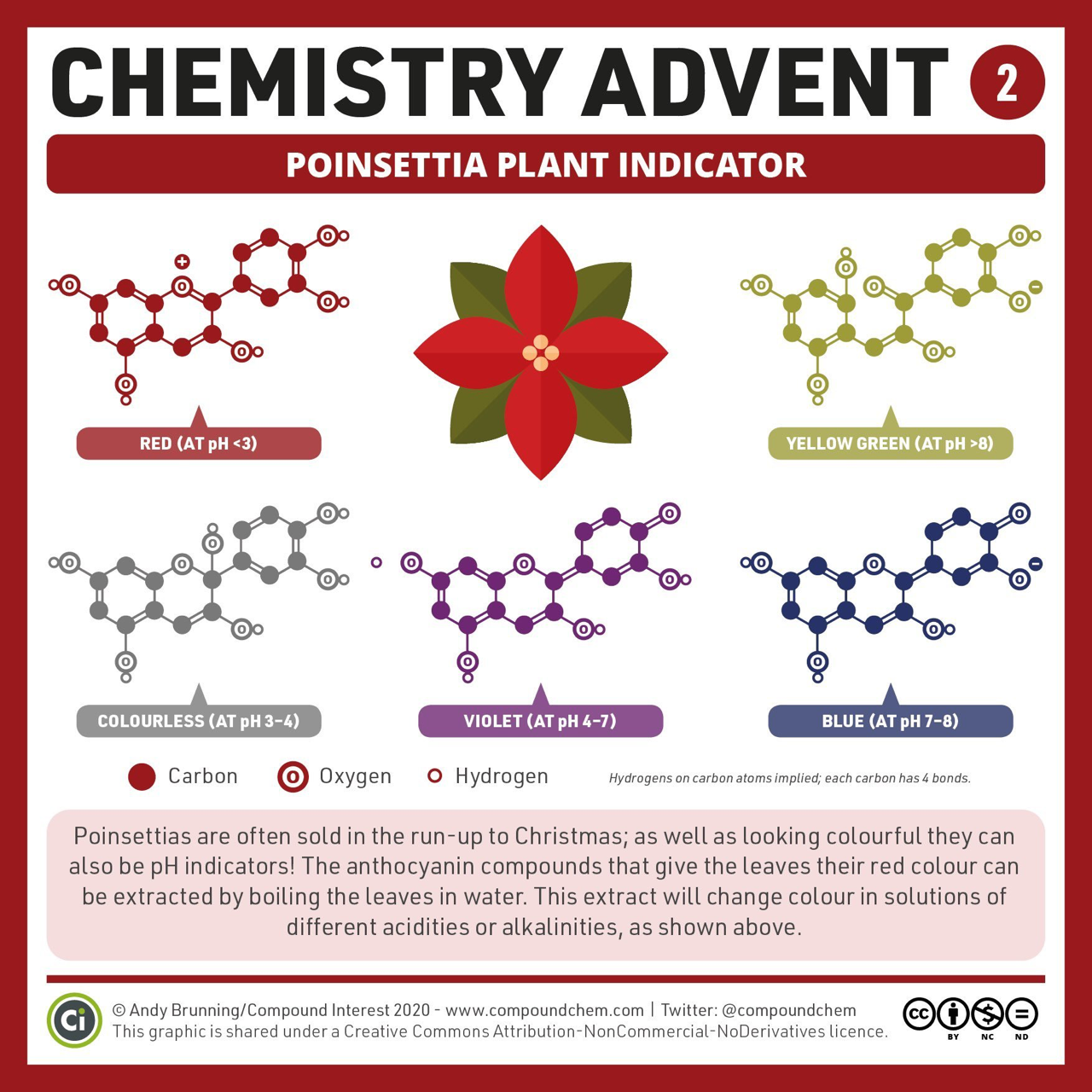
Day 2 of #ChemistryAdvent looks at how festive poinsettia plants can be used as a colourful pH indicator 🌈
Neurofrontiers
boosted
It's December, which means it's #ChemistryAdvent time again! Follow along in this thread every day, kicking off with the molecules behind the piney scent of Christmas trees 🎄
Neurofrontiers
boosted

 🇳🇱
🇳🇱



This weekend I will be working more on the "United Federation of Instances"
First thing I want to do is go through all the issues in the repo and try to comment or add my opinion on them.
Feel free to get in on the conversation here, its open to everyone.
https://gitlab.com/ufoi/constitution/-/issues
Next I will work more on finishing the full bylaws, and try to incorperate any new perspectives from the discussions in the issues (eventually we can vote on the final wording).
Anyone interested in seeing the progress on that (the first draft isnt done) you can check that out here:
https://ufoi.gitlab.io/constitution/united_federation_of_instances_bylaws.pdf
Of course you can see the original proposal document (which is the easier read and sumarizes the bylaws) here:
https://ufoi.gitlab.io/constitution/united_federation_of_instances_proposal.pdf
If anyone wants to contribute just join the first link I mentioned and feel free to offer merge requests. Also if anyone wants to help work on things like a website for us please speak up.
As always if you want to get into the conversation there are two ways other than the gitlab.
The first is fediverse groups: @ufoi
The other is our matrix chat room: #UFoI:matrix.org
Hope to see you all there.
So we went with a study that looks at the influence of experimenter sex on mouse behavior and their response to ketamine: https://www.nature.com/articles/s41593-022-01146-x
It seems mice show aversion towards males & exposure to male scents activates the corticotropin-releasing factor neurons in the entorhinal cortex. Plus, this pathway must be activated before ketamine administration, or ketamine won’t produce its antidepressant effects.
https://neurofrontiers.blog/why-men-stress-mice/
We're a neuroscience blog trying to make neuroscience accessible for everyone! Check it out here: https://neurofrontiers.blog
Joined Nov 2021
