

 🇳🇱
🇳🇱
@protecttruth I am no fan of the right in general.. but we already know well from past bans on guns in america that it has had the unfortunate result of increasing homicides.. Not banning guns is the reason more people arent murdered.
Yes there is a problem that needs to be addressed with crime and homicies.. banning guns has never been shown to be the solution however, and only results in more deaths. Lets look for real, science-based solutions.
@protecttruth Thats like saying "fewer vaccines means fewer vaccine death", while technically true its also very poor logic. Sadly no, banning guns generally means more homicides overall.
Also who said anything about Canada. Sadly the body of the american data on this clearly disagrees with the assesment.
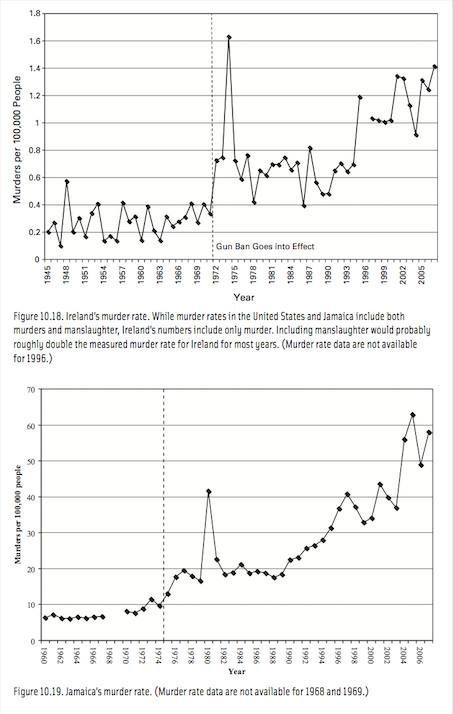
Here is an image of ther effects of one such gun ban within Jamaica.. sad to say this isnt na isolated pattern. If you really want to get into the nitty gritty I can show a dozen or two similar charts across many countries. The pattern is quite obvious sadly.

@rrb @protecttruth As an expert int he field I'd be happy to pick apart studies and go back and forth if thats what your after? There are quite a few rather fundemental problems with these studies, namely that they arent attempting in any way to show causation, only point out certain correlations. We do causation through the analysis of granger causality as a starting point which we arent seeing here.
For example take a simple study like your first one that seems to claim owning a gun wich *cause* you to be more likely to die in a violent death. Yet it doesnt address quite a few things:
1) it is just as likely people in high risk areas with violence tend to buy guns. Therefore it is not that having tyhe gun puts you at risk but rather being at risk tends to cause you to buy a gun.
2) It doesnt analyze the overall effect on society.. The underlying explanation for why guns reduce overall homicides is because the whole of society benefits, people are more reluctant to engaged in violence, even against unarmed people, when they dont know who or who is not armed in the first place.
3) As I stated no attempt was made to do causality analysis where one can use techniques like granger causality to suggest the cause-effect relationship
Just curious about the two items that seem to be most important:
1. Increased suicide risk
2. Use in domestic violence.
You do not see causality in those cases?
Would also like your take on the red flag laws and safe storage. Do you see any downsides with those mandates. They just seem like common sense to me.
#1 is something i reject as even being valid in the debate.I beleive absolutely on bodily autonomy to be a fundemental right. This is why I support the right to abortions by the same logic I support the right for people to commit suicide. If we want to prevent suicide the focus needs to be on access to proper health care (something poorly lacking).
#2 is of course concerning, and in the narrow case of talking about domestic abuse, yes there is some causality there. But for one its not representative of the full picture and also we would need to address how often is saves a life to offset this, either in general, or even in women protecting their own lives against an abuser.
The argument with suicide, and for waiting times for gun purchases, is that suicide seems to be caused by short-lived impulses. If they wait, then they do not try it. Also, guns are more deadly than other methods. If they try with another method and survive, they do not do it again.
I tend to support "free will" with most things. In this case, forcing someone to wait for a while does not seem onerous.
I am fine with euthanasia, for example, but find it OK to make someone wait for a while first.
When forcing suicidal people to wait because you want to dictate what they can or cant do with their body and when.. at the expense of a woman not being able to protect herself against a rapist... Id lean towards letting the woman protect herself.
Let it be an opt-in thing.. everyone at the age of 18 must register witht he government if they want to be forced to wait for a gun or if they want the privilage not to.. Then if they want to be protected against possibly being suicidal they now have that protection. For those who dont want the "protection" of a wait then they wont have it.
With # 2, a large percentage of mass shootings in the US are domestic violence related. Would you be fine with red flag laws tied to domestic abuse or restraining orders?
That seems to be a problem in many cases.
I think if your beating your wife or husband then you should go to jail. Sinc eit is a violent crime and if you served jail time then I would be fine with them having their gun rights revoked. More generally anyone who has went to jail for a violent crime probably should be denied a gun.
@freemo @protecttruth
My other question would be that economists often use "natural experiments" comparing similar states in the USA with different laws and seeing how things evolve.
Do you have data on that? I am curious. I have been following Daniel Webster at Hopkins' work and he seems to draw different conclusions than you.
thats just bad science.. To get accurate date you must monitor the same state before and after a law change.. comparing similar states results in us statisticians doing our best to guess at what "similar" even means and even if can define all the datapoints you the states will be far from identical and simply not the way we do this sort of science.. again, the only way you can truly show causation is with stuff like granger causality.
My understanding, I am not an economist, is that they look for states with similar trends and social make up until the law implementation. Then they see how the trends progress in the two states after the change.
That seems to me to make sense.
As long as they are comparing a state against itself both pre-law change and post, and they do that analysis correctly, then yes that would be fine science.
@freemo @protecttruth
Johns Hopkins center for prevention of gun violence's most common suggestions:
1. Red Flag laws to let people close to someone have guns taken away if people are shown to provide a risk to themselves or others.
2. Laws to mandate safe storage of firearms.
3. Universal background checks.
4. Waiting periods for firearm purchases.
Now we are getting into the weeds (in a good way).. I think its valid and important to discuss what, if any, we want to place limits on guns...
#1 I can support in principle, but in practice based on specific implementations I often oppose it more than support it... If a person is **charged** with a crime I think that crime should and can be used to judge if they can have a gun.. But to take a gun away from a person who has not commited a crime, that adds more problems than it solves and is particularly concerning slippery slope.
#2 This can be ok, but again needs to be nuanced. As long as you can ensure someone has quick access to the gun while still being able to secure it I would say this will work well. Obviously the laws need to provide restrictions that can allow for easy access.
#3 As long as those background checks are strictly limited to criminal records I can support this.
#4 This one is dangerous, one of the biggest reasons to allow guns is so women can protect themselves, its the great equalizer. If a rapist or stalker is thrteatening a woman a waiting period can cost her her life.
@freemo @protecttruth
So, if I get the causality model correct, it seems that if 2 time series are correlated you assume that the one time series that started earlier is a good predictor of the second. This makes a lot of sense. I would worry about using that for social science, though, since you will have limited independent samples and you can have multiple other factors.
For example, the 2 examples you provide is Northern Ireland during the "troubles" and I would suspect that the deadly violence may have been more influenced by "Bloody Sunday" than a dun control bill.
Similarly, the Jamaica data you present is tied to a period of increased drug dealing and gang violence.
But, this is always a problem with social science as a whole. I think it forces analysts to be "creative" which can lead to cherry picking data.
In social sciences there is no perfect analysis. But this is still superior to simple corelation in this case. That said there are more advanced techniques that are arguably even better. But those are hard to explain to people.


It seems in recent cases of shootings mental healh issues seems to have played a part. While that can't exactly be used as an excuse, we need address what leads ot Mental Health issues, other than pressures on people to perform at school, look, dress, act in a certain way or a miriad of other things.
Rather than simply accpeting people for who they are and including them, we are really good at excluding different groups.
I am doing a courses with the ANti Bullying Alliance and it looks at how people can be victims of bullying if they are part of marginal groups, have disabilities and schools can take steps to ensure everyone is involved in including all members of their community, so knowing how to communicate with a deaf pupil, can make a big difference and make them feel they are part of that community.

@freemo No.
Fewer guns means fewer gun homicides.
Here's a paper that shows that. This is science showing fewer guns means fewer homicides and fewer deaths.
Ban handguns and weapons of war. Like Canada does.
https://www.nber.org/digest/feb01/fewer-guns-mean-fewer-gun-homicides